MCQ
Two identical capacitors are joined in parallel, charged to potential $V$, separated and then, connected in series, $i.e.$, the positive plate of one is connected to the negative plate of the other. Then
  • the charges on the free plates connected together are destroyed
  • B
    charges on the free plates are destroyed
  • C
    the energy stored in the system increases
  • D
    the potential difference between the free plates is $2\,V$
Answer

Correct option: A.
the charges on the free plates connected together are destroyed
a
Both capacitors are charged to the same potential, so they acquire the same charge. When connected in series, the charges on free plates neutralise each other.

Need a full question paper?

Generate a complete, print-ready paper with questions like this in minutes — across 16+ boards, with answer keys.

Start Generating Free

Similar questions

Power delivered by the source of the circuit becomes maximum, when
When the conductivity of a semiconductor is only due to breaking of covalent bonds, the semiconductor is called:
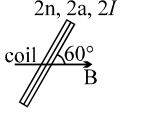
A rectangular coil $PQ$ has $2n$ turns, an area $2a$ and carries a current $2I,$ (refer figure). The plane of the coil is at $60^o$ to a horizontal uniform magnetic field of flux density $B.$ The torque on the coil due to magnetic force is
Which series of hydrogen atom lie in infrared region?
The splitting of white light into several colours on passing through a glass prism is due to
Which one of the following is the Boolean expression for $NOR$ gate?
A source simultaneously emitting light at two wavelengths $400 \,nm$ and $800 \,nm$ is used in the Young's double slit experiment. If the intensity of light at the slit for each wavelength is $I_{0}$, then the maximum intensity that can be observed at any poin on the screen is
A microscope is having objective of focal length $1\  cm$  and eye-piece of focal length $6\  cm$. If tube length is $30\  cm$ and image is formed at the least distance of distinct vision, what is the magnification produced by the microscope. Take $D = 25\  cm$.
Red light of wavelength $5400$ $\mathring {A}$ from a distant source falls on a slit $0.80\, mm$ wide. Calculate the distance between first two dark bands on each side of central bright band in the diffraction pattern observed on a screen place $1.4\, m$ from the slit. (in $mm$)
Tungsten has work function $4.8\ eV$. We wish to use tungsten as photo$-$cathode with a $600\ nm$ wavelength. What shall we do?