Question
Two identical conducting rods are first connected independently to two vessels, one containing water at $100^o C$ and the other containing ice at $0^oC$. In the second case, the rods are joined end to end and connected to the same vessels. Let ${q_1}$ and ${q_2}$ $g / s$ be the rate of melting of ice in two cases respectively. The ratio of ${q_1}/{q_2}$ is
Answer

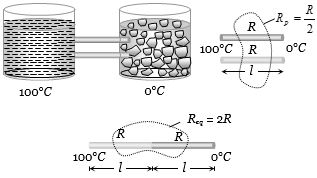
(c)Initially the rods are placed in vessels as shown below

$\frac{Q}{t} = \frac{{({\theta _1} - {\theta _2})}}{R}$

${\left( {\frac{Q}{t}} \right)_1} = \frac{{mL}}{t} = {q_1}L = \frac{{(100 - 0)}}{{\frac{R}{2}}}$   ... $(i)$

Finally when rods are joined end to end as shown

$\Rightarrow {\left( {\frac{Q}{t}} \right)_2} = \frac{{mL}}{t} = {q_2}L = \frac{{(100 - 0)}}{{2R}}$                   ... $(ii)$

From equation $(i)$ and $(ii)$ ,  $\frac{{{q_1}}}{{{q_2}}} = \frac{4}{1}$

Need a full question paper?

Generate a complete, print-ready paper with questions like this in minutes — across 16+ boards, with answer keys.

Start Generating Free

Similar questions

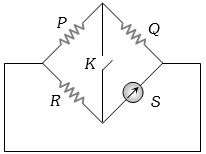
In the following Wheatstone bridge $P/Q = R/S$. If key $K$ is closed, then the galvanometer will show deflection
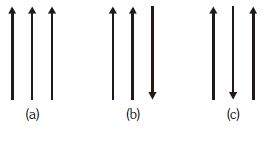
When three electric dipoles are near each other, they each experience the electric field of the other two, and the three dipole system has a certain potential energy. Figure below shows three arrangements $(1)$ , $(2)$ and $(3)$ in which three electric dipoles are side by side. All three dipoles have the same magnitude of electric dipole moment, and the spacings between adjacent dipoles are identical. If $U_1$ , $U_2$ and $U_3$ are potential energies of the arrangements $(1)$ , $(2)$ and $(3)$ respectively then
Two waves executing simple harmonic motion travelling in the same direction with same amplitude and frequency are superimposed. The resultant amplitude is equal to the $\sqrt{3}$ times of amplitude of individual motions. The phase difference between the two motions is $.....(degree)$
A series $LCR$ circuit is connected to a $45 \sin (\omega t)$ Volt source. The resonant angular frequency of the circuit is $10^5 \mathrm{rad} \mathrm{s}^{-1}$ and current amplitude at resonance is $I_{0 . .}$. When the angular frequency of the source is $\omega=8 \times 10^4 \mathrm{rad} \mathrm{s}^{-1}$, the current amplitude in the circuit is $0.05 I_0$. If $L=50 \mathrm{mH}$, match each entry in List-$I$ with an appropriate value from List-$II$ and choose the correct option.
List-$I$ List-$II$
($P$) $I_o$ in $\mathrm{mA}$ $(1) 44.4$
($Q$) The quality factor of the circuit $(2) 18$
($R$) The bandwidth of the circuit in rad s ${ }^{-1}$ $(3) 400$
($S$) The peak power dissipated at resonance in Watt $(4) 2250$
  $(5) 500$
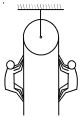
Two men of unequal masses hold on to the two sections of a light rope passing over a smooth light pulley. Which of the following are possible?
$Assertion :$ A bubble comes from the bottom of a lake to the top.
$Reason :$ Its radius increases.
Compound $(C)$ is
Which is a vector quantity
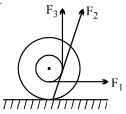
$A$ yo-yo is resting on a rough horizontal table. Forces $F_1, F_2$ and $F_3$ are applied separately as shown. The correct statement is
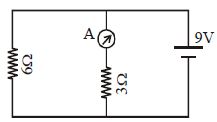
In the figure shown, if the internal resistance of the battery is $1\, ohm$ , the reading of the ammeter will be ................. $\mathrm{A}$