MCQ
Two identical cylindrical vessels with their bases at same level each contains a liquid of density $\rho$. The height of the liquid in one vessel is $h_1$ and that in the other vessel is $h_2$. The area of either base is$A$. The work done by gravity in equalizing the levels when the two vessels are connected, is
  • A
    $\left(h_1-h_2\right) g \rho$
  • B
    $\left(h_1-h_2\right) g A \rho$
  • C
    $\frac{1}{2}\left(h_1-h_2\right)^2 g A \rho$
  • $\frac{1}{4}\left(h_1-h_2\right)^2 g A \rho$
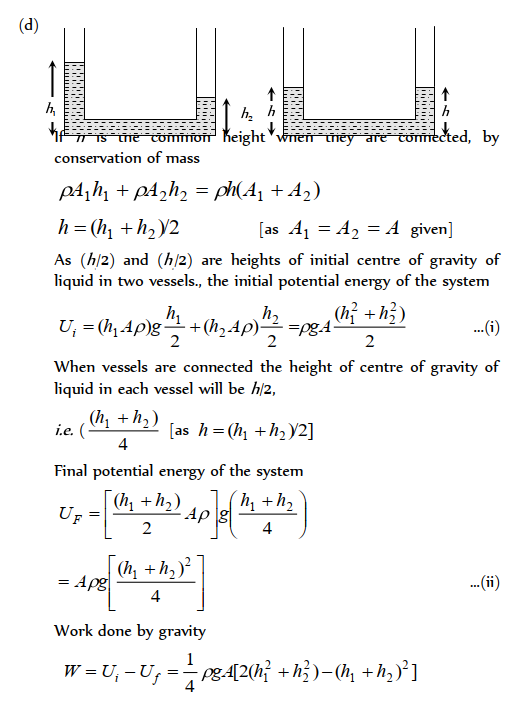
Answer

Correct option: D.
$\frac{1}{4}\left(h_1-h_2\right)^2 g A \rho$

Image
$=\frac{1}{4} \rho g A\left(h_1 \sim h_2\right)^2$

Need a full question paper?

Generate a complete, print-ready paper with questions like this in minutes — across 16+ boards, with answer keys.

Start Generating Free

Similar questions

If $\sigma$ be the surface tension, the work done in breaking a big drop of radius $R$ in $n$ drops of equal radius is
A double convex lens of glass of $\mu=1.5$ has radius of curvature of each of its surface is $0.2 \mathrm{~m}$. The power of the lens is
The cathode rays have particle nature because of the fact that
A block of mass $100 \mathrm{gm}$ slides on a rough horizontal surface. If the speed of the block decreases from $10 \mathrm{~m} / \mathrm{s}$ to $5 \mathrm{~m} / \mathrm{s}$, the thermal energy developed in the process is
A bus is moving with a velocity of $5 \mathrm{~m} / \mathrm{s}$ towards a huge wall. the driver sounds a horn of frequency $165 \mathrm{~Hz}$. If the speed of sound in air is $355 \mathrm{~m} / \mathrm{s}$, the number of beats heard per second by a passenger on the bus will be
The focal lengths of the objective and eye lenses of a telescope are respectively $200 \mathrm{~cm}$ and $5 \mathrm{~cm}$. The maximum magnifying power of the telescope will be
A thin lens made of glass of refractive index $1.5$ has a front surface + II $D$ power and back surface - $6 D$. If this lens is submerged in a liquid of refractive index $1.6,$ the resulting power of the lens is
First law of thermnodynamics is given by
The volume of an ideal gas is 1 litre and its pressure is equal to $72 \mathrm{~cm}$ of mercury column. The volume of gas is made $900 \mathrm{~cm}$ by compressing it isothermally. The stress of the gas will be
Two planets move around the sun. The periodic times and the mean radii of the orbits are $T_1, T_2$ and $r_1, r_2$ respectively. The ratio $T_1 / T_2$ is equal to