MCQ
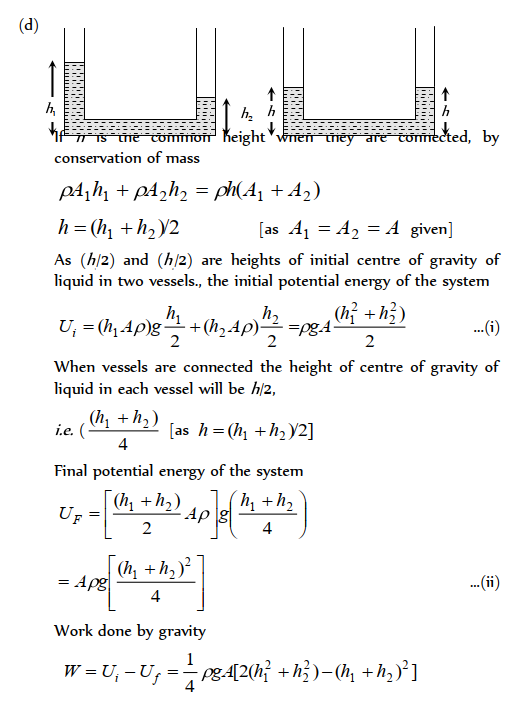
Two identical cylindrical vessels with their bases at same level each contains a liquid of density $\rho$. The height of the liquid in one vessel is $h_1$ and that in the other vessel is $h_2$. The area of either base is$A$. The work done by gravity in equalizing the levels when the two vessels are connected, is
  • A
    $\left(h_1-h_2\right) g \rho$
  • B
    $\left(h_1-h_2\right) g A \rho$
  • C
    $\frac{1}{2}\left(h_1-h_2\right)^2 g A \rho$
  • $\frac{1}{4}\left(h_1-h_2\right)^2 g A \rho$
Answer

Correct option: D.
$\frac{1}{4}\left(h_1-h_2\right)^2 g A \rho$
Image
$=\frac{1}{4} \rho g A\left(h_1 \sim h_2\right)^2$

Need a full question paper?

Generate a complete, print-ready paper with questions like this in minutes — across 16+ boards, with answer keys.

Start Generating Free

Similar questions

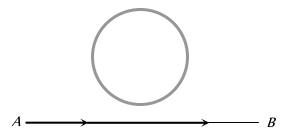
An electron moves along the line $A B$, which lies in the same plane as a circular loop of conducting wires as shown in the diagram. What will be the direction of current induced if any, in the loop
Image
Temperature of water at the surface of lake is $-20^{\circ} \mathrm{C}$. Then temperature of water just below the lower surface of ice layer is
Work done by 0.1 mole of a gas at $27^{\circ} \mathrm{C}$ to double its volume at constant pressure is $(R=2 \mathrm{cal} \mathrm{mol} \mathrm{C})$
Five rods of same dimensions are arranged as shown in the figure. They have thermal conductivities $K, K, K, K$ and $K$. When points $A$ and $B$ are maintained at different temperatures, no heat flows through the central rod if
Image
Which of the following is not the unit of time
The minimum wavelength of $X$-rays produced in a coolidge tube operated at potential difference of $40 \mathrm{kV}$ is
One mole of helium is adiabatically expanded from its initial state $\left(P_i, V_i, T_i\right)$ to its final state $\left(P_f, V_f, T_f\right)$. The decrease in the internal energy associated with this expansion is equal to
A perfect gas contained in a cylinder is kept in vacuum. If the cylinder suddenly bursts, then the temperature of the gas
A body slides down a frictionless track which ends in a circular loop of diameter $D$, then the minimum height $h$ of the body in term of $D$ so that it may just complete the loop, is
If $\vec{A}=2 \hat{i}+4 \hat{j}-5 \hat{k}$ the direction of cosines of the vector $\vec{A}$ are