MCQ
Two identical flutes produce fundamental nodes of frequency $300\,Hz$ at $27\,^oC.$ If the temperature of air in one flute is increased to $31\,^oC,$ the numbe  of the beats heard per second will be
  • A
    $1$
  • $2$
  • C
    $3$
  • D
    $4$

Answer

Correct option: B.
$2$
b
Velocity of sound increases if the temperature increases. So with $\mathrm{v}=\mathrm{n} \lambda,$ if $\mathrm{v}$ increases $\mathrm{n}$ will increase

at $27^{\circ} \mathrm{C}, \mathrm{v}_{1}=\mathrm{n} \lambda,$ at $31^{\circ} \mathrm{C}, \mathrm{v}_{2}=(\mathrm{n}+\mathrm{x}) \lambda$

Now using $\mathrm{v} \propto \sqrt{\mathrm{T}} \quad(\because \mathrm{v}=\sqrt{\frac{\gamma \mathrm{RT}}{\mathrm{M}}})$

$\frac{\mathrm{v}_{2}}{\mathrm{v}_{1}}=\sqrt{\frac{\mathrm{T}_{2}}{\mathrm{T}_{1}}}=\frac{\mathrm{n}+\mathrm{x}}{\mathrm{n}}$

$\Rightarrow \frac{300+\mathrm{x}}{300}=\sqrt{\frac{(273+31)}{(273+27)}}=\sqrt{\frac{304}{300}}=\sqrt{\frac{300+4}{300}}$

$\Rightarrow 1+\frac{\mathrm{x}}{300}=\left(1+\frac{4}{300}\right)^{1 / 2}=\left(1+\frac{1}{2} \times \frac{4}{300}\right)$

$\Rightarrow x=2$           $\left[\because(1+\mathrm{x})^{\mathrm{n}}=1+\mathrm{nx}\right]$

Need a full question paper?

Generate a complete, print-ready paper with questions like this in minutes — across 16+ boards, with answer keys.
Start Generating Free

Similar questions

If mass of a body is $M$ on the earth surface, then the mass of the same body on the moon surface is
A satellite in force-free space sweeps stationary interplanetary dust at a rate $\frac{d M}{d t}=\alpha v$ where $M$ is the mass, $v$ is the velocity of the satellite and $\alpha $ is a constant. What is the deacceleration of the satellite
The pressure and temperature of an ideal gas in a closed vessel are $720\, kPa$ and $40^oC$ respectively. If $\frac{1}{4}^{th}$ of the gas is released from the vessel and the temperature of the remaining gas is raised to $353^oC,$ the final pressure of the gas is ....... $kPa$
If an ideal gas has volume $V$ at $27°C$ and it is heated at a constant pressure so that its volume becomes $1.5V.$ Then the value of final temperature will be ....... $^oC$
A uniform string oflength $20\ m$ is suspended from a rigid support. A short wave pulse is introduced at its lowest end. It starts moving up the string. The time taken to reach the supports is (take $g= 10 $ $ms^{-2}$ )
The volume of the bulb of a mercury thermometer at $0^o C$ is $V_0$and cross section of the capillary is $A_0$. The coefficient of linear expansion of glass is $a_g$ $per ^o C$ and the cubical expansion of mercury $\gamma_m$ $per ^o C$. If the mercury just fills the bulb at $0^o C$, what is the length of mercury column in capillary at $T^o C.$
If a body $A$ of mass $M$ is thrown with velocity $v$ at an angle of ${30^o}$ to the horizontal and another body $B$ of the same mass is thrown with the same speed at an angle of ${60^o}$ to the horizontal. The ratio of horizontal range of $A$ to $B$ will be
The maximum horizontal range of a projectile is $16\,km$ when the projectile is thrown at an elevation of $30^o$ from the horizontal, it will reach to the maximum height of ....... $km$
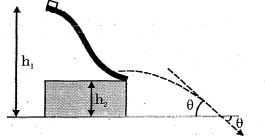
A block starts from rest at the top of frictionless slide at a height, $h_1$ above the ground. The block leaves the slide moving perfectly horizontally at a height $h_2$ above the ground. The block eventually hits the ground travelling at an angle $\theta = 30^o$ below the horizontal. Then
Name the type of energy $($kinetic energy $K$ or potential energy $U)$ possessed in a compressed spring: