Two identical flutes produce fundamental nodes of frequency $300\,Hz$ at $27\,^oC.$ If the temperature of air in one flute is increased to $31\,^oC,$ the numbe of the beats heard per second will be
Diffcult


Download our appand get started for free
Experience the future of education. Simply download our apps or reach out to us for more information. Let's shape the future of learning together!No signup needed.*
Similar Questions
- 1A hollow pipe of length $0.8 \mathrm{~m}$ is closed at one end. At its open end a $0.5 \mathrm{~m}$ long uniform string is vibrating in its second harmonic and it resonates with the fundamental frequency of the pipe. If the tension in the wire is $50 \mathrm{~N}$ and the speed of sound is $320 \mathrm{~ms}^{-1}$, the mass of the string isView Solution
- 2View SolutionWhen a wave travelling in medium is reflected from the boundary of a denser medium, which of the following will not change?
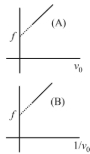
- 3A source of sound emits sound waves at frequency $f_0$. It is moving towards an observer with fixed speed $v_s$ ($v_s < v$, where $v$ is the speed of sound in air). If the observer were to move towards the source with speed $v_0$, one of the following two graphs ($A$ and $B$) will given the correct variation of the frequency $f$ heard by the observer as $v_0$ is changed The variation of $f$ with $v_0$ is given correctly byView Solution
- 4The ratio of intensities between two coherent soud sources is $4 : 1$. The differenmce of loudness in $dB$ between maximum and minimum intensities when they interfere in space is:View Solution
- 5A motorcyclist is approaching a large wall with a velocity of $90\,km/hr$. A car is chasing him with a velocity of $108\,km/hr$. If the car sounds a horn at $30\,Hz,$ beat frequency heard by motorcyclist is ____ $Hz$ . Take velocity of sound $= 330\,m/s$ .View Solution
- 6Following statements are given for a stationary waveView Solution
$(a)$ Every particle has a fixed amplitude which is different from the amplitude of its nearest particle.
$(b)$ All the particles cross their mean position at the same time.
$(c)$ All the particles are oscillating with same amplitude.
$(d)$ There is no net transfer of energy across any plane.
$(e)$ There are some particles which are always at rest.
Which of the following is correct
- 7If at $STP$, velocity of sound in a gas $(\gamma=1.5)$ is $600 \,m / s$, the $r.m.s.$ velocity of the gas molecules at $STP$ will be ........... $m / s$View Solution
- 8Two tuning forks when sounded together produced $4$ beats/sec. The frequency of one fork is $256.$ The number of beats heard increases when the fork of frequency $256$ is loaded with wax. The frequency of the other fork isView Solution
- 9In order to double the frequency of the fundamental note emitted by a stretched string, the length is reduced to $\frac{3}{4}$$^{th}$ of the original length and the tension is changed. The factor by which the tension is to be changed, isView Solution
- 10View SolutionIf vm is the velocity of sound in moist air, vd is the velocity of sound in dry air, under identical conditions of pressure and temperature