MCQ
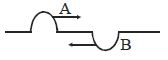
Two identical harmonic pulses travelling in opposite directions in a taut string approach each other. At the instant when they completely overlap, the total energy of the string will be
  • A
    zero
  • B
    partly kinetic and partly potential
  • purely kinetic
  • D
    purely potential

Answer

Correct option: C.
purely kinetic
c
When they overlap, they form stationary waves, as they cancel each other because of the opposite direction and equal magnitude.

Hence the displacement of the string becomes zero, resulting in zero potential energy and purely kinetic energy.

Need a full question paper?

Generate a complete, print-ready paper with questions like this in minutes — across 16+ boards, with answer keys.

Start Generating Free

Similar questions

The mean free path for air molecule with average speed 18.5ms-1 at STP is (Take, d = 2 × 10⁻¹⁰m and n = 2.7 × 1025m-3)
There is rod of length $l$. The velocities of its two ends are $v_1$ and $v_2$ in opposite directions normal to the rod. The distance of the instantaneous axis of rotation from $v_1$ is:
A whistle sends out $256$ waves in a second. If the whistle approaches the observer with velocity $\frac{1}{3}$ of the velocity of sound in air, the number of waves per second the observer will receive
A vector is added to an equal and opposite vector of similar nature, forms a ........
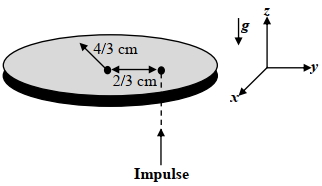
A thin circular coin of mass $5 \mathrm{gm}$ and radius $4 / 3 \mathrm{~cm}$ is initially in a horizontal $x y$-plane. The coin is tossed vertically up ( $+z$ direction) by applying an impulse of $\sqrt{\frac{\pi}{2}} \times 10^{-2} \mathrm{~N}-\mathrm{s}$ at a distance $2 / 3 \mathrm{~cm}$ from its center. The coin spins about its diameter and moves along the $+z$ direction. By the time the coin reaches back to its initial position, it completes $n$ rotations. The value of $n$ is. . . . . [Given: The acceleration due to gravity $\mathrm{g}=10 \mathrm{~ms}^{-2}$ ]
A ball is dropped vertically from a height of $h$ onto a hard surface. If the ball rebounds from the surface with a fraction $r$ of the speed with which it strikes the latter on each impact, what is the net distance travelled by the ball up to the 10th impact?
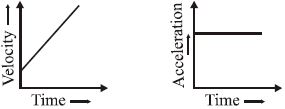
The velocity-time and acceleration-time graphs of a particle are given as Its position-time graph may be gvien as
A ball is projected from ground at an angle $45^{\circ}$ with horizontal from distance $d_1$ from the foot of a pole and just after touching the top of pole it the falls on ground at distance $d_2$ from pole on other side, the height of pole is ...........
The first law of thermodynamics can be explained as :
If the velocity varies parabolically, how does the acceleration vary?