MCQ
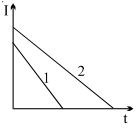
Two identical inductance carry currents that vary with time according to linear laws (as shown in figure). In which of two inductance is the self induction $emf$ greater?
  • $1$
  • B
    $2$
  • C
    same
  • D
    data are insufficient to decide

Answer

Correct option: A.
$1$
a
$e=-L\frac{d i}{d t} \Rightarrow\left(-\frac{d i}{d t}\right)_{1 }> \left(-\frac{d i}{d t}\right)_{2} \Rightarrow e_{1} > e_{2}$

Need a full question paper?

Generate a complete, print-ready paper with questions like this in minutes — across 16+ boards, with answer keys.
Start Generating Free

Similar questions

The maximum kinetic energy of the photoelectrons emitted from a surface is dependent on the:
Half lives of two radioactive substances A and B are respectively 20 minutes and 40 minutes. Initially the sample of A and B have equal number of nuclei. After 80 minutes, the ratio of remaining number of A and B nuclei is
Out of the following which one is not a possible energy for a photon to be emitted by hydrogen atom according to Bohr’s atomic model?
After $3$ hours, only $0.25 \,mg$ of a pure radioactive material is left. If initial mass was $2 \,mg$ then the half life of the substance is ...... $hr$
Magnetic lines of force:
If the focal length of objective and eye lens are $1.2\, cm$ and $3\, cm$ respectively and the object is put $1.25 \,cm$ away from the objective lens and the final image is formed at infinity. The magnifying power of the microscope is
The torque acting on a dipole of moment $\overrightarrow P $ in an electric field $\overrightarrow E $ is
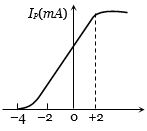
The mutual characteristic curves of a triode are as shown in figure. The cut off voltage for the triode is.....$V$
$A$ ray of light is incident upon an air/water interface (it passes from air into water) at an angle of $45^o$. Which of the following quantities change as the light enters the water?

$(I)$ wavelength                       $(II)$ frequency

$(III)$ speed of propagation      $(IV)$ direction of propagation

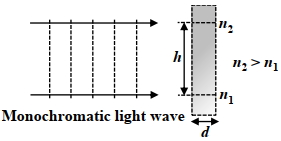
A monochromatic light wave is incident normally on a glass slab of thickness $d$, as shown in the figure. The refractive index of the slab increases linearly from $n_1$ to $n_2$ over the height $h$. Which of the following statement($s$) is (are) true about the light wave emerging out of the slab?

(image)

($A$) It will deflect up by an angle $\tan ^{-1}\left[\frac{\left(n_2^2-n_1^2\right) d}{2 h}\right]$

($B$) It will deflect up by an angle $\tan ^{-1}\left[\frac{\left(n_2-n_1\right) d}{h}\right]$

($C$) It will not deflect.

($D$) The deflection angle depends only on $\left(n_2-n_1\right)$ and not on the individual values of $n_1$ and $n_2$.