MCQ
Two identical lights sources S1​ and S2​ emit the light of same wavelength $\lambda$. These light rays will exhibit interference if:
  • A
    Their phase difference remain constant.
  • B
    Their phase difference is distributed randomly.
  • C
    Their light intensities remain constant.
  • D
    Their light intensities change continuously.
Answer

  1. Their phase difference remain constant.

Explanation:

For interference to take place the light sources need to be either in phase or have a constant phase difference. In case the phase difference keeps changing the interference pattern will keep on changing, as a result of interference pattern will be observed.

Need a full question paper?

Generate a complete, print-ready paper with questions like this in minutes — across 16+ boards, with answer keys.

Start Generating Free

Similar questions

A magnetic field exerts no force on:

When the reflecting or refracting rays do not actually intersect but appear to intersect when produced backwards, 

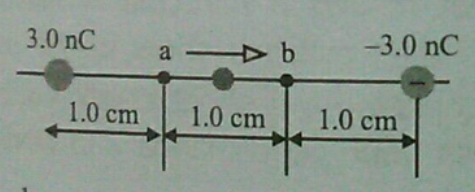
As shown in figure a dust particle with mass m = 5.0 × 10⁻⁹ kg and charge q= 2.0nC starts from rest at point a and moves in a straight line to point b. What is its speed v at point b?

A metal cube is placed in an empty vessel. When water is filled in the vessel so that the cube is completely immersed in the water, the force on the bottom of the vessel in contact with the cube.
  1. Will increase.
  2. Will decrease.
  3. Will remain the same.
  4. Will become zero.
A parallel-plate capacitor is connected to a battery. A metal sheet of negligible thickness is placed between the plates. The sheet remains parallel to the plates of the capacitor:

The brightness of a bulb will be reduced, if a resistance is connected in

(a) Series with it

(b) Parallel with it

(c) Series or parallel with it

(d) Brightness of the bulb cannot be reduced

A bar magnet of magnetic moment  J/T is free to rotate in a horizontal plane. The work done in rotating the magnet slowly from a direction parallel to a horizontal magnetic field of 4 ×  T to a direction 60° from the field will be

(a) 0.2 J

(b) 2.0 J

(c) 4.18 J 

(d) 2 × 10² J

Which of the following represents an infrared wavelength

(a)  cm

(b)  cm

(c)   cm

(d)  cm

At the centre (t = 0) of Newton's ring arrangement, we observe a:

The explosion of the atomic bomb takes place due to

(a) Nuclear fission

(b) Nuclear fusion

(c) Scattering

(d) Thermionic emission