MCQ
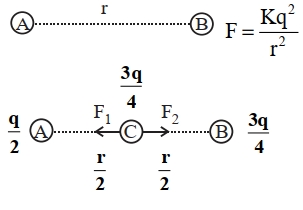
Two identical metallic spheres $A$ and $B$ when placed at certain distance in air repel each other with a force of $F$. Another identical uncharged sphere $C$ is first placed in contact with $A$ and then in contact with $B$ and finally placed at midpoint between spheres $A$ and $B$. The force experienced by sphere $C$ will be.
  • A
    $3\,F / 2$
  • $3\,F / 4$
  • C
    $F$
  • D
    $2\,F$

Answer

Correct option: B.
$3\,F / 4$
b
Let $q _{ A }= q _{ B }= q$

When $C$ is placed in contact with $A$, charge on $A$ and $ C$ will be $=\frac{ q }{2}$

Now $C$ is placed in contact with $B$, charge on $B$ and $C$ will be $=\frac{q+\frac{q}{2}}{2}=\frac{3 q}{4}$

$F ^{\prime}= F _{2}- F _{1}=\frac{\left( K \frac{3 q }{4}- K \frac{ q }{2}\right)}{\frac{ r ^{2}}{4}} \cdot \frac{3 q }{4}$

$=\frac{3 Kq ^{2}}{4 r ^{2}}=\frac{3 F }{4}$

Need a full question paper?

Generate a complete, print-ready paper with questions like this in minutes — across 16+ boards, with answer keys.

Start Generating Free

Similar questions

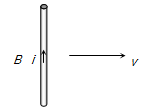
A conducting wire is moving towards right in a magnetic field B. The direction of induced current in the wire is shown in the figure. The direction of magnetic field will be
Assertion : Gauss theorem is not applicable in magnetism.
Reason : Mono magnetic pole does not exist.
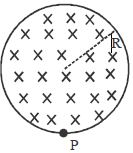
A uniform magnetic field of induction $B$ is confined to a cylinder region of radius $R$. The magnetic field is increasing at a constant rate of $\frac{{dB}}{{dt}}\left( {T/s} \right)$. A proton of charge $e$ and mass $m$ is placed at point $P$ on periphery. Its acceleration is
The self inductance of a straight conductor is
Which one of the following, when suspended freely, slowly sets itself parallel to the direction of the magnetic field?
In the experiment of potentiometer, at balance point, there is no current in the:
For a given plate-voltage, the plate current in a triode is maximum when the potential of
A combination of two thin convex lenses of focal length $0.3 m$ and $0.1 m$ will have minimum spherical and chromatic aberrations if the distance between them is......$m$
A proton and a deuteron are both accelerated through the same potential difference and enter in a magnetic field perpendicular to the direction of the field. If the deuteron follows a path of radius $R ,$ assuming the neutron and proton masses are nearly equal, the radius of the proton' s path will be
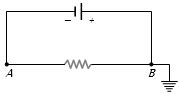
A battery is connected to a uniform resistance wire $AB$ and $B$ is earthed. Which one of the graphs below shows how the current density $J$ varies along $AB$