- Circuit 1 and circuit 2.
- Circuit 2 and circuit 3.
- Circuit 3 and circuit 1.
- Circuit 1 only.


Explanation:
In circuit 1, one diode is forward biassed and the other diode is reverse biassed. The forward-biassed diode offers zero resistance (ideally) to the current flow, so it can be replaced by a short circuit. The voltage drop across the first diode will be zero. The second diode is reverse biassed, so it can be replaced by an open circuit; hence, the voltage drop across this diode will be maximum.
In circuit 2, both the diodes are forward biassed, so they can be replaced by short circuits; hence, the voltage drop across both of them will be minimum and equal.
In circuit 3, both the diodes are reverse biassed, so both can be replaced by open circuits; hence, the voltage drop across both of them will be maximum and equal.

Generate a complete, print-ready paper with questions like this in minutes — across 16+ boards, with answer keys.
2μF capacitance has potential difference across its two terminals 200 volts. It is disconnected with battery and then another uncharged capacitance is connected in parallel to it, then P.D. becomes 20 volts. Then the capacity of another capacitance will be
|
(a) 2 μF |
(b) 4 μF |
(c) 18 μF |
(d) 10 μF |
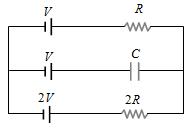
In the given circuit, with steady current, the potential drop across the capacitor must be

|
(a) V |
(b) V / 2 |
(c) V / 3 |
(d) 2V / 3 |
If the decay or disintegration constant of a radioactive substance is λ, then its half life and mean life are respectively
|
(a) |
(b) |
(c) |
(d) |
When a charged particle enters a uniform magnetic field its kinetic energy
|
(a) Remains constant |
(b) Increases |
(c) Decreases |
(d) Becomes zero |
A varying current at the rate of 3 A/s in a coil generates an e.m.f. of 8 mV in a nearby coil. The mutual inductance of the two coils is
|
(a) 2.66 mH |
(b) 2.66 |
(c) 2.66 H |
(d) 0.266 H |
20 μA current flows for 30 seconds in a wire, transfer of charge will be
|
(a) 2 |
(b) 4 |
(c) 6 |
(d) 8 |