Question
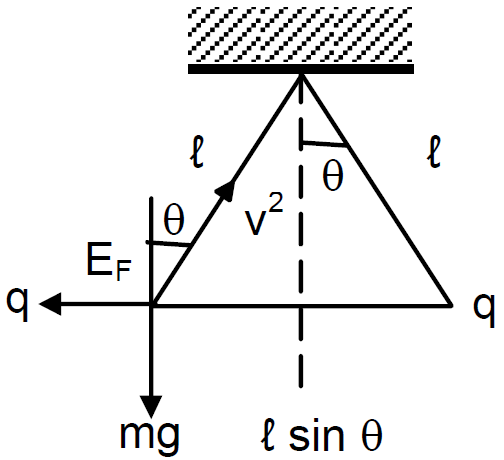
Two identical pith balls, each carrying a charge q, are suspended from a common point by two strings of equal length l. Find the mass of each ball if the angle between the strings is $2\theta$ in equilibrium.
Answer


Electric force $=\frac{\text{kq}^2}{(\ell\sin\text{Q}+\ell\sin\text{Q})^2}$

$=\frac{\text{kq}^2}{4\ell^2\sin^2}$

So, $\text{T}\cos\theta=\text{ms}$ (For equilibrium) $\text{T}\sin\theta=\text{Ef},$

$\text{tan}\theta=\frac{\text{Ef}}{\text{mg}}$
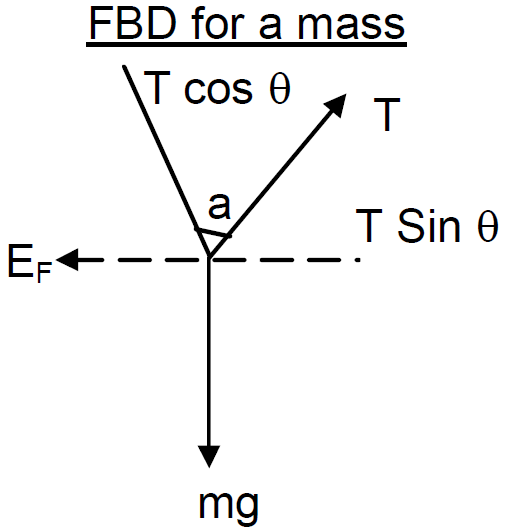
$\Rightarrow\text{mg}=\text{Ef}\cot\theta$

$=\frac{\text{kq}^2}{4\ell^2\sin^2\theta}\cot\theta$

$=\frac{\text{q}^2\cot\theta}{\ell^2\sin^2\theta16\pi\text{E}_0}$

$\text{m}=\frac{\text{q}^2\cot\theta}{16\pi\text{E}_0\ell^2\sin^2\theta\text{g}}\text{unit}$

Need a full question paper?

Generate a complete, print-ready paper with questions like this in minutes — across 16+ boards, with answer keys.
Start Generating Free

Similar questions

Find the ratio of the electric and gravitational forces between two protons.
A cube of side b has a charge q at each of its vertices. Determine the potential and electric field due to this charge array at the centre of the cube.
A wire of mass m and length l can slide freely on a pair of smooth, vertical rails (figure). A magnetic field B exists in the region in the direction perpendicular to the plane of the rails. The rails are connected at the top end by a capacitor of capacitance C. Find the acceleration of the wire neglecting any electric resistance.

A bar magnet of length 1cm and cross-sectional area 1.0cm2 produces a magnetic field of 1.5 × 10. T at a point in end-on position at a distance 15cm away from the centre.
  1. Find the magnetic moment M of the magnet.
  2. Find the magnetization I of the magnet.
  3. Find the magnetic field B at the centre of the magnet.
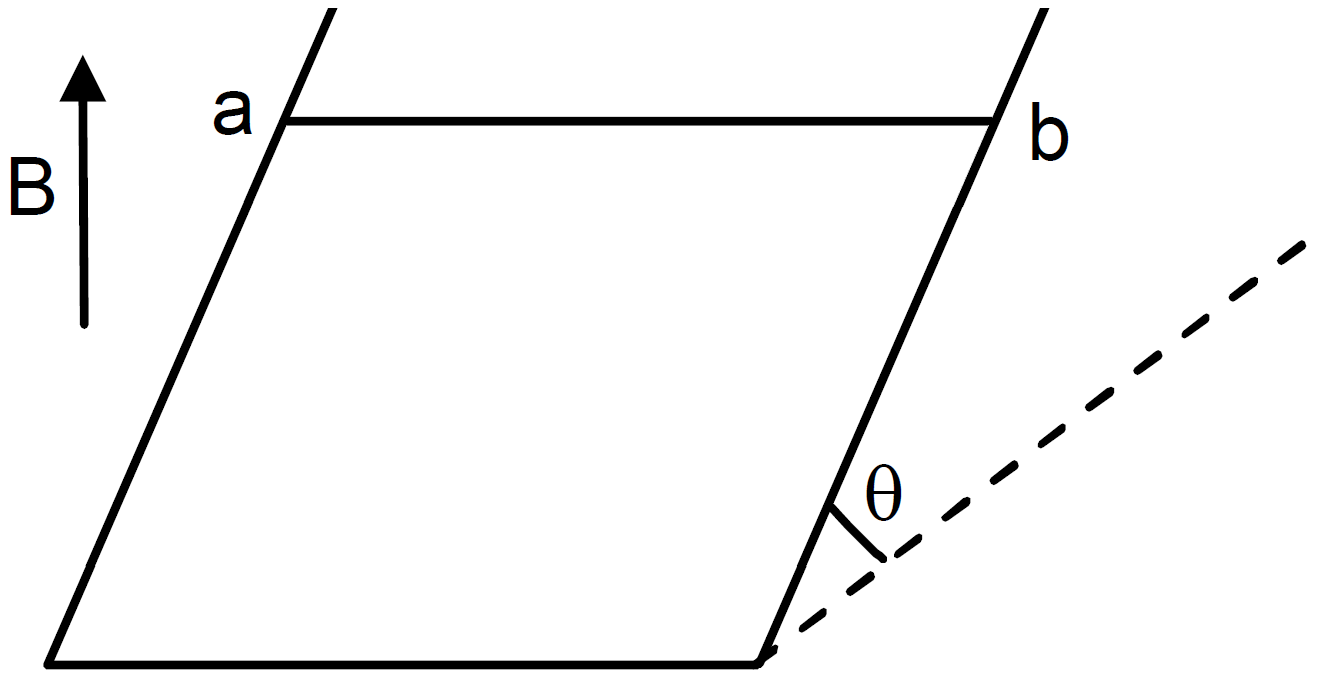
A wire ab of length l, mass m and resistance R slides on a smooth, thick pair of metallic rails joined at the bottom as shown in figure. The plane of the rails makes an angle θ with the horizontal. A vertical magnetic field B exists in the region. If the wire slides on the rails at a constant speed v, show that

$\text{B}=\sqrt{\frac{\text{mgR}\sin\theta}{\text{vl}^2\cos^2\theta}}$

Define resistivity of a conductor. Plot a graph showing the variation of resistivity with temperature for a metallic conductor. How does one explain such a behaviour, using the mathematical expression of the resistivity of a material?
State Biot-Savart law, giving the mathematical expression for it.
Use this law to derive the expression for the magnetic field due to a circular coil carrying current at a point along its axis.
How does a circular loop carrying current behave as a magnet?
A ball of mass m is dropped onto a floor from a certain height. The collision is perfectly elastic and the ball rebounds to the same height and again falls. Find the average force exerted by the ball on the floor during a long time interval.
A compound microscope consists of an objective of focal length 1cm and an eyepiece of focal length 5cm. An object is placed at a distance of 0.5cm from the objective. What should be the separation between the lenses so that the microscope projects an inverted real image of the object on a screen 30cm behind the eyepiece?
The friction coefficient between the horizontal surface and each of the blocks shown in figure is 0.20. The collision between the blocks is perfectly elastic. Find the separation between the two blocks when they come o rest. Take g = 10 m/s2.