Two identical positive charges are placed at $x =\, -a$ and $x = a$ . The correct variation of potential $V$ along the $x-$ axis is given by
Medium
Download our app for free and get started
On both sides of the positive charge $V=+\propto$ just over the charge

Download our appand get started for free
Experience the future of education. Simply download our apps or reach out to us for more information. Let's shape the future of learning together!No signup needed.*
Similar Questions
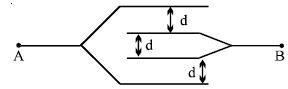
- 1Four metallic plates arearranged as shown in the figure. If the distance between each plate then capacitance of the given system between points $A$ and $B$ is (Given $d < < A$)View Solution
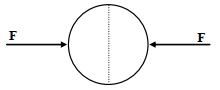
- 2A uniformly charged thin spherical shell of radius $\mathrm{R}$ carries uniform surface charge density of $\sigma$ per unit area. It is made of two hemispherical shells, held together by pressing them with force $\mathrm{F}$ (see figure). $\mathrm{F}$ is proportional toView Solution
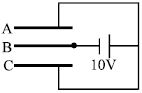
- 3Three plates $A, B$ and $C$ each of area $0.1 \ m^2$ are separated by $0.885\ mm$ from each other as shown in the figure. $A$ $10$ $V$ battery is used to charge the system. The energy stored in the system isView Solution
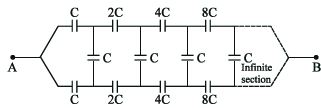
- 4Find the equivalent capacitance of the circuit between point $A$ and $B$.View Solution
- 5$n$ identical condensers are joined in parallel and are charged to potential $V$. Now they are separated and joined in series. Then the total energy and potential difference of the combination will beView Solution
- 6The maximum electric field that can be held in air without producing ionisation of air is $10^7\,V/m$. The maximum potential therefore, to which a conducting sphere of radius $0.10\,m$ can be charged in air isView Solution
- 7Capacitance of an isolated conducting sphere of radius $R_{1}$ becomes $n$ times when it is enclosed by a concentric conducting sphere of radius $R_{2}$ connected to earth. The ratio of their radii $\left(\frac{ R _{2}}{ R _{1}}\right)$ is:View Solution
- 8View SolutionWhich of the following is possible application of an RC circuit?
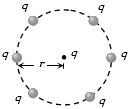
- 9A point charge is surrounded symmetrically by six identical charges at distance $r$ as shown in the figure. How much work is done by the forces of electrostatic repulsion when the point charge $q$ at the centre is removed at infinityView Solution
- 10The work done to take an electron from rest where potential is $-60\, V$ to another point where potential is $-20\, V$ is given by.....$eV$View Solution