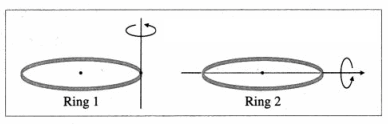
Two identical rings are to be rotated about different axes of rotation as shown by applying torques so as to produce the same angular acceleration in both. How is it possible ?
Q 103
Download our app for free and get started
The $\mathrm{MI}$ of ring 1 about a transverse tangent is $\mathrm{I}_1=2 \mathrm{MR}^2$
The $\mathrm{MI}$ of ring 2 about its diameter is
$
\mathrm{I}_2=\frac{1}{2} \mathrm{MR}^2
$
Since, torque $\mathrm{T}=\tau=I \alpha$, to produce the same angular acceleration in both,
$
\begin{aligned}
\frac{\tau_1}{I_1} & =\frac{\tau_2}{I_2} \Rightarrow \frac{\tau_1}{\tau_2}=\frac{I_1}{I_2}=4 \\
\text { i.e., } \tau_1 & =4 \tau_2
\end{aligned}
$
$\therefore$ It will be possible to produce the same angular acceleration in both the rings only if
$
\tau_1=4 \tau_2
$
The $\mathrm{MI}$ of ring 2 about its diameter is
$
\mathrm{I}_2=\frac{1}{2} \mathrm{MR}^2
$
Since, torque $\mathrm{T}=\tau=I \alpha$, to produce the same angular acceleration in both,
$
\begin{aligned}
\frac{\tau_1}{I_1} & =\frac{\tau_2}{I_2} \Rightarrow \frac{\tau_1}{\tau_2}=\frac{I_1}{I_2}=4 \\
\text { i.e., } \tau_1 & =4 \tau_2
\end{aligned}
$
$\therefore$ It will be possible to produce the same angular acceleration in both the rings only if
$
\tau_1=4 \tau_2
$

Download our appand get started for free
Experience the future of education. Simply download our apps or reach out to us for more information. Let's shape the future of learning together!No signup needed.*
Similar Questions
- 1View SolutionWhat is the recommendations on loading a vehicle for not toppling easily?
- 2View SolutionDefine the angular momentum of a particle.
- 3View SolutionState an expression for the moment of inertia of a solid sphere about its diameter. Write the expression for the corresponding radius of gyration.
- 4View SolutionDraw a diagram showing the linear velocity, angular velocity and radial acceleration of a particle performing circular motion with radius r.
- 5A thin uniform rod $1 \mathrm{~m}$ long has mass $1 \mathrm{~kg}$. Find its moment of inertia and radius of gyration for rotation about a transverse axis through a point midway between its centre and one end.View Solution
- 6A torque of $100 \mathrm{~N} . \mathrm{m}$ is applied to a body capable of rotating about a given axis. If the body starts from rest and acquires kinetic energy of $10000 \mathrm{~J}$ in 10 seconds, findView Solution
(i) its moment of inertia about the given axis
(ii) its angular momentum at the end of 10 seconds. - 7View SolutionWhat is vertical circular motion? Comment on its two types.
- 8View SolutionWhat do you do if your vehicle is trapped on a slippery or sandy road? What is the physics involved?
- 9The angular momentum of a body changes by $80 \mathrm{~kg} \cdot \mathrm{m}^2 / \mathrm{s}$ when its angular velocity changes from $20 \mathrm{rad} / \mathrm{s}$ to $40 \mathrm{rad} / \mathrm{s}$. Find the change in its kinetic energy of rotation.View Solution
- 10A solid sphere of mass $1 \mathrm{~kg}$ rolls on a table with linear speed $2 \mathrm{~m} / \mathrm{s}$, find its total kinetic energy.View Solution