Question
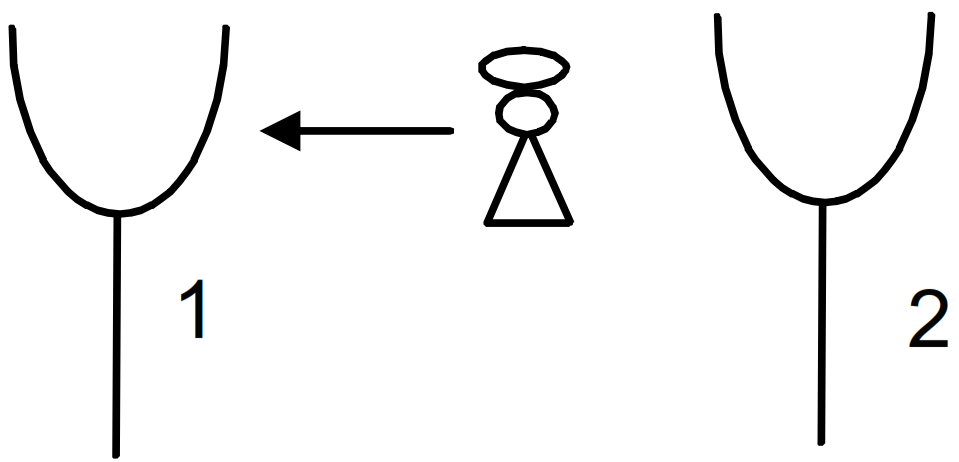
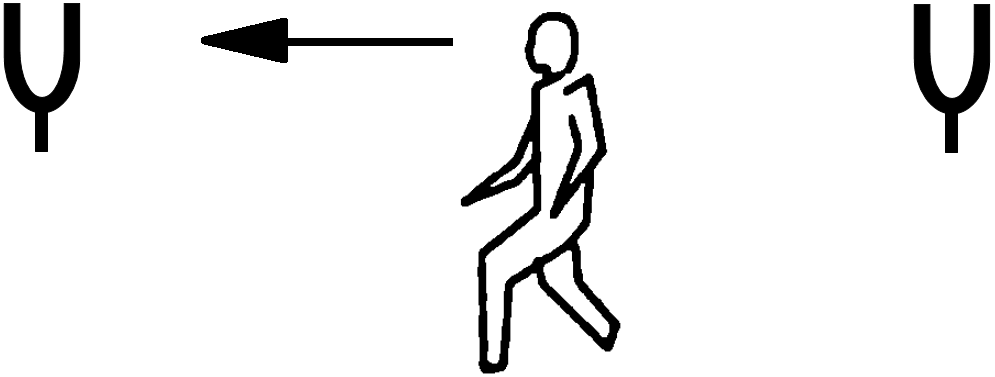
Two identical tuning forks vibrating at the same frequency 256Hz are kept fixed at some distance apart. A listener runs between the forks at a speed of 3.0m/s so that he approaches one tuning fork and recedes from the other figure. Find the beat frequency observed by the listener. Speed of sound in air = 332ms/s.
Answer


Here given velocity of the sources vs = 0

Velocity of the observer v0 = 3m/s

So, the apparent frequency heard by the man $=\Big(\frac{332+3}{332}\Big)\times256=258.3\text{Hz}.$

From the approaching tuning form = f'

$\text{f}'=\Big[\frac{(332-3)}{332}\Big]\times256=253.7\text{Hz}.$

So, beat produced by them $=258.3-253.7=4.6\text{Hz}.$

Need a full question paper?

Generate a complete, print-ready paper with questions like this in minutes — across 16+ boards, with answer keys.

Start Generating Free

Similar questions

A thin prism of crown glass $(\mu_\text{r}=1.515,\mu_\text{v}=1.525)$ and a thin prism of flint glass $(\mu_\text{r}=1.612,\mu_\text{v}=1.632)$ are placed in contact with each other. Their refracting angles are 5.0° each and are similarly directed. Calculate the angular dispersion produced by the combination.
The band gap between the valence and the conduction bands in zinc oxide (ZnO) is 3.2eV. Suppose an electron in the conduction band combines with a hole in the valence band and the excess energy is released in the form of electromagnetic radiation. Find the maximum wavelength that can be emitted in this process.
A ceiling fan has a diameter (of the circle through the outer edges of the three blades) of 120cm and rpm 1500 at full speed. Consider a particle of mass 1g sticking at the outer end of a blade. How much force does it experience when the fan runs at full speed? Who exerts this force on the particle? How much force does the particle exert on the blade along its surface?
What are the advantages of the null-point method in a Wheatstone bridge? What additional measurements would be required to calculate Runknown by any other method?
A hydrogen atom in state n = 6 makes two successive transitions and reaches the ground state. In the first transition a photon of 1.13eV is emitted. (a) Find the energy of the photon emitted in the second transition (b) What is the value of n in the intermediate state?
For a CE-transistor amplifier, the audio signal voltage across the collector resistance of 2 k$\Omega$ is 2 V. suppose the current amplification factor if the transistor is 100, find the input signal voltage and base current if the base resistance is 1 k$\Omega$.
$\text{ }^{197}_{80}\text{Hg}$ decay to $\text{ }^{197}_{79}\text{Au}$ through electron capture with a decay constant of 0.257 per day.
  1. What other particle or particles are emitted in the decay?
  2. Assume that the electron is captured from the K shell. Use Moseley's law $\sqrt{\text{v}}=\text{a(Z}-\text{b})$ with $\text{a}=4.95\times10^7\text{s}^{-\frac{1}{2}}$ and b = 1 to find the wavelength of the $\text{K}_{\alpha}$ X-ray emitted following the electron capture.
What is the energy of a hydrogen atom in the first excited state if the potential energy is taken to be zero in the ground state?
A bar magnet of magnetic moment 1.5 J T–1 lies aligned with the direction of a uniform magnetic field of 0.22 T.
  1. What is the amount of work required by an external torque to turn the magnet so as to align its magnetic moment: (i) normal to the field direction, (ii) opposite to the field direction?
  2. What is the torque on the magnet in cases (i) and (ii)?