Question
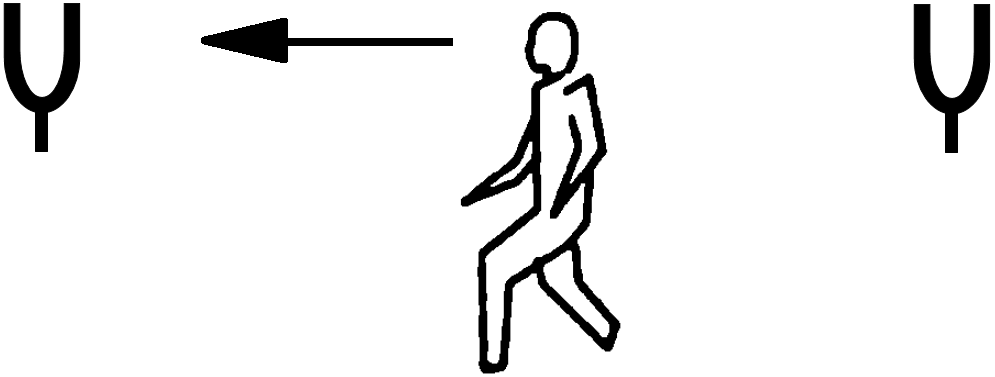
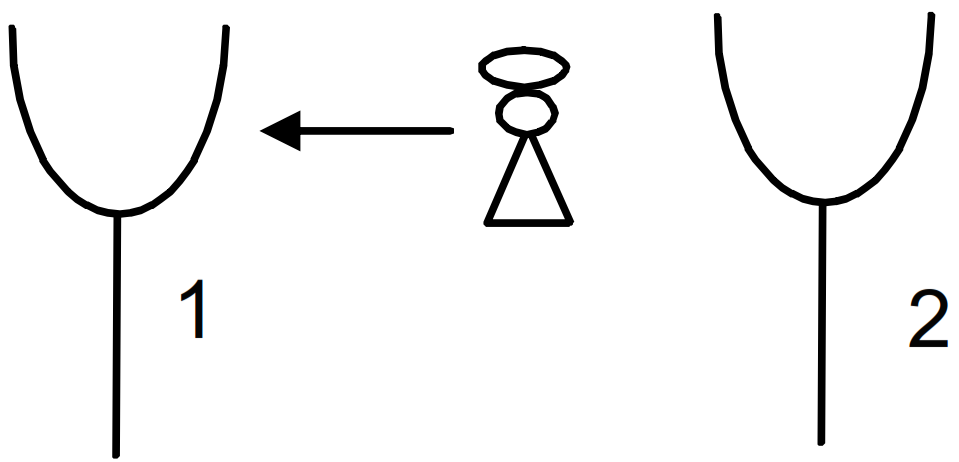
Two identical tuning forks vibrating at the same frequency 256Hz are kept fixed at some distance apart. A listener runs between the forks at a speed of 3.0m/s so that he approaches one tuning fork and recedes from the other figure. Find the beat frequency observed by the listener. Speed of sound in air = 332ms/s.
Answer


Here given velocity of the sources $v_s = 0$
Velocity of the observer $v_0 = 3m/s$
So, the apparent frequency heard by the man $=\Big(\frac{332+3}{332}\Big)\times256=258.3\text{Hz}.$
From the approaching tuning form = f'
$\text{f}'=\Big[\frac{(332-3)}{332}\Big]\times256=253.7\text{Hz}.$
So, beat produced by them $=258.3-253.7=4.6\text{Hz}.$

Need a full question paper?

Generate a complete, print-ready paper with questions like this in minutes — across 16+ boards, with answer keys.

Start Generating Free

Similar questions

A rough inclined plane is placed on a cart moving with a constant velocity u on horizontal ground. A block of mass M rests on the incline. Is any work done by force of friction between the block and incline? Is there then a dissipation of energy?
State the first law of thermodynamics. List the sign conventions used in the energy dealt by the law.
Calculate the speed of sound in a gas in which two waves of wavelengths 1.00m and 1.01m produce 10 beats in 3 seconds.
A physical quantity P is related to four observables a, b, c and d as follows: $\text{P}=\text{a}^3\text{b}^3/\big(\sqrt{\text{c}}\text{ d}\big)$ The percentage errors of measurement in a, b, c and d are 1%, 3%, 4% and 2%, respectively. What is the percentage error in the quantity P ? If the value of P calculated using the above relation turns out to be 3.763, to what value should you round off the result ?
Two vessels have the same base area but different shapes. The first vessel takes twice the volume of water that the second vessel requires to fill upto a particular common height. Is the force exerted by the water on the base of the vessel the same in the two cases ? If so, why do the vessels filled with water to that same height give different readings on a weighing scale?
Explain this common observation clearly: If you look out of the window of a fast moving train, the nearby trees, houses etc. seem to move rapidly in a direction opposite to the train’s motion, but the distant objects (hill tops, the Moon, the stars etc.) seem to be stationary. (In fact, since you are aware that you are moving, these distant objects seem to move with you).
A person standing on a platform finds that a train moving with velocity $0.6c$ takes one second to pass by him. Find:
  1. The length of the train as seen by the person and.
  2. The rest length of the train.
Shows that the projection angle $\theta_0$ for a projectile launched from the origin is given by, $\theta_0=\tan^{-1}\Big(\frac{4\text{h}_\text{m}}{\text{R}}\Big)$ where the symbols have their usual meaning.
Give the magnitude and direction of the net force acting on a stone of mass 0.1 kg ,
a. just after it is dropped from the window of a stationary train,
b. just after it is dropped from the window of a train running at a constant velocity of $36 km / h$.
c. just after it is dropped from the window of a train accelerating with $1 ms^{-2}$,
d. lying on the floor of a train which is accelerating with $1 ms^{-2}$, the stone being at rest relative to the train.
Neglect air resistance throughout.
Prove that the elastic potential energy density of a stretched wire is equal to half the product of stress and strain.