Question
Shows that the projection angle $\theta_0$ for a projectile launched from the origin is given by, $\theta_0=\tan^{-1}\Big(\frac{4\text{h}_\text{m}}{\text{R}}\Big)$ where the symbols have their usual meaning.

Answer

Maximum vertical height, $\text{h}_\text{m}=\frac{\text{u}_0^2\sin^2\theta}{2\text{g}}\ ...(\text{i})$ Horizontal range, $\text{R}=\frac{\text{u}_0^2\sin^22\theta}{\text{g}}\ ...(\text{ii})$ $\frac{\text{h}_\text{m}}{\text{R}}=\frac{\sin^2\theta}{2\sin^22\theta}$ $=\frac{\sin\theta\times\sin\theta}{2\times\sin\theta\cos\theta}$ $=\frac{\sin\theta}{4\cos\theta}=\frac{\tan\theta}{4}$ $\tan\theta=\frac{4\text{h}_\text{m}}{\text{R}}$ $\theta=\tan^{-1}\frac{4\text{h}_\text{m}}{\text{R}}$

Need a full question paper?

Generate a complete, print-ready paper with questions like this in minutes — across 16+ boards, with answer keys.
Start Generating Free

Similar questions

A traffic policeman sounds a whistle to stop a car-driver approaching towards him. The car-driver does not stop and takes the plea in court that because of the Doppler shift, the frequency of the whistle reaching him might have gone beyond the audible limit of 20kHz and he did not hear it. Experiments showed that the whistle emits a sound with frequency close to 16kHz. Assuming that the claim of the driver is true, how fast was he driving the car? Take the speed of sound in air to be 330m/s. Is this speed practical with today's technology?
A pendulum having a bob of mass $m$ is hanging in a ship sailing along the equator from east to west. When the ship is stationary with respect to water the tension in the string is $T_0$.
  1. Find the speed of the ship due to rotation of the earth about its axis.
  2. Find the difference between $T_0$ and the earth's attraction on the bob.
  3. If the ship sails at speed $v,$ what is the tension in the string? Angular speed of earth's rotation is $\omega$ and radius of the earth is $R.$
Show that the Reynold's number represents the ratio of the inertial force per unit area to the viscous force per unit area.
A physical quantity Q is given by$\text{Q}= \frac{\text{A}^2\text{B}^\frac{3}{2}}{\text{C}^{+4}\text{D}^\frac{1}{2}}$
The percentage error in A, B, C, D are 1%, 2%, 4%, 2% respectively. Find the percentage error in Q.
A vessel containing one mole of a monatomic ideal gas (molecular weight $=20 \mathrm{gmol}^{-1}$ ) is moving on a floor at a speed of $50 \mathrm{~ms}^{-1}$. The vessel is stopped suddenly. Assuming that the mechanical energy lost has gone into the internal energy of the gas, find the rise in its temperature.
Displacement versus time curve for a particle executing $\text{S.H.M}$. is shown in Fig. Identify the points marked at which,
  1. Velocity of the oscillator is zero,
  2. Speed of the oscillator is maximum.
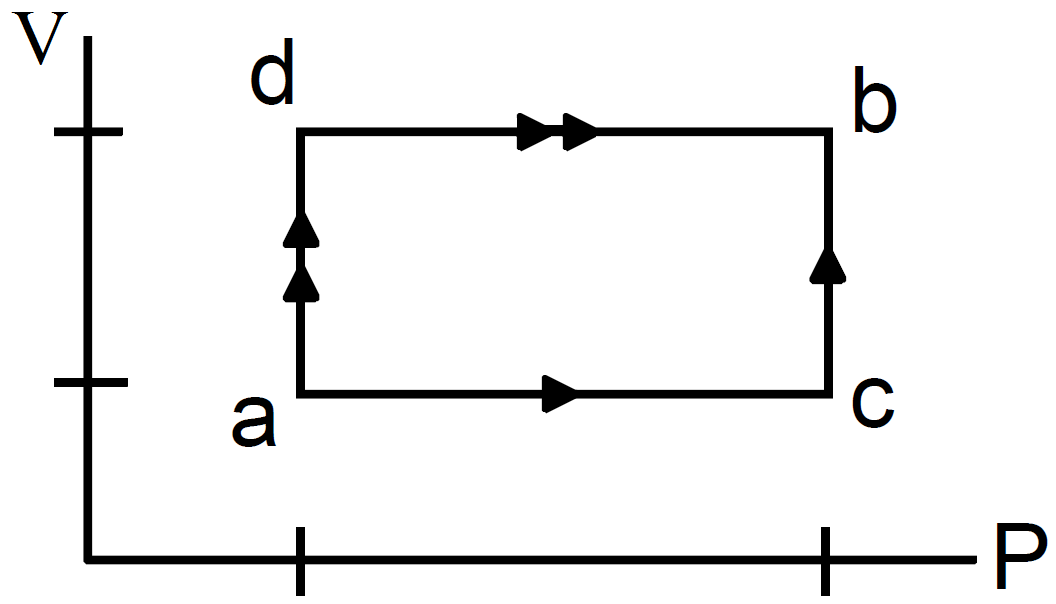
When a system is taken through the process abc shown in figure. 80J of heat is absorbed by the system and 30J of work is done by it. If the system does 10J of work during the process adc, how much heat flows into it during the process?
Explain why: An optical pyrometer (for measuring high temperatures) calibrated for an ideal black body radiation gives too low a value for the temperature of a red hot iron piece in the open, but gives a correct value for the temperature when the same piece is in the furnace.
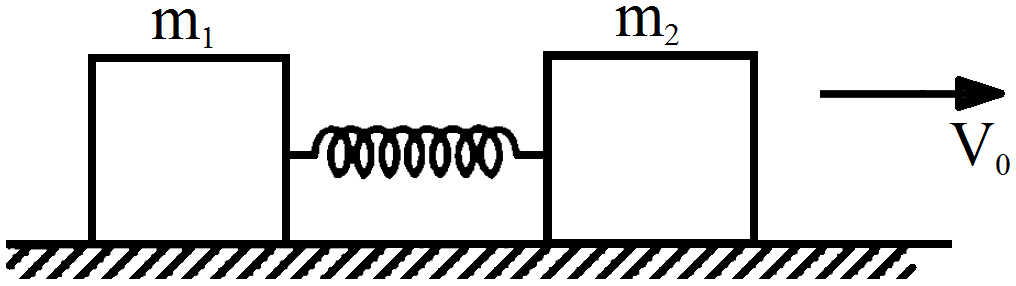
Two blocks of masses $m_1$ and $m_2$ are connected by a spring of spring constant $k.$ The block of mass $m_2$ is given a sharp impulse so that it acquires a velocity $v_0$ towards right. Find
  1. The velocity of the centre of mass.
  2. The maximum elongation that the spring will suffer.
A jet airplane travelling at the speed of $500 km\ h^{–1}$ ejects its products of combustion at the speed of $1500km\ h^{–1}$ relative to the jet plane. What is the speed of the latter with respect to an observer on the ground?