Question
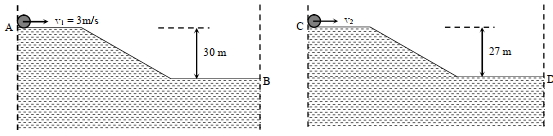
Two identical uniform discs roll without slipping on two different surfaces $AB$ and $CD$ (see figure) starting at $A$ and $C$ with linear speeds $v _1$ and $v _2$, respectively, and always remain in contact with the surfaces. If they reach $B$ and $D$ with the same linear speed and $v_1=3 \ m / s$, then $v_2$ in $m / s$ is $\left(g=10 \ m / s ^2\right)$
Answer

Kinetic energy of a pure rolling disc having velocity of centre of mass $v=\frac{1}{2} m v^2+\frac{1}{2}\left(\frac{m R^2}{2}\right) \frac{v^2}{R^2}=\frac{3}{4} m v^2$

So, $\frac{3}{4} m(3)^2+m g(30)=\frac{3}{4} m\left(v_2\right)^2+m g(27) \quad \therefore v_2=7 m / s$

Need a full question paper?

Generate a complete, print-ready paper with questions like this in minutes — across 16+ boards, with answer keys.

Start Generating Free

Similar questions

Two opposite and equal charges $4 \times {10^{ - 8}}\,coulomb$ when placed $2 \times {10^{ - 2}}\,cm$ away, form a dipole. If this dipole is placed in an external electric field $4 \times {10^8}\,newton/coulomb$, the value of maximum torque and the work done in rotating it through $180^\circ $ will be
 In a $YDSE$ bi-choromatic light of wavelength $400\, nm$ and $560\, nm$ are used. The distance betweenmthe slits is $0.1\, mm$ and the distance between the plane of the slits and the screen is $1\,m$. The minimum distance between two successive regions of complete darkness is.......$mm$
A smooth sphere $A$ of mass $m$ collides elastically with an identical sphere $B$ at rest. The velocity of $A$ before collision is $8\ m/s$ in a direction making $60^o$ with the line of centres at the time of impact.

$(i)$ The sphere $A$ comes to rest after collision.

$(ii)$ The sphere $B$ will move with a speed of $8\ m/s$ after collision.

$(iii)$ The directions of motion $A$ and $B$ after collision are at right angles.

$(iv)$ The speed of $B$ after collision is $4\ m/s$ . The correct option is 

A rectangular coil (Dimension $5\,cm\times 2\,cm$ ) with $100\,turns,$ carrying a current of $3\,A$ in the clock-wise direction, is kept centered at the origin and in the $X-Z$ plane. A magnetic field of $1\,T$ is applied along $X-$ axis. If the coil is tilted through $45^o$ about $Z-$ axis, then the torque on the coil is.....$Nm$
body moves with constant angular velocity on a circle. Magnitude of angular acceleration
$50 \,g$ ice at $0^{\circ} C$ is dropped into a calorimeter containing $100 \,g$ water at $30^{\circ} C$. If thermal capacity of calorimeter is zero then amount of ice left in the mixture at equilibrium is .......... $g$
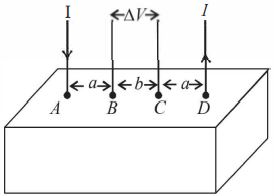
Consider a block of conducting material ofresistivity '$\rho$' shown in the figure. Current '$I$' enters at '$A$' and leaves from '$D$'. We apply superp osition principle to find voltage '$\Delta  V$ ' developed between '$B$' and '$C$'. The calculation is done in the following steps:
$(i)$ Take current '$I$' entering from '$A$' and assume it to spread over a hemispherical surface in the block.
$(ii)$ Calculatefield $E(r)$ at distance '$r$' from $A$ by using Ohm's law $E = \rho  j$, where j is the current per unit area at '$r$'.
(iii) From the '$r$' dependence of $E(r)$, obtain the potential $V(r)$ at $r$.
(iv) Repeat $(i), (ii)$ and $(iii)$ for current '$I$' leaving '$D$' and superpose results for '$A$' and '$D$'.

$\Delta V$ measured between $B$ and $C$ is

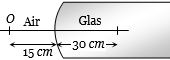
A point object $O$ is placed in front of a glass rod having spherical end of radius of curvature $30 cm.$ The image would be formed at
Assertion : Two concentric charged shells are given. The potential difference between the shells depends on charge of inner shell.

Reason : Potential due to charge of outer shell remains same at every point inside the sphere.

A bomb of $12 \,kg$ explodes into two pieces of masses $4 \,kg $ and $8 \,kg$. The velocity of $8\,kg$  mass is $6 m/sec$. The kinetic energy of the other mass is ............. $\mathrm{J}$