MCQ
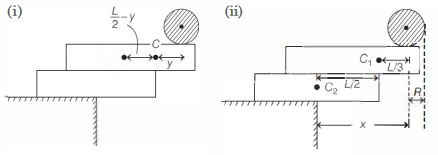
Two identical uniform rectangular blocks (with longest side $L$ ) and a solid sphere of radius $R$ are to be balanced at the edge of a heavy table such that the centre of the sphere remains at the maximum possible horizontal distance from the vertical edge of the table without toppling as indicated in the figure. If the mass of each block is $M$ and of the sphere is $M / 2$, then the maximum distance $x$ that can be achieved is
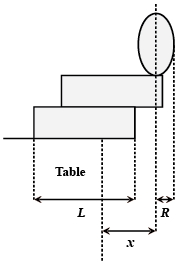
  • $8 L / 15$
  • B
    $5 L / 6$
  • C
    $(3 L / 4+R)$
  • D
    $(7 L / 15+R)$

Answer

Correct option: A.
$8 L / 15$
a
(a)

For system to be in equilibrium without toppling, following conditions must be fulfilled.

$(i)$ Centre of mass $C_1$ of sphere and upper block must lie inside the edge of lower block.

Taking origin of axes choosen at $C$, we have

$\frac{M}{2} \times y=M\left(\frac{L}{2}-y\right)$

$\Rightarrow \frac{y}{2}+y=\frac{L}{2} \text { or } y=\frac{L}{3}$

$(ii)$ Centre of mass of both of block and sphere must lie inside the edge of table.

So, again taking centre of mass $C_2$ as origin,

$\frac{3 M}{2}\left(x-\frac{L}{3}\right)+M\left(x-\frac{L}{3}-\frac{L}{2}\right)=0$

$\Rightarrow \frac{3 x}{2}-\frac{L}{2}+x-\frac{L}{3}-\frac{L}{2}=0$

$\Rightarrow \frac{5 x}{2}=\frac{4 L}{3}$

$\Rightarrow x =\frac{8 L}{15}$

Need a full question paper?

Generate a complete, print-ready paper with questions like this in minutes — across 16+ boards, with answer keys.

Start Generating Free

Similar questions

The temperature dependence of resistances of $Cu$ and undoped $Si$ in the temperature range $300-400\ K$, is best described by
By corpuscular theory of light, the phenomenon which can be explained is
The position of a particle related to time is given by $x =\left(5 t ^2-4 t +5\right) m$. The magnitude of velocity of the particle at $t=2\,s$ will be $...........ms^{-1}$
A stone is thrown vertically upward with an initial velocity $v_0$. The distance travelled in time $\frac{1.5\,v_0}{g}$ is
Two particles $P$ and $Q$ describe simple harmonic motions of same period, same amplitude, along the same line about the same equilibrium position $O.$ When $P$ and $Q$ are on opposite sides of $O$ at the same distance from $O$ they have the same speed of $1.2 \,m/s$ in the same direction, when their displacements are the same they have the same speed of $1.6\, m/s$ in opposite directions. The maximum velocity in $m/s$ of either particle is
A flat plate of area $10\,cm^2$  is separated from a large plate by a layer of glycerine $1\, mm$ thick. If the coefficient of viscosity of glycerine is $20$  poise, the force required to keep the plate moving with a velocity of  $1\,cm/sec$  is .......... $dyne$
A solid sphere, a solid cylinder, a disc and a ring are rolling down an inclined plane. Which of these bodies will reach the bottom simultaneously
Both the blocks shown here are of mass $m$ and are moving with constant velocity in direction shown in a resistive medium which exerts equal constant force on both blocks in direction opposite to the velocity. The tension in the string connecting both of them will be : (Neglect friction)
What is the power gain in a $CE$ amplifier, where input resistance is $3 \,k \Omega$ and load resistance $24 \,k \Omega$ given $\beta=6 ?$
Consider the snapshot of a wave traveling in positive $x$ -direction