MCQ
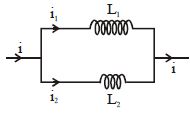
Two inductors $L_1$ and $L_2$ are connected in parallel and $a$ time varying current flow  as shown the Ratio of currents $i_1/i_2$ at any time $t$ is
  • A
    $L_1/ L_2$
  • $L_2 / L_1$
  • C
    $\frac{L^2_1}{(L_1 + L_2)^2}$
  • D
    $\frac{L^2_2}{(L_1 + L_2)^2}$

Answer

Correct option: B.
$L_2 / L_1$
b
since $L_{1}$ and $L_{2}$ are connected in parallel. Potential difference across $L_{1}$ is equal to

that across $L_{2}$ i.e. $\mathcal{E}_{1}=\mathcal{E}_{2}$

Or $-L_{1} \frac{d i_{1}}{d t}=-L_{2} \frac{d I_{2}}{d t}$

Or $L_{1} \int d i_{1}=L_{2} \int d i_{2}$

Or $L_{2} i_{2}=L_{1} i_{1}$

or $\frac{i_{1}}{i_{2}}=\frac{L_{2}}{L_{1}}$

Need a full question paper?

Generate a complete, print-ready paper with questions like this in minutes — across 16+ boards, with answer keys.
Start Generating Free

Similar questions

Optical fibres are related with
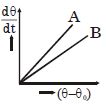
Two circular discs $A$ and $B$ with equal radii and equal mass are blackened. They are heated to same temperature and are cooled under identical conditions.What inference do you draw from their cooling curves ?
Two polaroids $P_1$ and $P_2$ are placed with their axis perpendicular to each other. Unpolarised light $I_0$ is incident on $P_1$. A third polaroid $P_3$ is kept in between $P_1$ and $P_2$ such that its axis makes an angle $45^o $ with that of $P_1$ .The intensity of transmitted light through $P_2$ is
A potential $V_0$ is applied across a uniform wire of resistance $R$. The power dissipation is $P_1$. The wire is then cut into two equal halves and a potential of $V _0$ is applied across the length of each half. The total power dissipation across two wires is $P_2$. The ratio $P_2: P_1$ is $\sqrt{x}: 1$. The value of $x$ is $.............$.
In a primary coil $5\,A$ current is flowing on $220 \,volts$. In the secondary coil $2200\,V$ voltage produces. Then ratio of number of turns in secondary coil and primary coil will be
The velocity of light in air is $3\times10^8\, ms^{-1}$ and that in water is $2.2\times10^8\, ms^{-1}$. The polarising angle of incidence is.......$^o$
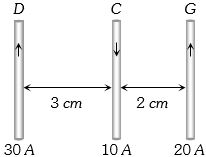
Three long, straight parallel wires carrying current, are arranged as shown in figure. The force experienced by a $25\, cm$ length of wire $C$ is
A thin film of soap solution $(n = 1.4)$ lies on the top of a glass plate $(n = 1.5)$. When visible light is incident almost normal to the plate, two adjacent reflection maxima are observed at two wavelengths $420\,nm$ and $630\,nm$. The minimum thickness of the soap solution is.....$nm$
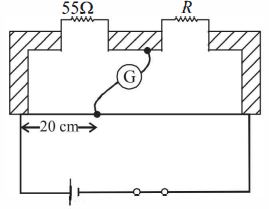
Shown in the figure below is a meter-bridge set up with null deflection in the galvanometer. The value of the unknown resistor $R$ is ............. $\Omega$
A sphere, a cube and a thin circular plate, all made of the same mass and finish are heated to a temperature of $200^{\circ} C$. Which of these objects will cool slowest, when left in air at room temperature?