MCQ
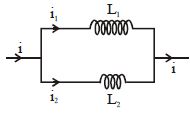
Two inductors $L_1$ and $L_2$ are connected in parallel and $a$ time varying current flow as shown the Ratio of currents $i_1/i_2$ at any time $t$ is
- A$L_1/ L_2$
- ✓$L_2 / L_1$
- C$\frac{L^2_1}{(L_1 + L_2)^2}$
- D$\frac{L^2_2}{(L_1 + L_2)^2}$
that across $L_{2}$ i.e. $\mathcal{E}_{1}=\mathcal{E}_{2}$
Or $-L_{1} \frac{d i_{1}}{d t}=-L_{2} \frac{d I_{2}}{d t}$
Or $L_{1} \int d i_{1}=L_{2} \int d i_{2}$
Or $L_{2} i_{2}=L_{1} i_{1}$
or $\frac{i_{1}}{i_{2}}=\frac{L_{2}}{L_{1}}$
Generate a complete, print-ready paper with questions like this in minutes — across 16+ boards, with answer keys.
Statement $I:$ The law of radioactive decay states that the number of nuclei undergoing the decay per unit time is inversely proportional to the total number of nuclei in the sample.
Statement $II:$ The half life of a radionuclide is the sum of the life time of all nuclei, divided by the initial concentration of the nuclei at time $t =0$.
In the light of the above statements, choose the most appropriate answer from the options given below :