MCQ
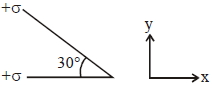
Two infinite planes each with uniform surface charge density $+\sigma$ are kept in such a way that the angle between them is $30^{\circ} .$ The electric field in the region shown between them is given by
  • A
    $\frac{\sigma}{\varepsilon_{0}}\left[\left(1+\frac{\sqrt{3}}{2}\right) \hat{\mathrm{y}}+\frac{\hat{\mathrm{x}}}{2}\right]$
  • $\frac{\sigma}{2 \varepsilon_{0}}\left[\left(1-\frac{\sqrt{3}}{2}\right) \hat{\mathrm{y}}-\frac{\hat{\mathrm{x}}}{2}\right]$
  • C
    $\frac{\sigma}{2 \varepsilon_{0}}\left[(1+\sqrt{3}) \hat{\mathrm{y}}+\frac{\hat{\mathrm{x}}}{2}\right]$
  • D
    $\frac{\sigma}{2 \varepsilon_{0}}\left[(1+\sqrt{3}) \hat{\mathrm{y}}-\frac{\hat{\mathrm{x}}}{2}\right]$
Answer

Correct option: B.
$\frac{\sigma}{2 \varepsilon_{0}}\left[\left(1-\frac{\sqrt{3}}{2}\right) \hat{\mathrm{y}}-\frac{\hat{\mathrm{x}}}{2}\right]$
b
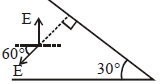
Electric field due to each sheet is uniform and equal to $\mathrm{E}=\frac{\sigma}{2 \varepsilon_{0}}$

Now net electric field between plates

$\overrightarrow{\mathrm{E}}_{\mathrm{net}} =\mathrm{E} \cos 60^{\circ}(-\hat{\mathrm{x}})+\left(\mathrm{E}-\mathrm{E} \sin 60^{\circ}\right)(\hat{\mathrm{y}})$

$=\frac{\sigma}{2 \varepsilon_{0}}\left[-\frac{\hat{\mathrm{x}}}{2}+\left(1-\frac{\sqrt{3}}{2}\right) \hat{\mathrm{y}}\right]$

Need a full question paper?

Generate a complete, print-ready paper with questions like this in minutes — across 16+ boards, with answer keys.

Start Generating Free

Similar questions

At a certain place, the horizontal component ${B_0}$ and the vertical component ${V_0}$ of the earth's magnetic field are equal in magnitude. The total intensity at the place will be
An electrostatic field in a region is radially outward with magnitude $E$ = $\alpha r$ , where $\alpha $ is a constant and $r$ is radial distance. The charge contained in a sphere of radius $R$ in this region (centred at the origin) is
A lens of power $+ 2$ diopters is placed in contact with a lens of power $-1$ diopoter. The combination will behave like
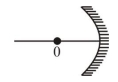
An object ' $o$ ' is placed at a distance of $100\,cm$ in front of a concave mirror of radius of curvature $200\,cm$ as shown in the figure. The object starts moving towards the mirror at a speed $2\,cm / s$. The position of the image from the mirror after $10\,s$ will be at ...... $cm$.
Two balls of same mass and carrying equal charge are hung from a fixed support of length $l$. At electrostatic equilibrium, assuming that angles made by each thread is small, the separation, $x$ between the balls is proportional to
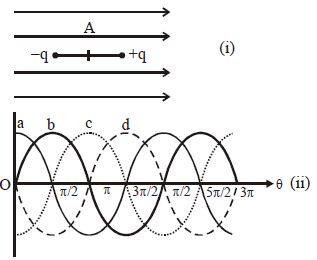
The electric dipole is situated in an electric field as shown in figure. The dipole and electric field vare both in the plane of paper. The dipole is rotated about an axis perpendicular to the paper at point $A$ in anticlockwise direction. If the angle of rotation is measured with respect to the direction of the electric field then the torque for different values of the angle of rotation $\theta $ will be as represented in Fig. $(ii)$
If a coil of metal wire is kept stationary in a non-uniform magnetic field, then
An atomic power nuclear reactor can deliver $300\, MW$. The energy released due to fission of each nucleus of uranium atom ${U^{238}}$ is $170\, MeV$. The number of uranium atoms fissioned per hour will be
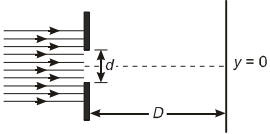
In an experiment, electrons are made to pass through a narrow slit of width '$d$' comparable to their de Broglie wavelength. They are detected on a screen at a distance '$D$' from the slit (see figure).

Which of the following graphs can be expected to represent the number of electrons '$N$' detected as a function of the detector position '$y$'($y = 0$ corresponds to the middle of the slit)

Two concave lenses $L_1$ and $L_2$ are kept in contact with each other. If the space between the two lenses is filled with a material of refractive index $\mu\approx1,$ the magnitude of the focal length of the combination: