Question
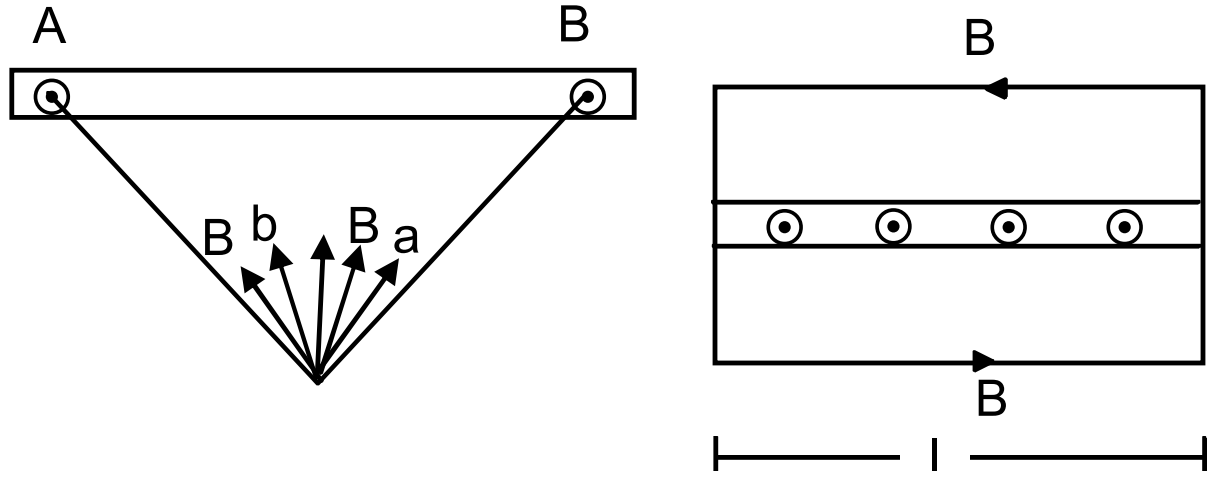
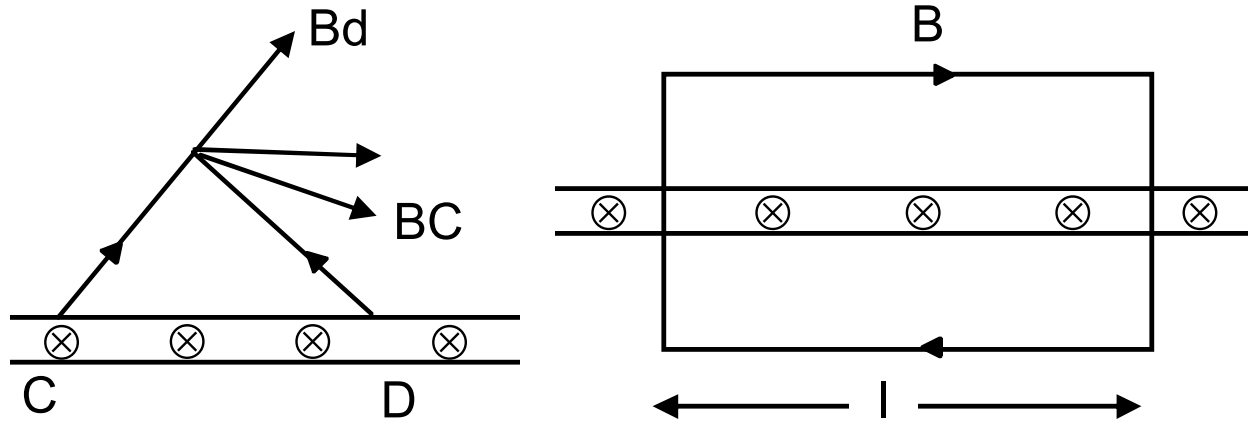
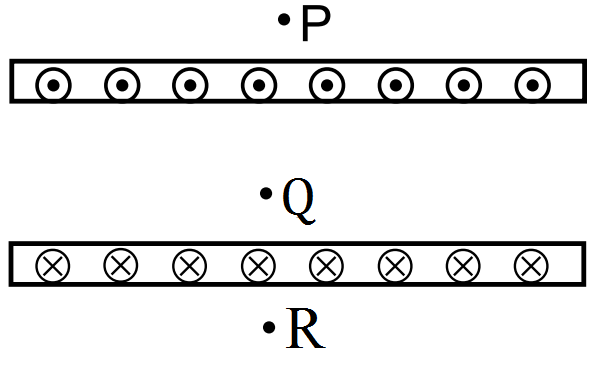
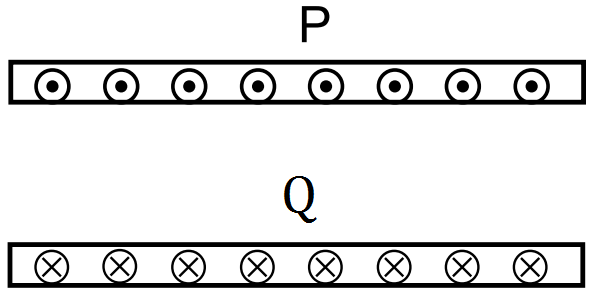
Two large metal sheets carry surface currents as shown in figure. The current through a strip of width dl is Kdl where K is a constant. Find the magnetic field at the points P, Q and R.
Answer


At point P, i = 0, Thus B = 0
At point R, i = 0, B = 0
At point $\theta,$
Applying ampere’s rule to the above rectangle

$\text{B}\times2\text{l}=\mu_0\text{K}_0\int\limits_\text{o}^\text{l}\text{dl}$
$\text{B}\times2\text{l}=\mu_0\text{Kl}\Rightarrow\text{B}=\frac{\mu_0\text{K}}{2}$
$\text{B}\times2\text{l}=\mu_0\text{K}_0\int\limits_\text{o}^\text{l}\text{dl}$
$\text{B}\times2\text{l}=\mu_0\text{Kl}\Rightarrow\text{B}=\frac{\mu_0\text{K}}{2}$
Since the $\overrightarrow{\text{B}}$ due to the 2 stripes are along the same direction, thus.

$\text{B}_\text{net}=\frac{\mu_0\text{K}}{2}+\frac{\mu_0\text{K}}{2}=\mu_0\text{k}$

Need a full question paper?

Generate a complete, print-ready paper with questions like this in minutes — across 16+ boards, with answer keys.
Start Generating Free

Similar questions

A sample of an ideal gas $(\gamma=1.5)$ is compressed adiabatically from a volume of $150cm^3$ to $50cm^3$. The initial pressure and the initial temperature are 150kPa and 300K. Find,
  1. The number of moles of the gas in the sample.
  2. The molar heat capacity at constant volume.
  3. The final pressure and temperature.
  4. The work done by the gas in the process.
  5. The change in internal energy of the gas.
A biconvex thick lens is constructed with glass $(\mu=1.50)$ Each of the surfaces has a radius of 10cm and the thickness at the middle is 5cm. Locate the image of an object placed far away from the lens.
A plane electromagnetic wave travels in vacuum along z - direction. What can you say about the directions of its electric and magnetic field vectors? If the frequency of the wave is 30 MHz, what is its wavelength?
Two identical balls, each having a charge of $2.00 \times 10^{-7}C$ and a mass of 100g, are suspended from a common point by two insulating strings each 50cm long. The balls are held at a separation 5.0cm apart and then released. Find,
  1. The electric force on one of the charged balls.
  2. The components of the resultant force on it along and perpendicular to the string.
  3. The tension in the string.
  4. The acceleration of one of the balls. Answers are to be obtained only for the instant just after the release.
A current of 2A enters at the corner d of a square frame abcd of side 20cm and leaves at the opposite corner b. A magnetic field B = 0.1 T exists in the space in a direction perpendicular to the plane of the frame, as shown in the figure. Find the magnitude and direction of the magnetic forces on the four sides of the frame.
A narrow beam of singly charged potassium ions of kinetic energy 32keV is injected into a region of width 1.00cm with a magnetic field of strength 0.500T, as shown in the figure. The ions are collected at a screen 95.5cm away from the field region. If the beam contains isotopes of atomic weights 39 and 41, find the separation between the points where these isotopes strike the screen. Take the mass of a potassium ion $= A (1.6 \times 10^{-27})kg$, where A is the mass number.
The particle P shown in figure has a mass of 10mg and a charge of $-0.01\mu\text{C}.$ Each plate has a surface area $100cm^2$ on one side. What potential difference V should be applied to the combination to hold the particle P in equilibrium?
Calculate potential energy of a point charge -q placed along the axis due to a charge +Q uniformly distributed along a ring of radius R. Sketch P.E. as a function of axial distance z from the centre of the ring. Looking at graph, can you see what would happen if -q is displaced slightly from the centre of the ring (along the axis)?
Are the nucleons fundamental particles, or do they consist of still smaller parts? One way to find out is to probe a nucleon just as Rutherford probed an atom. What should be the kinetic energy of an electron for it to be able to probe a nucleon? Assume the diameter of a nucleon to be approximately $10^{-15}m.$