Question
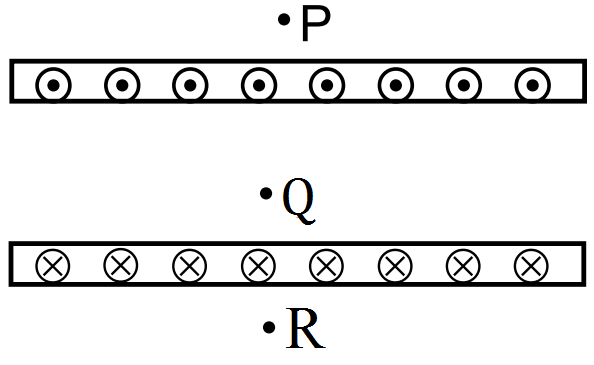
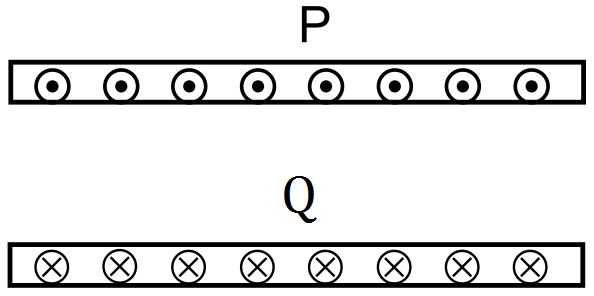
Two large metal sheets carry surface currents as shown in figure. The current through a strip of width dl is Kdl where K is a constant. Find the magnetic field at the points P, Q and R.
Answer


At point P, i = 0, Thus B = 0

At point R, i = 0, B = 0

At point $\theta,$

Applying ampere’s rule to the above rectangle
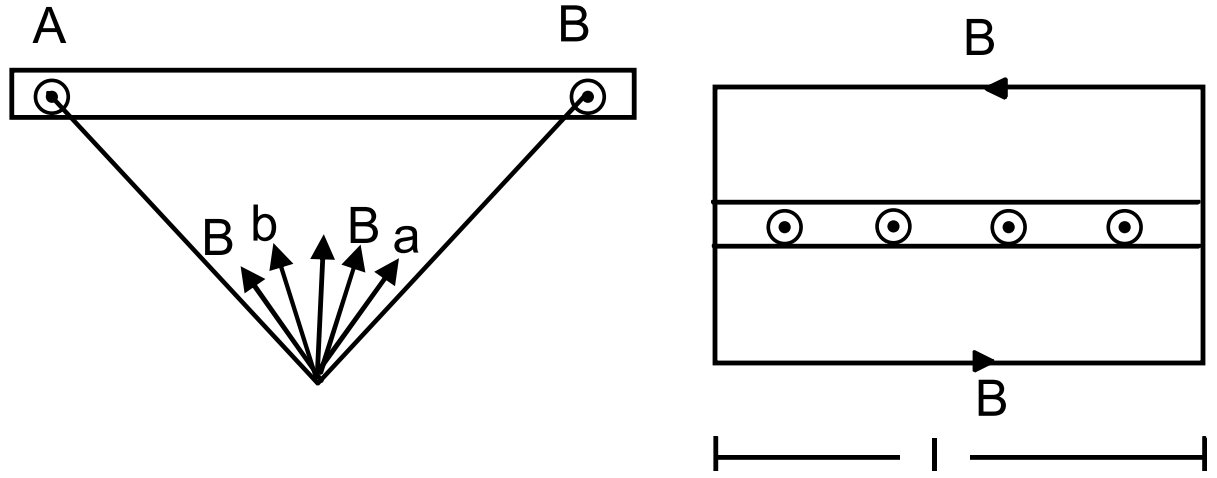
$\text{B}\times2\text{l}=\mu_0\text{K}_0\int\limits_\text{o}^\text{l}\text{dl}$

$\text{B}\times2\text{l}=\mu_0\text{Kl}\Rightarrow\text{B}=\frac{\mu_0\text{K}}{2}$

$\text{B}\times2\text{l}=\mu_0\text{K}_0\int\limits_\text{o}^\text{l}\text{dl}$

$\text{B}\times2\text{l}=\mu_0\text{Kl}\Rightarrow\text{B}=\frac{\mu_0\text{K}}{2}$

Since the $\overrightarrow{\text{B}}$ due to the 2 stripes are along the same direction, thus.
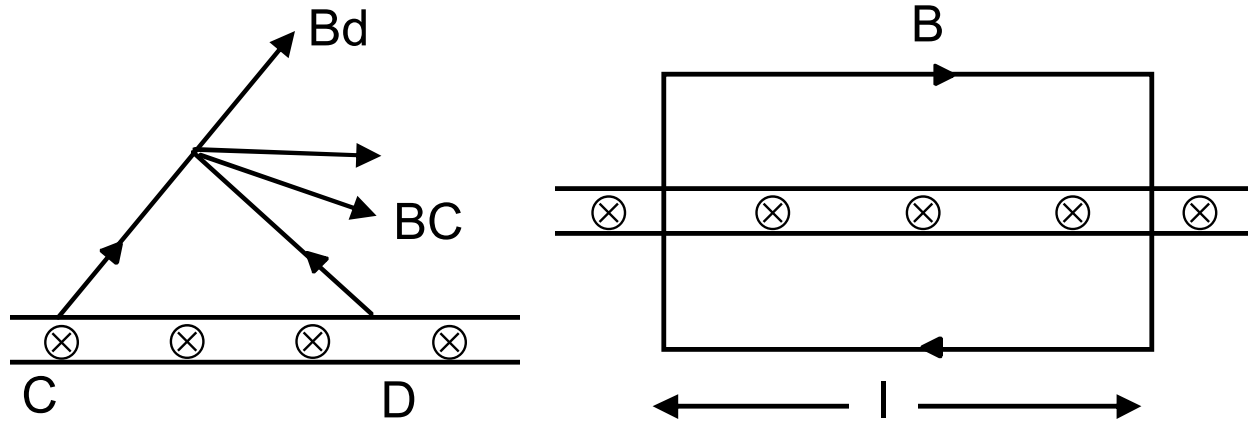
$\text{B}_\text{net}=\frac{\mu_0\text{K}}{2}+\frac{\mu_0\text{K}}{2}=\mu_0\text{k}$

Need a full question paper?

Generate a complete, print-ready paper with questions like this in minutes — across 16+ boards, with answer keys.
Start Generating Free

Similar questions

Explain the variation of conductivity with temperature for:
  1. A metallic conductor.
  2. Ionic conductors.
  3. Semiconductors.
Consider the situation shown in figure. Suppose a small electric field E exists in the space in the vertically upward direction and the upper block carries a positive charge Q on its top surface. The friction coefficient between the two blocks is g but the floor is smooth. What maximum horizontal force F can be applied without disturbing the equilibrium?
[Hint: The force on a charge Q by the electric field E is F = QE in the direction of E.]
Do permeability and relative permeability have the same dimensions?
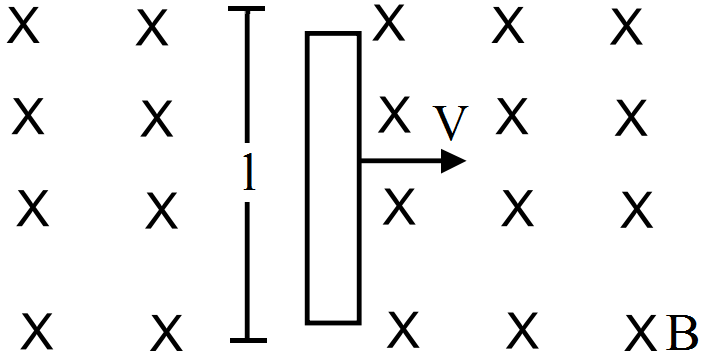
A conducting wire of length l, lying normal to a magnetic field B, moves with a velocity v, as shown in the figure.
  1. Find the average magnetic force on a free electron of the wire.
  2. Due to this magnetic force, electrons concentrate at one end, resulting in an electric field inside the wire. The redistribution stops when the electric force on the free electrons balances the magnetic force. Find the electric field developed inside the wire when the redistribution stops.
  3. What potential difference is developed between the ends of the wire?

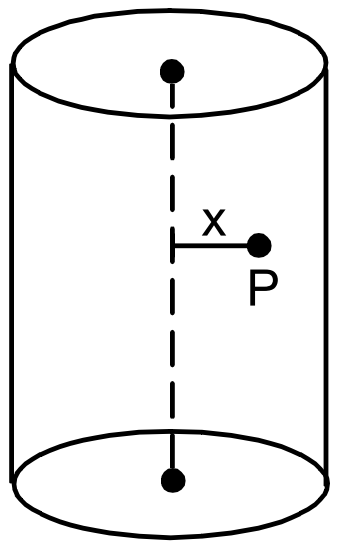
A long cylindrical volume contains a uniformly distributed charge of density $\rho.$ Find the electric field at a point P inside the cylindrical volume at a distance x from its axis (figure).

Two parallel wires seprated by a distance of 10cm carry currents of 10A and 40A along-the same direction. Where should a third current be placed so that it experiences no magnetic force?
A charge of $1\mu\text{C}$ is given to one plate of a parallel-plate capacitor of capacitance $0.1\mu\text{F}$ and a charge of $2\mu\text{C}$ is given to the other plate. Find the potential difference developed between the plates.
Figure shows a potentiometer with a cell of 2.0V and internal resistance of $0.40\Omega$ maintaining a potential drop across the resistor wire AB. A standard cell which maintains a constant emf of 1.02V (for very moderate currents upto a few mA) gives a balance point at 67.3cm length of the wire. To ensure very low currents drawn from the standard cell, a very high resistance of $600\text{k}\Omega$ is put in series with it, which is shorted close to the balance point. The standard cell is then replaced by a cell of unknown emf and the balance point found similarly, turns out to be at 82.3cm length of the wire.

  1. What is the value of $\varepsilon?$
  2. What purpose does the high resistance of $600\text{k}\Omega$ have?
  3. Is the balance point affected by this high resistance?
  4. Is the balance point affected by the internal resistance of the driver cell?
  5. Would the method work in the above situation if the driver cell of the potentiometer had an emf of 1.0V instead of 2.0V?
  6. Would the circuit work well for determining extremely small emf, say of the order of few mV (such as the typical emf of a thermo couple)? If not, how would you modify the circuit?
A pitcher with 1mm thick porous walls contains 10kg of water. Water comes to its outer surface and evaporates at the rate of 0.1gs-1. The surface area of the pitcher (one side)= 200cm2. The room temperature = 42°C, latent heat of vaporization $ =2.27\times10^6\text{Jkg}^{-1},$ and the thermal conductivity of the porous walls $=0.80\text{Js}^{-1}\text{m}^{-1}{^{\circ}}\text{C}^{-1}.$ Calculate the temperature of water in the pitcher when it attains a constant value.
  1. Draw a labelled ray diagram to obtain the real image formed by an astronomical telescope in normal adjustment position. Define its magnifying power.
  2. You are given three lenses of power 0.5 D, 4 D and 10 D to design a telescope:
  1. Which lenses should he used as objective and eyepiece? Justify your answer.
  2. Why is the aperture of the objective preferred to be large?