Question
Two large, thin metal plates are parallel and close to each other. On their inner faces, the plates have surface charge densities of opposite signs and of magnitude 17.0 × 10⁻²² C/m2 . What is E:
  1. In the outer region of the first plate,
  2. In the outer region of the second plate, and
  3. Between the plates?

Answer

Given,

Surface charge density, $\sigma$ = 17. 0 x 10-22 C /m2

  1. To the left of the plates, electric fields are equal and opposite as plates are close to each other electric field is zero as surface charge density in outer side is zero.
  2. To the right of the plates, electric fields are equal and opposite as plates are close to each other electric field is zero.
  3. Electric fields between the plates are in same direction as total E.F. on both sides of plate due to $\sigma$ surface charge density = $\frac{\sigma}{\in_0}$ electric field of inner side of plate =$\frac{\sigma}{2\in_0}$

and for both plate E $=\frac{\sigma}{2\in_0}+\frac{\sigma}{2\in_0}$

$\text{E}=\frac{\sigma}{\in_0}=\sigma\times4\pi\times9\times10^9$

E = 17.0 × 10-22 × 4 × 3.14 × 9 × 109

E = 1921.7 × 10-13

= 1.92 × 10-10 N/C.

Need a full question paper?

Generate a complete, print-ready paper with questions like this in minutes — across 16+ boards, with answer keys.

Start Generating Free

Similar questions

Explain with proper diagram, the application of a $p$ - $n$ junction diode as a halfwave rectifier.
Consider the situation of the previous problem. Define displacement resistance $\text{R}_\text{d}=\frac{\text{V}}{\text{i}_\text{d}}$ of the space between the plates, where V is the potential difference between the plates and id is the displacement current. Show that Rd varies with time as $\text{R}_\text{d}=\text{R}\big(\text{e}^{\text{t}/\tau}-1\big)$ 
  1. How does one explain the emission of electrons from a photosensitive surface with the help of Einstein's photoelectric equation?
  2. The work function of the following metals is given: Na 2.75ev, K = 2.3 eV, Mo = 4.17eV and Ni = 5.15eV. Which of these metals will not cause photoelectric emission for radiation of wavelength 3300 Å from a laser source placed 1m away from these metals? What happens if the laser source is brought nearer and placed 50cm away?
How does Maxwell modify Ampere's circuital law? Explain.
Draw a circuit diagram for use of NPN transistor as an amplifier in common emitter configuration. The input resistance of a transistor is $1000 \Omega$. On changing its base current by $10\mu\text{A}$ the collector current increases by 2mA. If a load resistance of $5\text{K}\Omega$. Is used in the circuit, calculate:
  1. The current gain.
  2. Voltage gain of the amplifier.
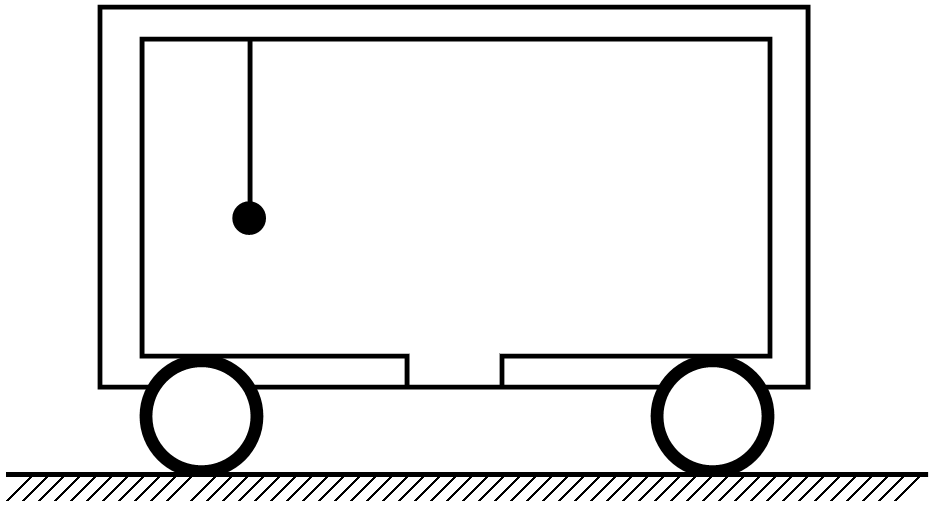
A cart of mass M is at rest on a frictionless horizontal surface and a pendulum bob of mass m hangs from the roof of the cart. The string breaks, the bob falls on the floor, makes several collisions on the floor and finally lands up in a small slot made in the floor. The horizontal distance between the string and the slot is L. Find the displacement of the cart during this process.

Explain the difference between conductor, insulator and semiconductor on the basis of energy band in solids.
  1. When an AC source is connected to an ideal capacitor, show that the average power supplied by the source over a complete cycle is zero.
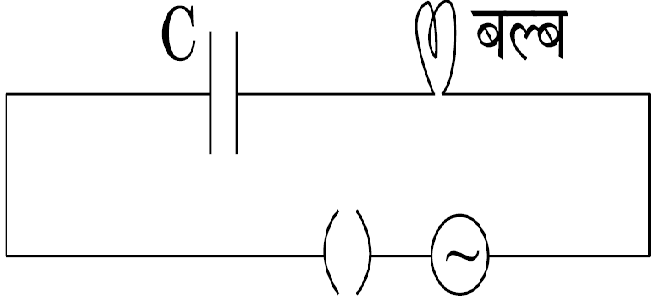
  2. A bulb is connected in series with a variable capacitor and an A.C. source as shown. What happens to the brightness of the bulb when the key is the capacitor is gradually reduced?

Two charged conducting spheres of radii a and b are connected to each other by a wire. What is the ratio of electric fields at the surfaces of the two spheres? Use the result obtained to explain why charge density on the sharp and pointed ends of a conductor is higher than on its flatter portions.
How are electromagnetic waves produced? What is the source of energy of these waves? Draw a schematic sketch of the electromagnetic waves propagating along the + x-axis. Indicate the directions of the electric and magnetic fields. Write the relation between the velocity of propagation and the magnitudes of electric and magnetic fields.