MCQ
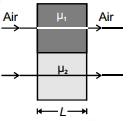
Two light rays initially in same phase travel through two media of equal length $L$ having refractive index $m _1$ and $m_2\left(m_1 > m_2\right)$ as shown in figure. If the wave length of light rays in air is $1$ , the phase difference of the emerging rays is given by
  • A
    $\frac{L \mu_1}{\lambda \mu_2}$
  • B
    $\frac{\left(\mu_1-\mu_2\right) L}{2 \pi \lambda}$
  • $\frac{2 \pi\left(\mu_1-\mu_2\right) L}{\lambda}$
  • D
    $0$

Answer

Correct option: C.
$\frac{2 \pi\left(\mu_1-\mu_2\right) L}{\lambda}$
c
(c)

Path difference between the emerging rays $=\mu_1 L -\mu_2 L$

$\frac{\phi}{2 \pi}=\frac{\left(\mu_1-\mu_2\right) L}{\lambda}$

$\therefore \phi=\frac{\left(\mu_1-\mu_2\right) L}{\lambda}$

Need a full question paper?

Generate a complete, print-ready paper with questions like this in minutes — across 16+ boards, with answer keys.

Start Generating Free

Similar questions

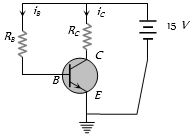
In the following common emitter circuit if $\beta = 100, V_{CE} = 7V, V_{BE} =$ Negligible $R_C = 2 k \Omega$ then $I_B = ?$....$mA$
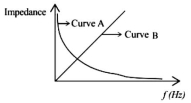
As per the given graph choose the correct representation for curve $A$ and curve $B$.Where $X _{ C }=$ reactance of pure capacitive circuit connected with $A.C.$ source $X _{ L }=$ reactance of pure inductive circuit connected with $A.C.$ source $R =$ impedance of pure resistive circuit connected with $A.C.$ source $Z =$ Impedance of the LCR series circuit $\}$
Two point masses having mass $m$ and $2 \,m$ are placed at distance $d$. The point on the line joining point masses, where gravitational field intensity is zero will be at distance ............
If the velocity of light $c$, universal gravitational constant $G$ and planck's constant $h$ are chosen as fundamental quantities. The dimensions of mass in the new system is
A particle moves on $x-$ axis according to the equation $x = x_0\,\,sin^2\,\omega t,$  the motion is simple harmonic
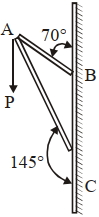
Consider a frame that is made up of two thin massless rods $AB$ and $AC$ as shown in the figure. $A$ vertical force $\overrightarrow{ P }$ of magnitude $100 \;N$ is applied at point $A$ of the frame. Suppose the force is $\overrightarrow{ P }$ resolved parallel to the arms $AB$ and $AC$ of the frame. The magnitude of the resolved component along the arm $AC$ is $xN$. The value of $x$, to the nearest integer, is ............

[Given : $\sin \left(35^{\circ}\right)=0.573, \cos \left(35^{\circ}\right)=0.819$ $\left.\sin \left(110^{\circ}\right)=0.939, \cos \left(110^{\circ}\right)=-0.342\right]$


What is the area of the plates of a $3\,F$ parallel plate capacitor, if the separation between the plates is $5\,mm$
Which is dimensionless
A kettle with $2\, littre$ water at $27\,^oC$ is heated by operating coil heater of power $1\, kW$. The heat is lost to the atmosphere at constant rate $160\, J/sec$, when its lid is open. In how much time will water heated to $77\,^oC$. (specific heat of water $= 4.2\, kJ/kg$) with the lid open ?
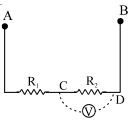
Resistances $R_1$ and $R_2$ each $60\,\Omega$ are connected in series as shown in figure. The Potential difference between $A$ and $B$ is kept $120$ volt. Then what ............. $V$ will be the reading of voltmeter connected between the point $C$ and $D$ if resistance of voltmeter is $120\,\Omega .$