Two long and parallel wires are at a distance of $0.1\, m$ and a current of $5\, A$ is flowing in each of these wires. The force per unit length due to these wires will be
Easy
Download our app for free and get started
(a) $F = \frac{{{\mu _0}}}{{4\pi }}\frac{{2 \times {i_1}{i_2}}}{a} = \frac{{{{10}^{ - 7}} \times 2 \times 5 \times 5}}{{0.1}} = 5 \times {10^{ - 5}}N/m$

Download our appand get started for free
Experience the future of education. Simply download our apps or reach out to us for more information. Let's shape the future of learning together!No signup needed.*
Similar Questions
- 1The circular coil of a galvanometer has fifty turns. The coil has a radius of $1\ cm$. The coil is placed in a radial magnetic field of $0. 010\ T$. The torsion coefficent of the spring on which the coil hangs is $3 \times 10^{-7}\ N-m-rad^{-1}$. Determine the deviation of the galvanometer's hand if the current through the coil is $1.0\ mA$......$^o$View Solution
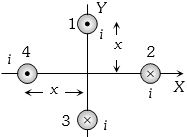
- 2What will be the resultant magnetic field at origin due to four infinite length wires. If each wire produces magnetic field '$B$' at originView Solution
- 3$20$ $ampere$ current is flowing in a long straight wire. The intensity of magnetic field at a distance $20\, cm$ from the wire will beView Solution
- 4View SolutionTwo wires of same length are shaped into a square and a circle. If they carry same current, ratio of the magnetic moment is
- 5Suppose an isolated north pole is kept at the centre of a circular loop carrying a electric current $i$. The magnetic field due to the north pole at a point on the periphery of the wire is $B$. The radius of the loop is $a$. The force on the wire isView Solution
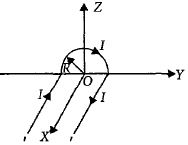
- 6A wire carrying current $I$ has the shape as shown in adjoining figure.Linear parts of the wire are very long and parallel to $X-$axis while semicircular portion of radius $R$ is lying in $Y-Z$ plane. Magnetic field at point $O$ isView Solution
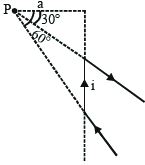
- 7Find magnetic field at point $P$ in given diagram.View Solution
- 8A particle of mass $m$ and charge $q$ is thrown from origin at $t = 0$ with velocity $2\hat{i}$ + $3\hat{j}$ + $4\hat{k}$ units in a region with uniform magnetic field $\vec B$ = $2\hat{i}$ units. After time $t =\frac{{\pi m}}{{qB}}$ , an electric field is switched on such that particle moves on a straight line with constant speed. $\vec E$ may beView Solution
- 9View SolutionA negative test charge is moving near a long straight wire carrying a current. The force acting on the test charge is parallel to the direction of the current. The motion of the charge is
- 10Which of the following graphs shows the variation of magnetic induction $B$ with distance $r$ from a long wire carrying currentView Solution