MCQ
Two long parallel horizontal rails, a distance $l$ apart and each has a resistance $\lambda$ per  unit length are joined at one end by a resistance $R$. A perfectly conducting rod $MN$ of mass  $m$ is free to slide along the rails without friction. There is a uniform magnetic field of  induction $B$ normal to the plane of paper and directed into the paper. A variable force $F$ is applied to the rod $MN$ such that, as the rod moves, a constant current $i$ flows through $P$. The applied force $F$ as function of distance $x$ of the rod from $R$ is
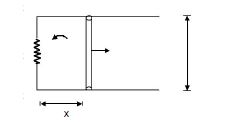
 

  • A
    $i\,lB-\frac{2m \lambda i^2}{B^2 l^2}(R + 2 \lambda x)$
  • B
    $i\,lB+ \frac{4m \lambda i^2}{B^2 l^2}(R - 2 \lambda x)$
  • $i\,lB+ \frac{2m \lambda i^2}{B^2 l^2}(R + 2 \lambda x)$
  • D
    none of these

Answer

Correct option: C.
$i\,lB+ \frac{2m \lambda i^2}{B^2 l^2}(R + 2 \lambda x)$
c
$\mathrm{F}-\mathrm{i} \ell \mathrm{B}=\mathrm{ma}$            ........$(1)$

$\mathrm{B} \ell \mathrm{v}=\mathrm{i}(\mathrm{R}+2 \lambda \mathrm{x})$           ..........$(2)$

$\left(\frac{d V}{d x}\right)=\left(\frac{2 \lambda i}{B \ell}\right)$            ..........$(3)$

$a=V\left(\frac{d v}{d x}\right)=\left(\frac{2 \lambda i}{B \ell}\right)\left(\frac{i(R+2 \lambda x)}{B \ell}\right)$

$\mathrm{a}=\frac{2 \lambda \mathrm{i}^{2}}{\mathrm{B}^{2} \ell^{2}}(\mathrm{R}+2 \lambda \mathrm{x})$             ...........$(4)$

Need a full question paper?

Generate a complete, print-ready paper with questions like this in minutes — across 16+ boards, with answer keys.

Start Generating Free

Similar questions

Due to $10\, ampere$ of current flowing in a circular coil of $10\, cm$ radius, the magnetic field produced at its centre is $3.14 \times {10^{ - 3}}\,Weber/{m^2}$. The number of turns in the coil will be
The current in a $LR$  circuit builds up to $\frac{3}{4}$ th of its steady state value in $4s$. The time constant of this circuit is
Two metal plates having charges $Q, -Q$ face each other at some separation and are dipped into an oil tank. If the oil is pumped out, the electric field between the plates will:
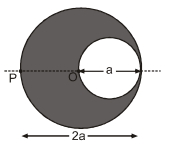
A cylindrical cavity of diameter a exists inside a cylinder of diameter $2$a shown in the figure. Both the cylinder and the cavity are infinitely long. A uniform current density $J$ flows along the length. If the magnitude of the magnetic field at the point $P$ is given by $\frac{N}{12} \mu_0$ aJ, then the value of $N$ is :
The correct relation is (Where $B_H=$ Horizontal component of earth's magnetic field; $B_V$ = Vertical component of earth's magnetic field and B = Total intensity of earth's magnetic field)
The work function of caesium is $2.14\, eV$. Find the wavelength of the incident light if the photo current is brought to zero by a stopping potential of $0.60\, volt$ ............ $nm$
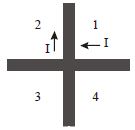
Identical currents flow in two perpendicular wires, as shown in the figure. The wires are very close but do not touch. The magnetic field can be zero:
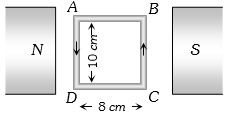
A $100$ $turns$ coil shown in figure carries a current of $2\, amp$ in a magnetic field $B = 0.2\,Wb/{m^2}$. The torque acting on the coil is
The effective value of current $i = 2\, sin\, 100\, \pi\, t + 2 \,sin(100\, \pi \,t + 30^o)$ is :
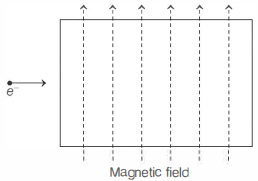
An electron enters a chamber in which a uniform magnetic field is present as shown below.  An electric field of appropriate magnitude is also applied, so that the electron travels undeviated without any change in its speed through the chamber. We are ignoring gravity. Then, the direction of the electric field is