Correct option: A.$L = \frac{{{\mu _0}{\text{l}}}}{\pi }\,{\log _e}\,\frac{{d - a}}{a}$
a
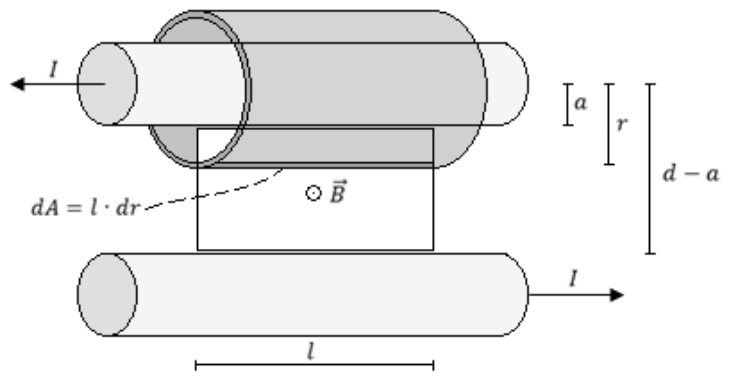
Using Ampere's law for one of the wires to obtain the magnetic field in terms of current $I$ and
the variable radius $r$ due to one of the wire
$\mu_{0} I =\oint \vec{B} \cdot \overrightarrow{d l}$
$=\int_{0}^{2 \pi} B r d \theta$
$\mu_{0} I =B(2 \pi r)$
$\Rightarrow \quad B =\frac{\mu_{0} I}{2 \pi r}$
Note that because of the symmetry of the setup, the total magnetic flux $(\phi)$ will be two times
generated by one of the wires. Then, we continue to use the relation between self inductance
and flux
$\phi_{\text {total}}=2 \int_{A} \vec{B} \cdot \overrightarrow{d A}$
$=2 \int_{a}^{d-a}\left(\frac{\mu_{0} I}{2 \pi r}\right) l d r$
$\phi_{\text {total}}=\frac{\mu_{0} I l}{\pi} \ln \left(\frac{d-a}{a}\right)$
Inductance, $L=\frac{\phi_{\text {total}}}{I}=\frac{\mu_{0} l}{\pi} \ln \left(\frac{d-a}{a}\right)$
Inductance per unit length, $\phi_{\text {total }}=\frac{\mu_{0}}{\pi} \ln \left(\frac{d-a}{a}\right)$