Two long straight wires are placed along $x$-axis and $y$-axis. They carry current $I_1$ and $I_2$ respectively. The equation of locus of zero magnetic induction in the magnetic field produced by them is
Medium
Download our app for free and get started
(c)
On a general point $A$ magnetic field will be zero when $\frac{\mu_0 I_2}{2 \pi x}=\frac{\mu_0 l_1}{2 \pi y}$
$y=\frac{I_1}{I_2} x$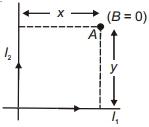

Download our appand get started for free
Experience the future of education. Simply download our apps or reach out to us for more information. Let's shape the future of learning together!No signup needed.*
Similar Questions
- 1View SolutionTwo long wires are hanging freely. They are joined first in parallel and then in series and then are connected with a battery. In both cases, which type of force acts between the two wires
- 2A charge having $q/m$ equal to $10^8\, C/kg$ and with velocity $3 \times 10^5\, m/s$ enters into a uniform magnetic field $0.3\, tesla$ at an angle $30^o$ with direction of field. The radius of curvature will be ......$cm$View Solution
- 3Two particles $\mathrm{X}$ and $\mathrm{Y}$ having equal charges are being accelerated through the same potential difference. Thereafter they enter normally in a region of uniform magnetic field and describes circular paths of radii $R_1$ and $R_2$ respectively. The mass ratio of $\mathrm{X}$ and $\mathrm{Y}$ is :View Solution
- 4A charged particle enters a uniform magnetic field with velocity vector making an angle of $30^o$ with the magnetic field. The particle describes a helical trajectory of pitch $x$ . The radius of the helix isView Solution
- 5A square shaped wire loop of mass $m$, resistance $R$ and side $a$ moving speed $v_{0}$, parallel to the $X$-axis, enters a region of uniform magnetic field $B$, which is perpendicular to the plane of the loop. The speed of the loop changes with distance $x(x < a)$ in the field, asView Solution
- 6A deuteron and a proton moving with equal kinetic energy enter into to a uniform magnetic field at right angle to the field. If $r_{d}$ and $r_{p}$ are the radii of their circular paths respectively, then the ratio $\frac{r_{d}}{r_{p}}$ will be $\sqrt{ x }: 1$ where $x$ is ..........View Solution
- 7View SolutionIf a copper rod carries a direct current, the magnetic field associated with the current will be
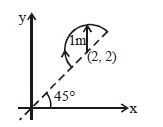
- 8A uniform magnetic field $\vec B = \left( {3\hat i + 4\hat j + \hat k} \right)$ exists in region of space. A semicircular wire of radius $1\,m$ carrying current $1\,A$ having its centre at $(2, 2, 0)$ is placed in $x-y$ plane as shown in figure. The force on semicircular wire will beView Solution
- 9Proton with kinetic energy of $1\;MeV$ moves from south to north. It gets an acceleration of $10^{12}\; \mathrm{m} / \mathrm{s}^{2}$ by an applied magnetic field (west to east). The value of magnetic field :.......$mT$ (Rest mass of proton is $1.6 \times 10^{-27} \;\mathrm{kg}$ )View Solution
- 10$\alpha $ particle, proton and duetron enters in a uniform (transverse) magnetic field $'B'$ with same acceleration potential find ratio of radius of path followed by these particles.View Solution