Question
Two long strings $A$ and $B,$ each having linear mass density $1.2 \times 10^{-2}\ kg/m$, are stretched by different tensions $4.8N$ and $7.5N$ respectively and are kept parallel to each other with their left ends at $x = 0.$ Wave pulses are produced on the strings at the left ends at $t = 0$ on string $A$ and at $t = 20\ ms$ on string $B.$ When and where will the pulse on $B$ overtake that on $A$?
Answer

$\text{m}_\text{A}=1.2\times10^{-2}\text{ kg/m},\ \text{T}_\text{A}=4.8\text{N}$
$\Rightarrow\text{v}_\text{A}=\sqrt{\frac{\text{T}}{\text{m}}}=20\text{m/s}$
$\text{m}_\text{B}=1.2\times10^{-2}\text{kg/m},\ \text{T}_\text{B}=7.5\text{N}$
$\Rightarrow\text{V}_\text{B}=\sqrt{\frac{\text{T}}{\text{m}}}=25\text{m/s}$
$\text{t}=0$ in string $A$
$\text{t}_1=0+20\text{ ms}=20\times10^{-3}=0.02\text{ sec}$
In $0.02 \sec A$ has travelled $20\times0.02=0.4\text{mt}$
Relative speed between $A$ and $B =25-20=5\text{m/s}$
Time taken for $B$ for overtake $A =\frac{\text{s}}{\text{v}}=\frac{0.4}{5}=0.08\text{ sec}$

Need a full question paper?

Generate a complete, print-ready paper with questions like this in minutes — across 16+ boards, with answer keys.

Start Generating Free

Similar questions

A proton has spin and magnetic moment just like an electron. Why then its effect is neglected in magnetism of materials?
A solenoid of length $1.0m,$ radius $1\ cm$ and total turns $1000$ wound on it, carries a current of $5A$. Calculate the magnitude of the axial magnetic field inside the solenoid. If an electron was to move with a speed of $104ms^{–1}$ along the axis of this current carrying solenoid, what would be the force experienced by this electron?
A long, vertical wire carrying a current of $10A$ in the upward direction is placed in a region where a horizontal magnetic field of magnitude $2·0 \times 10^{-3}T$ exists from south to north. Find the point where the resultant magnetic field is zero.
In a single slit diffraction experiment $,a$ slit of width $d$ is illuminated by red light of wavelength $650 \ nm$. For what value of $d$ will
$i$. the first minimum fall is at an angle of diffraction of $30^\circ$ and
$ii$. the first maximum fall is at an angle of diffraction of $30^\circ$ ?
Suppose an attractive nuclear force acts between two protons which may be written as $\text{F}=\text{Ce}^{-\text{kr}}/\text{r}^2.$
  1. Write down the dimensional formulae and appropriate $SI$ units of $C$ and $k.$
  2. Suppose that $k = 1 fermi^{-1}$ and that the repulsive electric force between the protons is just balanced by the attractive nuclear force when the separation is $5$ fermi. Find the value of $C.$
$^{228}Th$ emits an alpha particle to reduce to $^{224}Ra.$ Calculate the kinetic energy of the alpha particle emitted in the following decay:
$\text{ }^{228}\text{Th}\rightarrow\text{ }^{224}\text{Ra}^*+\alpha$
$\text{ }^{224}\text{Ra}^*\rightarrow\text{ }^{224}\text{Ra}+\gamma(217\text{kev}).$
Atomic mass of $^{228}Th$ is $228.028726u,$ that of $^{224}Ra$ is $224.020196u$ and that of $\text{ }^4_2\text{He}$ is $4.00260u.$
What do electromagnetic waves consist of ? Explain on what factors does its velocity in vacuum depend?
(i) Define rectification.
(ii) Draw circuit diagram of a full-wave rectifier.
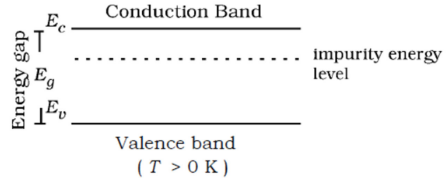
(iii) Semi-conductor related to given energy band diagram is:
n-type semi-conductor, p-type semi-conductor or intrinsic semiconductor.
Image
What is the de Broglie wavelength of:
  1. A bullet of mass $0.040 \ kg$ travelling at the speed of $1.0 \ km/s,$
  2. A ball of mass $0.060 \ kg$ moving at a speed of $1.0\ m/s,$ and
  3. A dust particle of mass $1.0 \times 10^{–9} \ kg$ drifting with a speed of $2.2\ m/s?$
(i) Determine the resonant frequency of series L-C-R circuit.
(ii) A charged $30 \mu F$ capacitor is connected to a 27mH inductor. Find the frequency of free oscillations of the circuit.