Question
Two long strings A and B, each having linear mass density $1.2 \times 10^{-2}kg/m$, are stretched by different tensions 4.8N and 7.5N respectively and are kept parallel to each other with their left ends at $x = 0$. Wave pulses are produced on the strings at the left ends at t = 0 on string A and at t = 20ms on string B. When and where will the pulse on B overtake that on A?
Answer

$\text{m}_\text{A}=1.2\times10^{-2}\text{kg/m},\ \text{T}_\text{A}=4.8\text{N}$$\Rightarrow\text{v}_\text{A}=\sqrt{\frac{\text{T}}{\text{m}}}=20\text{m/s}$
$\text{m}_\text{B}=1.2\times10^{-2}\text{kg/m},\ \text{T}_\text{B}=7.5\text{N}$
$\Rightarrow\text{V}_\text{B}=\sqrt{\frac{\text{T}}{\text{m}}}=25\text{m/s}$
$\text{t}=0$ in string A
$\text{t}_1=0+20\text{ms}=20\times10^{-3}=0.02\text{sec}$
In 0.02 sec A has travelled $20\times0.02=0.4\text{mt}$
Relative speed between A and B $=25-20=5\text{m/s}$
Time taken for B for overtake A $=\frac{\text{s}}{\text{v}}=\frac{0.4}{5}=0.08\text{sec}$

Need a full question paper?

Generate a complete, print-ready paper with questions like this in minutes — across 16+ boards, with answer keys.

Start Generating Free

Similar questions

Calculate the magnetic dipole moment corresponding to the motion of the electron in the ground state of a hydrogen atom.
Half life of $^{238}\text{U}_{92}$against$\alpha$ decay is $4.5 \times 10^{9}$years. Calculate the activity of Ig sample of$^{238}\text{U}_{92}$? Given Avogadro's number $= 6 \times 10^{26}$atoms/kmol.
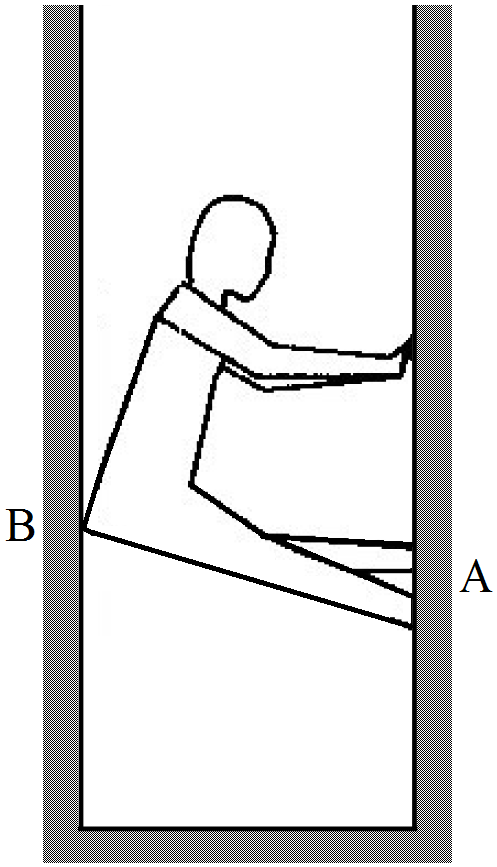
A person (40kg) is managing to be at rest between two vertical walls by pressing one wall A by his hands and feet and the other wall B by his back. Assume that the friction coefficient between his body and the walls is 0.8 and that limiting friction acts at all the contacts.
  1. Show that the person pushes the two walls with equal force.
  2. Find the normal force exerted by either wall on the person. Take $g = 10m/s^2.$
The magnetic intensity Hat the centre of a long solenoid carrying a current of 2.0A, is found to be 1500A/m. Find the number of turns per centimetre of the solenoid.
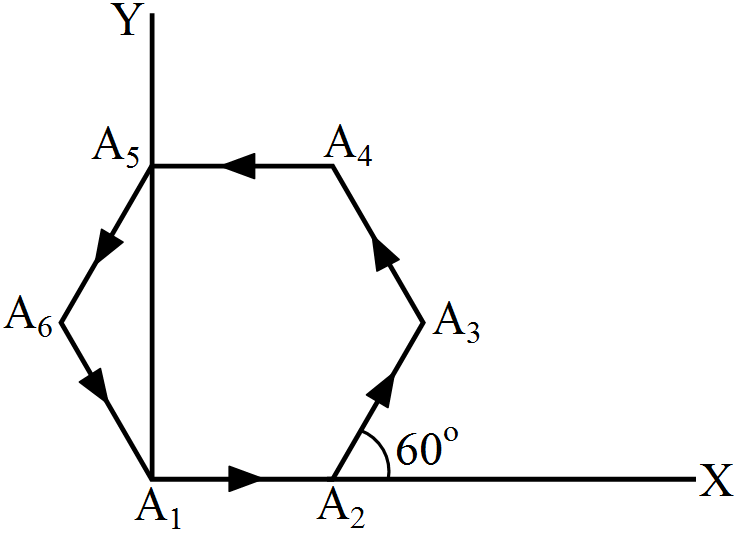
Let $A_1A_2A_3 A_4 A_5 A_6 A_1$ be a regular hexagon. Write the x-components of the vectors represented by the six sides taken in order. Use the fact that the resultant of these six vectors is zero, to prove that$\cos0+\cos\frac{\pi}{3}+\cos\frac{2\pi}{3}+\cos\frac{3\pi}{3}+\cos\frac{4\pi}{3}+\cos\frac{5\pi}{3}=0.$
Use the known cosine values to verify the result.
  1. For a given a.c.,$\text{i} = \text{i}_{m}\sin\omega\text{t},$ show that the average power dissipated in a resistor R over a complete cycle is $\frac{1}{2}\text{i}_{m}^{2}\text{R}.$
  2. A light bulb is rated at 100 W for a 220 V a.c. supply. Calculate the resistance of the bulb.
Consider a head-on collision between two particles of masses $m_1$ and $m_2$. The initial speeds of the particles are $u_1$ and $u_2$ in the same direction. The collision starts 2 at t = 0 and the particles interact for a time interval $\triangle\text{t}.$ During the collision, the speed of the first particle varies as.$\text{v}(\text{t})=\text{u}_1+\frac{\text{t}}{\triangle\text{t}}(\text{v}_1-\text{u}_1).$
Find the speed of the second particle as a function of time during the collision.
State two important properties of photon which are used to write Einstein's photoelectric equation. Define (i) Stopping potential and (ii) Threshold frequency, using Einstein's equation and drawing necessary plot between relevant quantities.
(a) Magnetic field lines show the direction (at every point) along which a small magnetised needle aligns (at the point). Do the magnetic field lines also represent the lines of force on a moving charged particle at every point?
(b) If magnetic monopoles existed, how would the Gauss's law of magnetism be modified?
(c) Does a bar magnet exert a torque on itself due to its own field? Does one element of a current-carrying wire exert a force on another element of the same wire?
(d) Magnetic field arises due to charges in motion. Can a system have magnetic moments even though its net charge is zero?
A spy report about a suspected car reads as follows. "The car moved 2.00km towards east, made a perpendicular left turn, ran for 500m, made a perpendicular right turn, ran for 4.00km and stopped". Find the displacement of the car.