State two important properties of photon which are used to write Einstein's photoelectric equation. Define (i) Stopping potential and (ii) Threshold frequency, using Einstein's equation and drawing necessary plot between relevant quantities.
CBSE OUTSIDE DELHI - SET 2 NORTH 2016
Download our app for free and get startedPlay store
Properties of Photon:
  1. For a radiation of frequency$\upsilon$, each photon has an energy, $\text{E} = \text{h}v,$ associated with it.
  2. The energy of a photon is independent of the intensity of incident radiation.
  3. During the collision of a photon, with an electron, the total energy of the photon gets absorbed by the electron.
Einstein’s photoelectric equation is,

$\text{K}_{max} = \text{hv} - \phi_{0}$

or $\text{eV}_{0} = \text{hv} -\phi_{0}$
  1. Stopping potential, $\text{V}_{0}$ equals that value of the negative potential for which
$|\text{eV}_{0}| =\text{K}_{max}$

Alternate Answer

(The stopping potential ($\text{V}_{0}$) equals that (least) value of the (negative) plate potential that just stops the most energetic emitted photoelectrons from reaching the plate.)
  1. Threshold frequency $(\vartheta_{o})$ equals that value of the frequency of incident radiation for which $\text{K}_{max} = 0 . $
Alternate Answer

(For a given photosensitive surface, its threshold frequency is the minimum value of the frequency of incident radiation for which photoelectrons can be just emitted from that surface or that maximum frequency of incident radiation below which no photo emission takes place.)

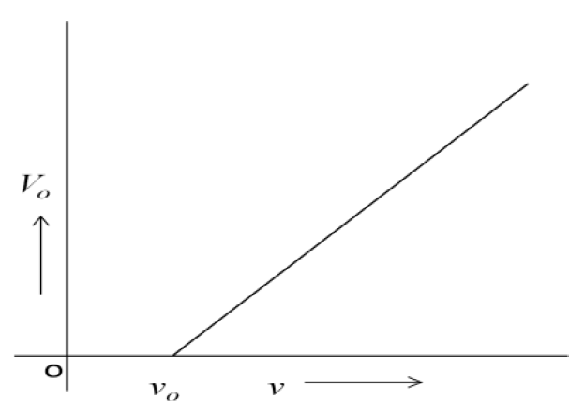
The plot, between $\text{V}_{0}$ and$\vartheta , $ , has the form shown:
art

Download our app
and get started for free

Experience the future of education. Simply download our apps or reach out to us for more information. Let's shape the future of learning together!No signup needed.*

Similar Questions

  • 1
    A thin metallic spherical shell of radius R carries a charge Q on its surface. A point charge Q/2 is placed at the centre C, and another charge + 2Q is placed outside the shell at A at a distance x from the centre as shown in the figure.
    1. Find the electric flux through the shell.
    2. State the law used.
    3. Find the force on the charges at the centre C of the shell and at the point A.
    View Solution
  • 2
    Compare and explain three distinguishing features observed in Young’s double slit interference pattern with those seen for a coherently illuminated single slit producing diffraction pattern.
    View Solution
  • 3
    Answer the following:
    1. In what way is diffraction from each slit related to the interference pattern in a double slit experiment?
    2. When a tiny circular obstacle is placed in the path of light from a distant source, a bright spot is seen at the centre of the shadow of the obstacle. Explain, why.
    3. How does the resolving power of a microscope depend on (i) the wavelength of the light used and (ii) the medium used between the object and the objective lens?
    View Solution
  • 4
    Explain why the reactance offered by an inductor increases with increasing frequency of an alternating voltage.
    View Solution
  • 5
    An AC voltage $V = V_m$​​​​​​​ is applied across a:
    1. Series RC circuit in which capacitive reactance is ‘a’ times the resistance in the circuit.
    2. Series RL circuit in which inductive reactance is ‘b’ times the resistance in the circuit.
    Find the value of power factor of the circuit in each case.
    View Solution
  • 6
    A network of four 10 $\mu$F capacitors is connected to a 500 V supply as shown in the figure. Determine the
    1. equivalent capacitance of the network and
    2. charge on each capacitor
    View Solution
  • 7
    Write symbolically the nuclear $\beta^{+}$decay process of $^{11}_{6}\text{C}$ . Is the decayed product X an isotope or isobar of $^{11}_{6}\text{C}$?
    Given the mass values m $(^{11}_{6}\text{C})$ = 11·011434 u and m (X) = 11·009305 u. Estimate the Q-value in this process.
    View Solution
  • 8
    Calculate the equivalent capacitance between points A and B in the circuit below. If a battery of 10 V is connected across A and B, calculate the charge drawn from the battery by the circuit.
    View Solution
  • 9
    A resistance R and a capacitor C are connected in series to a source $\text{V}=\text{V}_0\sin\omega\text{t}.$
    Find:
    1. The peak value of the voltage across the (i) resistance and (ii) capacitor.
    2. The phase difference between the applied voltage and current. Which of them is ahead?
    View Solution
  • 10
    In a series LCR circuit, $\text{R = 1k}\Omega,\text{C}=2\mu\text{F}$ and voltage across R is 100V. The resonant frequency of the circuit $\omega$ is 200 rad $s^{-1}$. Calculate the value of voltage across L at resonance.
    View Solution