Two masses ${m_1}$ and ${m_2}$ are suspended together by a massless spring of constant k. When the masses are in equilibrium, ${m_1}$ is removed without disturbing the system. Then the angular frequency of oscillation of ${m_2}$ is
Easy


Download our appand get started for free
Experience the future of education. Simply download our apps or reach out to us for more information. Let's shape the future of learning together!No signup needed.*
Similar Questions
- 1An object is attached to the bottom of a light vertical spring and set vibrating. The maximum speed of the object is $15\, cm/sec$ and the period is $628$ milli-seconds. The amplitude of the motion in centimeters isView Solution
- 2A particle executes $SHM$ of amplitude $25\, cm$ and time period $3\, s$. What is the minimum time required for the particle to move between two points $12.5\, cm$ on either side of the mean position ..... $\sec$View Solution
- 3When an oscillator completes $100$ oscillations its amplitude reduced to $\frac{1}{3}$ of initial value. What will be its amplitude, when it completes $200$ oscillations?View Solution
- 4A point mass oscillates along the x-axis according to the law $x=x_0cos$$\left( {\omega t - \frac{\pi }{4}} \right)$ If the acceleration of the particle is written as $a=Acos$$\left( {\omega t + \delta } \right)$ thenView Solution
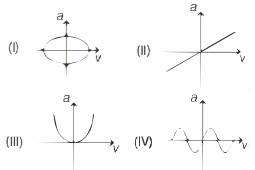
- 5If the speed $v$ of the bob in a simple pendulum is plotted against the tangential acceleration $a$, the correct graph will be represented byView Solution
- 6A body of mass $m $ is attached to the lower end of a spring whose upper end is fixed. The spring has negligible mass. When the mass $m$ is slightly pulled down and released , it oscillates with a time period of $3\,s$ . When the mass $m$ is increased by $1\,kg$ , the time period of oscillations becomes $5\,s$ . The value of $m$ in $kg$ isView Solution
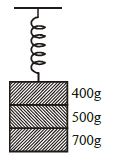
- 7Three mass and string system is in equilibrium. When $700\,gm$ mass is removed, then the system oscillates with a period of $3\,seconds$ . When the $500\,gm$ mass is also removed, then what will be new time period for system ..... $\sec$View Solution
- 8A disc of radius $R$ and mass $M$ is pivoted at the rim and is set for small oscillations. If simple pendulum has to have the same period as that of the disc, the length of the simple pendulum should beView Solution
- 9A simple pendulum has time period $T_1$. The point of suspension is now moved upward according to equation $y = k{t^2}$ where $k = 1\,m/se{c^2}$. If new time period is $T_2$ then ratio $\frac{{T_1^2}}{{T_2^2}}$ will beView Solution
- 10The metallic bob of a simple pendulum has the relative density $\rho$. The time period of this pendulum is $T$. If the metallic bob is immersed in water, then the new time period is given byView Solution