A particle executes $SHM$ of amplitude $25\, cm$ and time period $3\, s$. What is the minimum time required for the particle to move between two points $12.5\, cm$ on either side of the mean position ..... $\sec$
AIIMS 2010, Medium
Download our app for free and get started
$y=r \sin \omega t$
$12.5=25 \sin \frac{2 \pi}{3} \times t \quad\left(\because \omega=\frac{2 \pi}{\mathrm{T}}\right)$
$\frac{\pi}{6}=\frac{2 \pi}{3} t$
$t=\frac{1}{4} \sec =0.25 \mathrm{sec}$
$t^{\prime}=2 t$
$=2 \times 0.25=0.5 \mathrm{sec}$
for either side

Download our appand get started for free
Experience the future of education. Simply download our apps or reach out to us for more information. Let's shape the future of learning together!No signup needed.*
Similar Questions
- 1The equation of motion of a particle is $x = a\,cos (\alpha\, t)$ . The motion isView Solution
- 2A particle of mass $0.50 \mathrm{~kg}$ executes simple harmonic motion under force $\mathrm{F}=-50\left(\mathrm{Nm}^{-1}\right) \mathrm{x}$. The time period of oscillation is $\frac{x}{35} s$. The value of $x$ is . . . . .(Given $\pi=\frac{22}{7}$ )View Solution
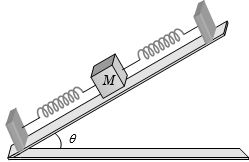
- 3On a smooth inclined plane, a body of mass $M$ is attached between two springs. The other ends of the springs are fixed to firm supports. If each spring has force constant $K$, the period of oscillation of the body (assuming the springs as massless) isView Solution
- 4Two particles are executing $SHM$ in a straight line. Amplitude $'A'$ and time period $'T'$ of both the particles are equal. At time $t = 0$ one particle is at displacement $x_1 = +A$ and other at ${x_2} = \frac{{ - A}}{2}$ and they are approaching towards each other. Time after which they will cross each other isView Solution
- 5A particle executes $S.H.M$ between $x =\, -A$ to $x =\, +A$ . The time taken for it in going from $0$ to $A/2$ is $T_1$ and from $A/2$ to $A$ is $T_2$. ThenView Solution
- 6A particle performs $S.H.M.$ of amplitude $A$ with angular frequency $\omega$ along a straight line. Whenit is at a distance $\frac{{\sqrt 3 }}{2}$ $A$ from mean position, its kinetic energy gets increased by an amount $\frac{1}{2}m{\omega ^2}{A^2}$ due to an impulsive force. Then its new amplitude becomesView Solution
- 7If $< E >$ and $< U >$ denote the average kinetic and the average potential energies respectively of mass describing a simple harmonic motion, over one period, then the correct relation isView Solution
- 8The total energy of particle performing $S.H.M.$ depend onView Solution
- 9A simple pendulum of frequency $f$ has a metal bob. If bob is charged negatively and is allowed to oscillate with large positive charged plate under it, frequency will beView Solution
- 10In a simple pendulum, the period of oscillation $T$ is related to length of the pendulum $l$ asView Solution