Question
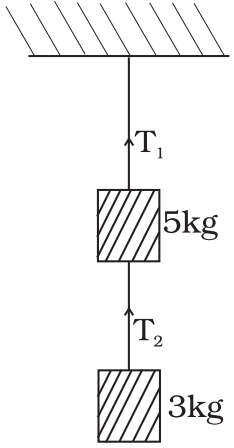
Two masses of $5kg$ and $3kg$ are suspended with help of massless inextensible strings as shown in Calculate $T_1$ and $T_2$ when whole system is going upwards with acceleration = $2m s^2$(use $g = 9.8m s^{–2}$).
Answer

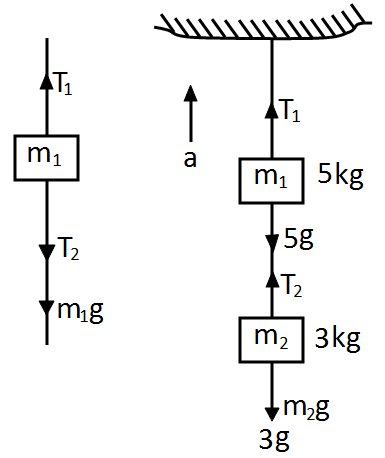
As the whole system is going up with acceleration = $a = 2ms-2\text{m}_1=5\text{kg}\ \text{m}_2=3\text{kg}\ \text{g}=9.8\text{m/ s}^2$

Tension in a string is equal and opposite in all parts of a string.
Forces on mass $m_1$
$\text{T}_1-\text{T}_2-\text{m}_1\text{g}=\text{m}_1\text{a}$
$\text{T}_1-\text{T}_2-5\text{g}+5\text{a}$
$\text{T}_1-\text{T}_2=5\text{g}+5\text{a}$
$\text{T}_1-\text{T}_2=5(9.8+2)$
$=5\times11.8$
$\text{T}_1-\text{T}_2=59.0\ \text{N}$
Forces on mass $m_2$
$\text{T}_2-\text{m}_2\text{g}=\text{m}_2\text{a}$
$\text{T}_2=\text{m}(\text{g}+\text{a})=3(9.8+2)=3\times11.8$
$\text{T}_2=35.4$
$\text{T}_1=\text{T}_2+59.0\Rightarrow\text{T}_1=53.4+59.0=94.4\ \text{N}$

Need a full question paper?

Generate a complete, print-ready paper with questions like this in minutes — across 16+ boards, with answer keys.

Start Generating Free

Similar questions

Considering the pressure p to be proportional to the density, find the pressure p at a height h if the pressure on the surface of the earth is $p_0$.
Use the formula $\text{v}=\sqrt{\frac{\gamma\text{P}}{\rho}}$ to explain why the speed of sound in air:
Increases with temperature,
A star $2.5$ times the mass of the sun and collapsed to a size of $12km$ rotates with a speed of $1.2$ rev. per second. (Extremely compact stars of this kind are known as neutron stars. Certain stellar objects called pulsars belong to this category). Will an object placed on its equator remain stuck to its surface due to gravity? (mass of the sun = $2 \times 10^{30}kg$).
A steel rod $100cm$ long is clamped at its middle. The fundamental frequency of longitudinal vibrations of the rod are given to be $2.53$ kHz. What is the speed of sound in steel?
Consider the Atwood machine of the previous problem. The larger mass is stopped for a moment $2.0s$ after the system is set into motion. Find the time elapsed before the string is tight again.
Figure shows a smooth track which consists of a straight inclined part of length $1$ joining smoothly with the circular part. A particle of mass $m$ is projected up the incline from its bottom.
  1. Find the minimum projection$-$speed $v_0$, for which the particle reaches the top of the track.
  2. Assuming that the projection$-$speed is $2v_0$ and that the block does not lose contact with the track before reaching its top, find the force acting on it when it reaches the top.
  3. Assuming that the projection$-$speed is only slightly greater than $v_0$, where will the block lose contact with the track?
Two ideal gas thermometers A and B use oxygen and hydrogen respectively. The following observations are made:
Temperature
Pressure thermometer A
Pressure thermometer B
Triple-point of water
$1.250 \times 10^5Pa$
$0.200 \times 10^5Pa$
Normal melting point of sulphur
$1.797 \times 10^5Pa$
$0.287 \times 10^5Pa$
What is the absolute temperature of normal melting point of sulphur as read by thermometers A and B?
What do you think is the reason behind the slight difference in answers of thermometers A and B? (The thermometers are not faulty). What further procedure is needed in the experiment to reduce the discrepancy between the two readings?
In Millikan's oil drop experiment, what is the terminal speed of an uncharged drop of radius $2.0 \times 10^{-5} \mathrm{~m}$ and density $1.2 \times 10^3 \mathrm{~kg} \mathrm{~m}^{-3}$. Take the viscosity of air at the temperature of the experiment to be $1.8 \times 10^{-5} \mathrm{Pas}$. How much is the viscous force on the drop at that speed? Neglect buoyancy of the drop due to air.
An insulated container containing monoatomic gas of molar mass m is moving with a velocity $v_0$. If the container is suddenly stopped, find the change in temperature.
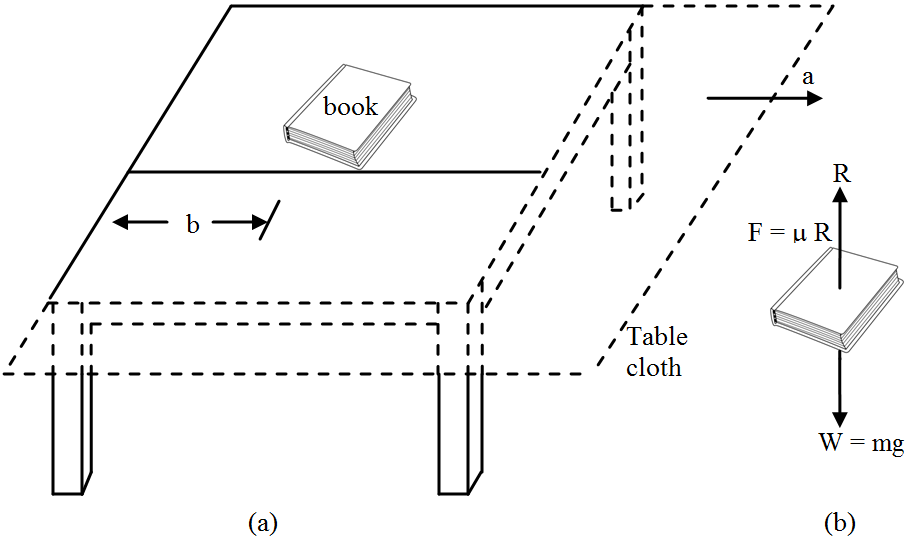
A book rests on a table cloth spread over a table as shown in Fig. The centre of the book is at a distance of b from the edge of the table at time t = 0; the table cloth is suddenly pulled at this instant with an acceleration a. Show that the cloth will slip from under the book if a > µ g, where u is the coefficient of sliding friction between the table cloth and the book. Assuming this condition to be satisfied. calculate:
  1. Time instant.
  2. The velocity.
  3. The distance of the centre of the book from the edge of the table when the edge of the table cloth passes over the centre of the book.