Question
Use the formula $\text{v}=\sqrt{\frac{\gamma\text{P}}{\rho}}$ to explain why the speed of sound in air:
Increases with temperature,

Answer

Take the relation:
$\text{v}=\sqrt{\frac{\gamma\text{P}}{\rho}}\ \dots(\text{i})$
or one mole of any ideal gas, the equation can be written as:
PV = RT
$\text{P}=\frac{\text{RT}}{\text{V}}\ \dots(\text{ii})$
Substituting equation (ii) in equation (i), we get:
$\text{v}=\sqrt{\frac{\gamma\text{RT}}{\text{VP}}}=\sqrt{\frac{\gamma\text{RT}}{\text{M}}}\ \dots(\text{iii})$
where,
mass, $\text{M}=\rho\text{V}$ is a constant
γ and R are also constants
We conclude from equation (iii) that $\text{v}\propto\sqrt{\text{T}}$
Hence, the speed of sound in a gas is directly proportional to the square root of the temperature of the gaseous medium, i.e., the speed of the sound increases with an increase in the temperature of the gaseous medium and vice versa.

Need a full question paper?

Generate a complete, print-ready paper with questions like this in minutes — across 16+ boards, with answer keys.
Start Generating Free

Similar questions

Two metre scales, one of steel and the other of aluminium, agree at $20^{\circ} \mathrm{C}$. Calculate the ratio aluminium-centimetre/ steel-centimetre at:
a. $0^{\circ} \mathrm{C}$,
b. $40^{\circ} \mathrm{C}$
c. $100 \mathrm{C} . \alpha$ for steel $=1.1 \times 10^{-5}{ }^{\circ} \mathrm{C}{ }^{-1}$ and for aluminium $=2.3 \times 10^{-5}{ }^{\circ} \mathrm{C}^{-1}$.
A metre scale made of steel reads accurately at $20^\circ C$. In a sensitive experiment, distances accurate up to $0.055mm$ in $1m$ are required. Find the range of temperature in which the experiment can be performed with this metre scale. Coefficient of linear expansion of steel = $11 \times {10}^{-6}{^\circ C}^{-1}$.
For the harmonic travelling wave $\text{y}=2\cos2\pi(10\text{t}-0.0080\text{x}+3.5)$ where x and y are in cm and t is second. What is the phase difference between the oscillatory motion at two points separated by a distance of:
What is the phase difference between the oscillation of a particle located at x = 100cm at t = T and t = 5s?
A voltmeter coil has resistance $50.0\Omega$ and a resistor of $1.15\text{k}\Omega$ is connected in series. It can read potential differences up to 12 volts. If this same coil is used to construct an ammeter that can measure currents up to 2.0A, what should be the resistance of the shunt used?
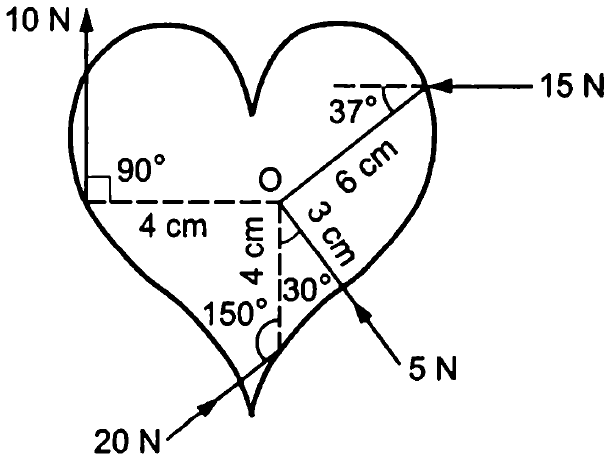
Calculate the total torque acting on the body shown in figure about the point O.
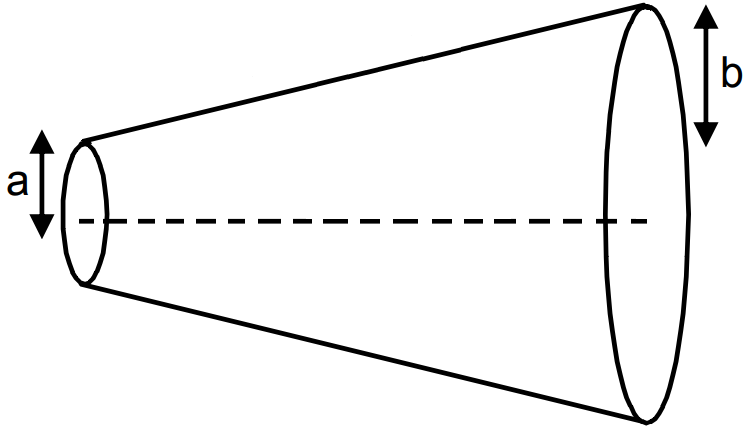
Figure. shows a conductor of length l with a circular cross-section. The radius of the cross-section varies linearly from a to b. The resistivity of the material is ρ. Assuming that b - a << l, find the resistance of the conductor.
Ten one-rupee coins are put on top of each other on a table. Each coin has a mass m. Give the magnitude and direction of:
  1. The force on the $7^{th}$ coin (counted from the bottom) due to all the coins on its top.
  2. The force on the $7^{th}$ coin by the eighth coin.
  3. The reaction of the 6th coin on the $7^{th}$ coin.
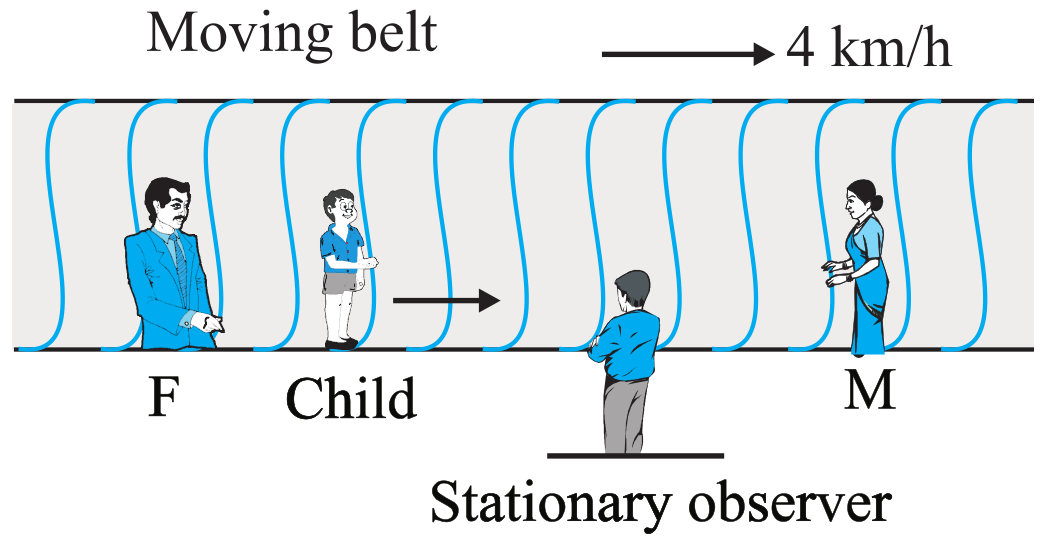
On a long horizontally moving belt a child runs to and fro with a speed $9\ km h^{–1} ($with respect to the belt$)$ between his father and mother located $50 m$ apart on the moving belt. The belt moves with a speed of $4\ km h^{–1}$. For an observer on a stationary platform outside, what is the
  1. speed of the child running in the direction of motion of the belt?.
  2. speed of the child running opposite to the direction of motion of the belt?
  3. time taken by the child in $(a)$ and $(b)?$
Which of the answers alter if motion is viewed by one of the parents?
The internal energy of a gas is given by $U=1.5 \mathrm{PV}$. It expands from $100 \mathrm{~cm}^3$ to $200 \mathrm{~cm}^3$ against a constant pressure of $1.0 \times 10^5 \mathrm{~Pa}$. Calculate the heat absorbed by the gas in the process.
Consider an ideal gas with following distribution of speeds.
Speed m/s
200
400
600
800
1000
% of molecules
10
20
40
20
10
Calculate $V_{rms}$ and hence T. $(m = 3.0 \times 10^{-26}kg)$