Two monoatomic ideal gases $1$ and $2$ of molecular masses $m_1$ and $m_2$ respectively are enclosed in separate containers kept at the same temperature. The ratio of the speed of sound in gas $1$ to that in gas $2$ is given by
IIT 2000, Easy
Download our app for free and get started
(b) Speed of sound in gases is given by
$v = \sqrt {\frac{{\gamma RT}}{M}} \Rightarrow v \propto \frac{1}{{\sqrt M }}$
==> $\frac{{{v_1}}}{{{v_2}}} = \sqrt {\frac{{{m_2}}}{{{m_1}}}} $

Download our appand get started for free
Experience the future of education. Simply download our apps or reach out to us for more information. Let's shape the future of learning together!No signup needed.*
Similar Questions
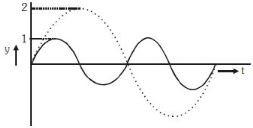
- 1Dependence of disturbances due to two waves on time is shown in the figure. The ratio of their intensities $I_1 / I_2$ will beView Solution
- 2A man, standing between two cliffs, claps his hands and starts hearing a series of echoes at intervals of one second. If the speed of sound in air is $340 ms^{-1}$, the distance between the cliffs is .... $m$View Solution
- 3The frequency of the sinusoidal wave $y = 0.40\cos [2000\,t + 0.80\,x]$ would beView Solution
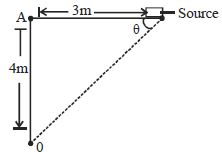
- 4A source of sound is travelling at $\frac{{100}}{3}\,m/\sec $ along a road, towards a point $A$, when the source is $3\, m$ away from $A$, a person standing at a point $O$ on a road at perpendicular position. The distance of $O$ from $A$ at that time is $4\,m$. If the original frequency is $640\, Hz$,then the value of apperent frequency listen by person is ...... $Hz$ (speed of sound is $340\, m/sec$)View Solution
- 5View SolutionIn a transverse wave, the particles of the medium:
- 6View SolutionWhat is the phase difference between two successive crests in the wave
- 7A string of length $1\,\,m$ and linear mass density $0.01\,\,kgm^{-1}$ is stretched to a tension of $100\,\,N.$ When both ends of the string are fixed, the three lowest frequencies for standing wave are $f_1, f_2$ and $f_3$. When only one end of the string is fixed, the three lowest frequencies for standing wave are $n_1, n_2$ and $n_3$. ThenView Solution
- 8A wave in a string has an amplitude of $2\,\, cm.$ The wave travels in the $+ve$ direction of $x-$ axis with a speed of $128\,\, m/s$ and it is noted that $5$ complete waves fit in $4\,\, m$ length of the string. The equation describing the wave isView Solution
- 9A wire of $10^{-2} kgm^{-1}$ passes over a frictionless light pulley fixed on the top of a frictionless inclined plane which makes an angle of $30^o$ with the horizontal. Masses $m$ and $M$ are tied at two ends of wire such that m rests on the plane and $M$ hangs freely vertically downwards. The entire system is in equilibrium and a transverse wave propagates along the wire with a velocity of $100 ms^{^{-1}}$.View Solution
- 10A source of sound $S$ is moving with the velocity of $50\,m/s$ towards a stationary observer. The observer measures the frequency of the sound as $1000\,Hz.$ What will be the apparent frequency of the source when it is moving away from the observer after crossing him ... $Hz$ ? (Take velocity of sound in air is $350\,m/s$ )View Solution