A string of length $1\,\,m$ and linear mass density $0.01\,\,kgm^{-1}$ is stretched to a tension of $100\,\,N.$ When both ends of the string are fixed, the three lowest frequencies for standing wave are $f_1, f_2$ and $f_3$. When only one end of the string is fixed, the three lowest frequencies for standing wave are $n_1, n_2$ and $n_3$. Then
Advanced
Download our app for free and get started
When both ends are fixed, the string forms a length half the wavelength. That is, it has two nodes at the ends. For the next frequency, it will have the length equals the wavelength. So, the general formula for length of the string becomes $L=n \lambda / 2$
For the string fixed on only one end, there is always an anti node at one end and a node at the other end. So, the length of the string gets divided into $1 / 4 t h$ of the wavelength $(\lambda) .$ The general formula for the length of the string is $L^{\prime}=n \lambda / 4$
The frequency $f$ becomes $V / \lambda, V$ is the velocity. In the first case, frequency $f=n V / 2 L$ $n=1,2,3, \dots$
In the second case, it is $n V / 4 L, \quad n=1,3,5,7 \ldots \ldots$ because of the length of the string will always have a half wave present. This makes $n$ an odd number.
For the first case$:$
$f_{1}=1 / 2 L(\sqrt{(T / \mu)})=50 H z=V / 2 \times L$
$f_{2}=2 \times f_{1}=100 H z=V / L$
$f 3=3 \times f_{1}=150 H z=3 V / 2 \times L$
Second case$:$
$n_{1}=V / 4 L$
$n_{2}=3 V / 4 L=\left(f-1+f_{2}\right) / 2=(100+50) / 2=75 H z$

Download our appand get started for free
Experience the future of education. Simply download our apps or reach out to us for more information. Let's shape the future of learning together!No signup needed.*
Similar Questions
- 1A wave travels uniformly in all directions from a point source in an isotropic medium. The displacement of the medium at any point at a distance $r$ from the source may be represented by ($A$ is a constant representing strength of source)View Solution
- 2A whistle sends out $256$ waves in a second. If the whistle approaches the observer with velocity $\frac{1}{3}$ of the velocity of sound in air, the number of waves per second the observer will receiveView Solution
- 3A bat moving at $10\,ms^{-1}$ towards a wall sends a sound signal of $8000\,Hz$ towards it. On reflection it hears a sound of frequency $f$. The value of $f$ in $Hz$ is close to (speed of sound $= 320\,ms^{-1}$ )View Solution
- 4Two uniform strings $A$ and $B$ made of steel are made to vibrate under the same tension. if the first overtone of $ A$ is equal to the second overtone of $B$ and if the radius of $A$ is twice that of $B,$ the ratio of the lengths of the strings isView Solution
- 5Two closed organ pipes, when sounded simultaneously gave $4$ beats per sec. If longer pipe has a length of $1m$. Then length of shorter pipe will be, ... $cm$ $(v = 300 m/s)$View Solution
- 6A hollow pipe of length $0.8 \mathrm{~m}$ is closed at one end. At its open end a $0.5 \mathrm{~m}$ long uniform string is vibrating in its second harmonic and it resonates with the fundamental frequency of the pipe. If the tension in the wire is $50 \mathrm{~N}$ and the speed of sound is $320 \mathrm{~ms}^{-1}$, the mass of the string isView Solution
- 7View SolutionIn a simple harmonic wave, minimum distance between particles in same phase always having same speed, is ..........
- 8A transverse wave is represented by the equation $y = {y_0}\sin \frac{{2\pi }}{\lambda }(vt - x)$ For what value of $\lambda$, the maximum particle velocity equal to two times the wave velocityView Solution
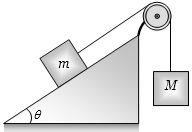
- 9A wire of $9.8 \times {10^{ - 3}}kg{m^{ - 1}}$ passes over a frictionless light pulley fixed on the top of a frictionless inclined plane which makes an angle of $30°$ with the horizontal. Masses $m$ and $M$ are tied at the two ends of wire such that $m$ rests on the plane and $M$ hangs freely vertically downwards. The entire system is in equilibrium and a transverse wave propagates along the wire with a velocity of $100 ms^{-1}$. Chose the correct option $m =$ ..... $kg$View Solution
- 10Three coherent waves of equal frequencies having amplitude $10 \,\, \mu m$, $4\,\,\mu m$ and $7 \,\,\mu m$ respectively, arrive at a given point with successive phase difference of $\pi /2$. The amplitude of the resulting wave in $mm$ is given byView Solution