Two monoatomic ideal gases $1$ and $2$ of molecular masses $m_1$ and $m_2$ respectively are enclosed in separate containers kept at the same temperature. The ratio of the speed of sound in gas $1$ to that in gas $2$ is given by
IIT 2000, Easy


Download our appand get started for free
Experience the future of education. Simply download our apps or reach out to us for more information. Let's shape the future of learning together!No signup needed.*
Similar Questions
- 1A plane wave of sound traveling in air is incident upon a plane surface of a liquid. The angle of incidence is $60^o.$ The speed of sound in air is $300 \,m /s$ and in the liquid it is $600\, m /s .$ Assume Snell’s law to be valid for sound waves.View Solution
- 2A tuning fork of frequency $512\, Hz$ makes $4$ beats per second with the vibrating string of a piano. The beat frequency decreases to $2$ beats per sec when the tension in the piano string is slightly increased. The frequency of the piano string before increasing the tension was .... $Hz$View Solution
- 3A wave represented by the given equation $y = a\cos (kx - \omega \,t)$ is superposed with another wave to form a stationary wave such that the point $x = 0$ is a node. The equation for the other wave isView Solution
- 4A transverse harmonic wave on a string is given by $y(x, t)=5 \sin (6 t+0.003 x)$ where $x$ and $y$ are in $cm$ and $t$ in $sec$. The wave velocity is $...........\,ms ^{-1}$.View Solution
- 5A Siren emitting sound of frequency $800 \;Hz$ is going away from a static listener with a speed of $30\; m/s$, frequency of the sound to be heard by the listener is... $Hz$ (take velocity of sound as $330 \;m/s$)View Solution
- 6$Assertion :$ When a beetle moves along the sand within a few tens of centimeters of a sand scorpion, the scorpion immediately turns towards the beetle and dashes towards itView Solution
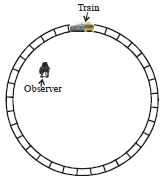
$Reason :$ When a beetle disturbs the sand, it sends pulses along the sand's surface. One set of pulses is longitudinal while the other set is transverse. - 7An engine is moving with uniform speed along a circular track emitting a sound of frequency $400\, Hz$ as shown in the figure. Speed of engine is $30\, m/sec$ and speed of sound is $330\, m/sec$. An observer is standing inside the track. Maximum frequency observed by the observer isView Solution
- 8View SolutionWhich of the following do not require medium for transmission
- 9The equation $y = 0.15\sin 5x\cos 300t$, describes a stationary wave. The wavelength of the stationary wave is .... $m$View Solution
- 10In the standing wave shown, particles at the positions $A$ and $B$ have a phase difference ofView Solution