MCQ
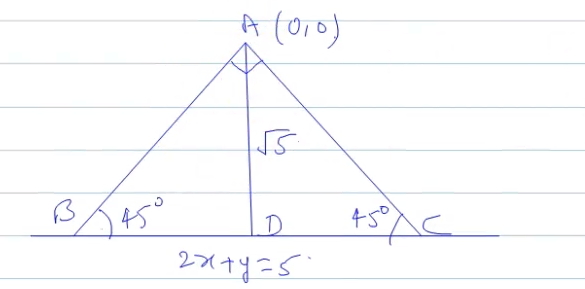
Two mutually perpendicular straight lines through the origin from an isosceles triangle with the line $2x + y = 5$ . Then the area of the triangle is :
  • $5$
  • B
    $3$
  • C
    $2.5$
  • D
    $1$

Answer

Correct option: A.
$5$
a
$A D=\left|\frac{0+0-5}{\sqrt{(2)^{2}+(1)^{2}}}\right| \Rightarrow \frac{5}{\sqrt{5}} \Rightarrow \sqrt{5}$

$In$ triangle $A B D$

$\tan 45^{\circ}=\frac{A D}{B D} \Rightarrow \frac{\sqrt{5}}{B D}=1$

$B D=\sqrt{5}$

$DC=\sqrt{5}$

$BC=2 \sqrt{5}$

Area of $\Delta A B C=\frac{1}{2} \times B C \times A D \Rightarrow \frac{1}{2} \times 2 \sqrt{5} \times \sqrt{5}$$=5$
 

Need a full question paper?

Generate a complete, print-ready paper with questions like this in minutes — across 16+ boards, with answer keys.

Start Generating Free

Similar questions

Exact set of values of $a$ for which ${x^3}(x + 1) = 2(x + a)(x + 2a)$ is having four real solutions is
The number of distinct solutions of the equation $\frac{5}{4} \cos ^2 2 x+\cos ^4 x+\sin ^4 x+\cos ^6 x+\sin ^6 x=2$ in the interval $[0,2 \pi]$ is
If $PQ$ is a double ordinate of the hyperbola $\frac{{{x^2}}}{{{a^2}}} - \frac{{{y^2}}}{{{b^2}}} = 1$ such that $OPQ$ is an equilateral triangle, $O$ being the center of the hyperbola. then the $'e'$ eccentricity of the hyperbola, satisfies
If $\tan \theta = t,$ then $\tan 2\theta + \sec 2\theta = $
The equation formed by decreasing each root of $a{x^2} + bx + c = 0$ by $1$ is $2{x^2} + 8x + 2 = 0,$ then
Choose the correct answers:
If $f(x) = ax + b,$ where $a$ and $b$ are integers, $f(–1) = –5$ and $f(3) = 3,$ then $a$ and $b$ are equal to.
Suppose $A B C D E F$ is a hexagon such that $A B=B C=C D=1$ and $D E=E F=F A=2$. If the vertices $A, B, C, D, E, F$ are concyclic, the radius of the circle passing through them is
If $\alpha $ is the interior angle of a regular octagon, then $\mathop {\lim }\limits_{\theta  \to {\alpha ^ + }} \frac{{\tan \theta  - 1}}{{\left[ {\sin \theta  + \cos \theta } \right]}}$ is equal to (Note : $[k]$ denotes greatest integer less than or equal to $k$ )
Let $A = \{1, 2, 3\}, B = \{1, 3, 5\}.$ If relation $R$ from $A$ to $B$ is given by $= \{(1, 3), (2, 5), (3, 3)\},$ Then $R^{-1}$ is:
$\mathop {\lim }\limits_{x \to 0} \frac{{{{(1 + x)}^{1/2}} - {{(1 - x)}^{1/2}}}}{x} = $