Question
Two objects A and B are thrown upward simultaneously with the same speed. The mass of A is greater than the mass of B. Suppose the air exerts a constant and equal force of resistance on the two bodies:
  1. The two bodies will reach the same height.
  2. A will go higher than B.
  3. B will go higher than A.
  4. Any of the above three may happen depending on the speed with which the objects are thrown.
Answer

  1. A will go higher than B.

Explanation:

Let the air exert a constant resistance force = F (in downward direction).

Acceleration of particle A in downward direction due to air resistance, $\text{a}_{\text{A}}=\frac{\text{F}}{\text{m}_{\text{A}}}.$

Acceleration of particle B in downward direction due to air resistance, $\text{a}_{\text{B}}=\frac{\text{F}}{\text{m}_{\text{B}}}.$

$\text{m}_{\text{A}}>\text{m}_{\text{B}}$

$\text{a}_{\text{A}}<\text{a}_{\text{B}}$

$\text{S = us}+\frac{1}2{}\text{at}^2$

So, $\text{H}_{\text{A}}=\text{ut}-\frac{1}{2}\big(\text{a}_{\text{A}}+\text{g}\big)\text{t}^2$

$\text{H}_{\text{B}}=\text{ut}-\frac{1}{2}\big(\text{a}_{\text{B}}+\text{g}\big)\text{t}^2$

$\text{H}_{\text{A}}>\text{H}_{\text{B}}$

Therefore, A will go higher than B.

Need a full question paper?

Generate a complete, print-ready paper with questions like this in minutes — across 16+ boards, with answer keys.

Start Generating Free

Similar questions

Ram is a  student of class X in a village school. His uncle gifted him a bicycle with a dynamo fitted in it. He was very excited to get it. While cycling during night, he could light the bulb and see the objects on the road. He however, did not know this device works. He asked this question to his teacher. the teacher considered it an opportunity to explain the working to the whole class.
Answer the following question:
  1. State the principle and working of a dynamo.
  2. Write two values each displayed by Ram and his school teacher.
A circular loop of string rotates about its axis on a frictionless horizontal plane at a uniform rate so that the tangential speed of any particle of the string is v. If a small transverse disturbance is produced at. a point of the loop, with what speed (relative to the string) will this disturbance travel on the string?
Show that the first few frequencies of light that is emitted when electrons fall to the nth level from levels higher than n, are approximate harmonics (i.e. in the ratio 1 : 2: 3...) when n > > 1.
Two friends A and B (each weighing 40kg) are sitting on a frictionless platform some distance d apart. A rolls a ball of mass 4kg on the platform towards B which B catches. Then B rolls the ball towards A and A catches it. The ball keeps on moving back and forth between A and B. The ball has a fixed speed of 5m/s on the platform.
  1. Find the speed of A after he rolls the ball for the first time.
  2. Find the speed of A after he catches the ball for the first time.
  3. Find the speeds of A and B after the ball has made 5 round trips and is held by A.
  4. How many times can A roll the ball?
  5. Where is the centre of mass of the system ''A + B + ball'' at the end of the nth trip?
The work function of caesium metal is 2.14 eV. When light of frequency 6 × 1014 Hz is incident on the metal surface, photoemission of electrons occurs. What is the
  1. Maximum kinetic energy of the emitted electrons,
  2. Stopping potential, and
  3. Maximum speed of the emitted photoelectrons?
  1. With the help of a diagram, explain the principle and working of a moving coil galvanometer.
  2. What is the importance of a radial magnetic field and how is it produced?
  3. Why is it that while using a moving coil galvanometer as a voltmeter a high resistance in series is required whereas in an ammeter a shunt is used?
A particle slides on the surface of a fixed smooth sphere starting from the topmost point. Find the angle rotated by the radius through the particle, when it leaves contact with the sphere.
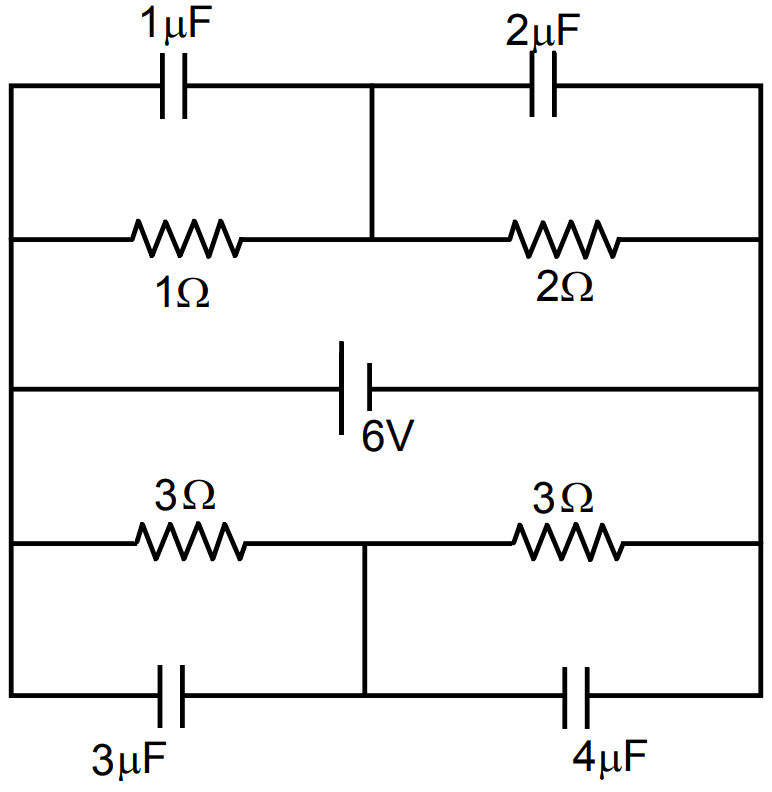
Find the charges on the four capacitors of capacitances $1\mu\text{F},2\mu\text{F},3\mu\text{F}$ and $4\mu\text{F}$ shown in the figure.

Derive Snell's law for refraction of light by Huygen's wave theory.
The gravitational pontential in a region is given by V = (20N/kg) (x + y).
  1. Show that the equation is dimensionally correct.
  2. Find the gravitational field at the point (x, y). Leave your answer in terms of the unit vectors $\overrightarrow{\text{i}},\ \overrightarrow{\text{j}},\ \overrightarrow{\text{k}}.$
  3. Calculate the magnitude of the gravitational force on a particle of mass 500g placed at the origin.