Question
Two open tubes, whose length are 50 cm and 50.05 cm respectively. 10 beats are produced in 3 seconds. Find their fundamental frequencies.

Answer

Frequency of open tube
$\begin{aligned} n & =\frac{ v }{2 l} \\ v & \rightarrow \text { speed of sound } \\ l & \rightarrow \text { length of tube } \\ n_1 & =\frac{ v }{2 l_1}\ldots\ldots (1) \\ n_2 & =\frac{ v }{2 l_2}\ldots\ldots (2)\end{aligned}$
Given:
$\begin{aligned}n_1-n_2 & =\frac{10}{3} \\l_1 & =50 cm \\l_2 & =50.5 cm \\n_1-n_2 & =\frac{v}{2 l_1} \times \frac{v}{2 l_2} \\& =\frac{v}{2}\left[\frac{l_2-l_1}{l_1 l_2}\right] \\ \frac{10}{3} & =\frac{v}{2}\left[\frac{50.5-50}{50 \times 50.5}\right] \\\frac{10}{3} & =\frac{v}{2}\left[\frac{0.5}{2525}\right] \\\text { or } \quad v & =\frac{50500}{1.5}\end{aligned}$
$\begin{array}{l}=336.66 cm / s \\=336.66 m / \text { second }
\end{array}$
Put value in eqn. (1) and (2)
$\begin{array}{l}n_1=\frac{v}{2 l_1}=\frac{336.66}{2 \times 0.50} \\n_1=336.66 \cong 337 \text { vibration/sec. }\end{array}$
Similarly,
$\begin{array}{l}n_2=\frac{v}{2 l_2}=\frac{336.66}{2 \times 50.5 \times 10^{-2}} \\n_2=333 \text { vibration } / \text { second. }\end{array}$

Need a full question paper?

Generate a complete, print-ready paper with questions like this in minutes — across 16+ boards, with answer keys.
Start Generating Free

Similar questions

Two balls of different masses are thrown vertically upwards with same initial speed. Which one will rise to the greater height? Which of the two will come back with greater speed to the point of projection?
The count rate from a radioactive sample falls from $4.0 \times 10^6$ per second to $1.0 \times 10^6$ per second in 20 hours. What will be the count rate 100 hours after the beginning?
The velocity of sound $v$ in the air depends on the air pressure, P and density of air $d$. Establish the possible formula by dimensional method :
$
v= K \sqrt{\frac{ P }{d}}
$
A uniform tube closed at one end, contains a pellet of mercury $10cm$ long. When the tube is kept vertically with the closed-end upward, the length of the air column trapped is $20cm$. Find the length of the air column trapped when the tube is inverted so that the closedend goes down. Atmospheric pressure = $75cm$ of mercury.
A body of mass M at rest is struck by a moving body of mass m. Show that the fraction of the initial kinetic energy of moving mass m transferred to the struck body is $4Mm /(m + M)^2.$
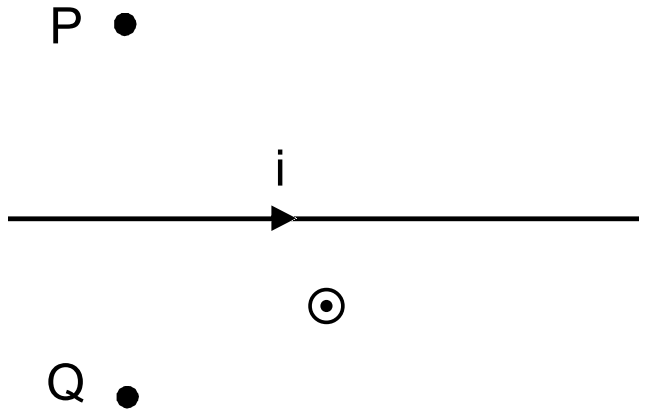
A long, straight wire carrying a current of 1.0A is placed horizontally in a uniform magnetic field B = $1.0 \times 10^{-5}T$ pointing vertically upward figure. Find the magnitude of the resultant magnetic field at the points Pand Q, both situated at a distance of 2.0cm from the wire in the same horizontal plane.
How many astronomical units (A.U.) make 1 parsec?
How does the velocity-time graph for uniform motion give a geometrical way of calculating the displacement covered during a given time t?
Define a uniform circular motion. For uniform circular motion, prove that: Linear velocity $\text{v}=\text{r}\omega.$
In one-dimensional elastic collision of equal masses, the velocities are interchanged. Can velocities in a onedimensional collision be interchanged if the masses are not equal?