MCQ
Two opposite and equal charges $4 ×10^{-8}$ coulomb when placed $2\times 10^{-2}$ cm away, form a dipole. If this dipole is placed in an external electric field $4 ×10^{8}$ newton/coulomb, the value of maximum torque and the work done in rotating it through 180° will be
  • A
    $64 \times 10^{-4}Nm$ and $64 \times 10^{-4}J$
  • B
    $32 \times 10^{-4}Nm $ and $32 \times 10^{-4}J$
  • C
    $ 64 \times 10^{-4}Nm$ and $32 \times 10^{-4}J$
  • $32 \times 10^{-4}Nm $ and $ 64 \times 10^{-4}J$
Answer

Correct option: D.
$32 \times 10^{-4}Nm $ and $ 64 \times 10^{-4}J$
(d) $32 \times 10^{-4}Nm$ and $ 64 \times 10^{-4}J$

Need a full question paper?

Generate a complete, print-ready paper with questions like this in minutes — across 16+ boards, with answer keys.

Start Generating Free

Similar questions

In the Young's double slit experiment, if the phase difference between the two waves interfering at a point is $\varnothing$, the intensity at that point can be expressed by the expression (Where $A$ and $B$ depend upon the amplitudes of the two waves)
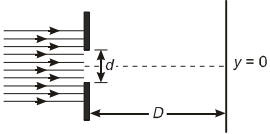
In an experiment, electrons are made to pass through a narrow slit of width '$d$' comparable to their de Broglie wavelength. They are detected on a screen at a distance '$D$' from the slit (see figure).

Which of the following graphs can be expected to represent the number of electrons '$N$' detected as a function of the detector position '$y$'($y = 0$ corresponds to the middle of the slit)

A long cylindrical shell carries positive surface charge $\sigma$ in the upper half and negative surface charge $-\sigma$ in the lower half. The electric field lines around the cylinder will look like figure given in : (figures are schematic and not drawn to scale)
The distance between the two charges 25μC and 36μC is 11 cm At what point on the line joining the two, the intensity will be zero
The amplitude modulated $(AM)$ radio wave bends appreciably round the corners of a $1m \times 1m$ board but the frequency modulated $(FM)$ wave only negligibly bends. If the average wavelengths of $AM$ and $FM$ waves are $\lambda_\text{a}$ and $\lambda_\text{f}:$
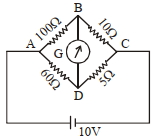
The four arms of a Wheatstone bridge have resistances as shown in the figure. A  galvanometer of $15\, \Omega$ resistance is connected across $BD$. Calculate the current through the galvanometer when a potential difference of $10\, V$ is maintained across $AC.$
In a Frank-hertz experiment, an electron of energy $5.6\,eV$ passes through mercury vapour and emerges with an energy $0.7\,eV.$ The minimum wavelength of photons emitted by mercury atoms is close to ............. $nm$
In terms of Rydberg's constant $R,$ the wave number of the first Balmer line is
Two resistors $R$ and $2R$ are connected in series in an electric circuit. The thermal energy developed in $R$ and $2R$ are in the ratio :
The power of a biconvex lens is $10$ dioptre and the radius of curvature of each surface is $10 \;cm$. Then the refractive index of the material of the lens is,