Question
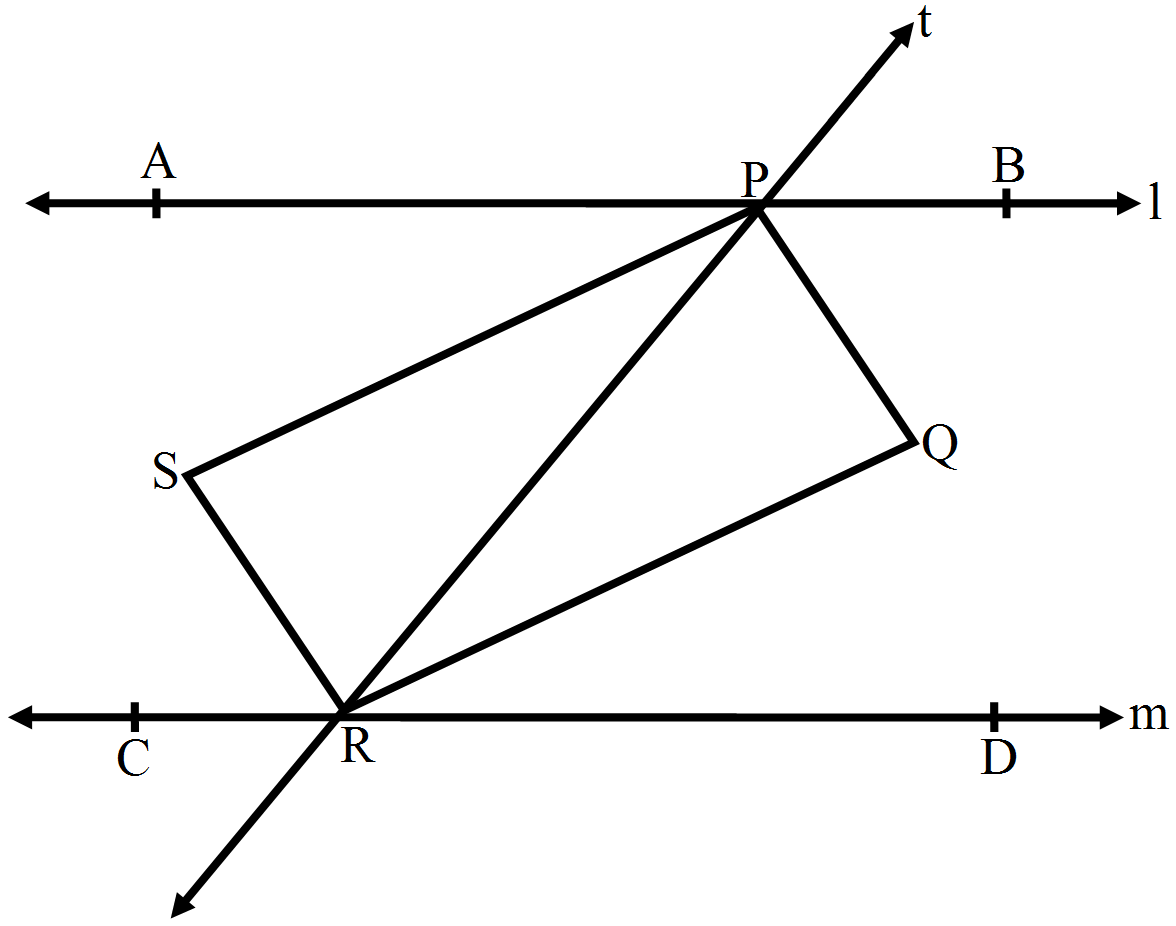
Two parallel lines l and m are intersected by a transversal t. Show that the quadrilateral formed by the bisectors of interior angles is a rectangle.
Answer

l || m and t is a transversal.$\Rightarrow\angle\text{APR}=\angle\text{PRD}$ (alternate angles)
$\Rightarrow\frac{1}{2}\angle\text{APR}=\frac{1}{2}\angle\text{PRD}$
$\Rightarrow\angle\text{SPR}=\angle\text{PRQ}$ (PS and RQ are the bisectors of $\angle\text{APR}$ and $\angle\text{PRD}$)
Thus, PR intersects PS and RQ at P and R respectively such that $\angle\text{SPR}=\angle\text{PRQ}$ i.e., alternate angles are equal.$\Rightarrow\text{PS || RQ}$
Similarly, we have $\text{SR ∥ PQ.}$ Hence, PQRS is a parallelogram. Now, $\angle\text{BPR}+\angle\text{PRD}=180^{\circ}$ (interior angles are supplementary)$\Rightarrow2\angle\text{QPR}+2\angle\text{QRP}=180^{\circ}$ (PQ and RQ are the bisectors of $\angle\text{BPR}$ and $\angle\text{PRD}$)
$\Rightarrow\angle\text{QPR}+\angle\text{QRP}=90^{\circ}$
In $\triangle\text{PQR},$ by angle sum property,$\angle\text{PQR}+\angle\text{QPR}+\angle\text{QRP}=180^{\circ}$
$\Rightarrow\angle\text{PQR}+90^{\circ}=180^{\circ}$
$\Rightarrow\angle\text{PQR}=90^{\circ}$
Since PQRS is a parallelogram,$\angle\text{PQR}=\angle\text{PSR}$
$\Rightarrow\angle\text{PSR}=90^{\circ}$
Now, $\angle\text{SPQ}+\angle\text{PQR}=180^{\circ}$ (adjacent angles in a parallelogram are supplementary)$\Rightarrow\angle\text{SPQ}+90^{\circ}=180^{\circ}$
$\Rightarrow\angle\text{SPQ}=90^{\circ}$
$\Rightarrow\angle\text{SRQ}=90^{\circ}$
Thus, all the interior angles of quadrilateral PQRS are right angles. Hence, PQRS is a rectangle.

Need a full question paper?

Generate a complete, print-ready paper with questions like this in minutes — across 16+ boards, with answer keys.
Start Generating Free

Similar questions

Draw the graphs of the following equations on the same system of co-ordinates. Write the co-ordinates of their points of intersection.
x + 4 = 0,
y – 1 = 0,
2x + 3 = 0,
3y – 15 = 0
Which number should be subtracted from 12, 16 and 21 so that resultant numbers are in continued proportion?
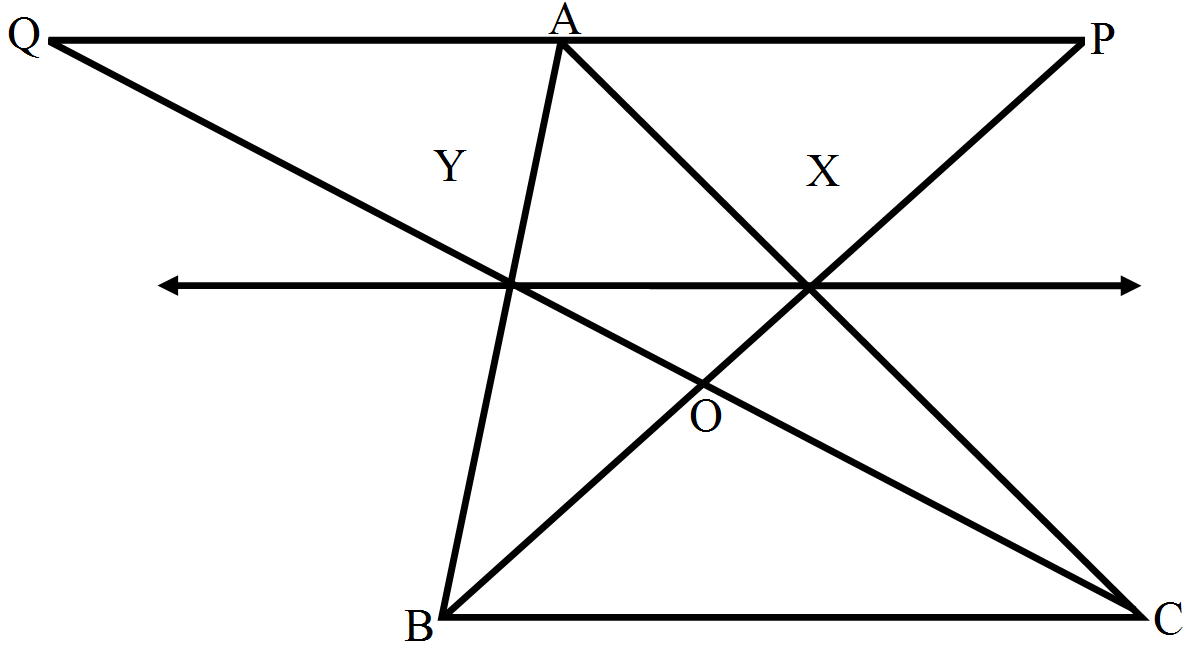
In figure, X and Y are the mid points of AC and AB respectively, QP || BC and CYQ and BXP are straight lines. Prove that $\text{ar}(\triangle\text{ABP})=\text{ar}(\triangle\text{ACQ}).$
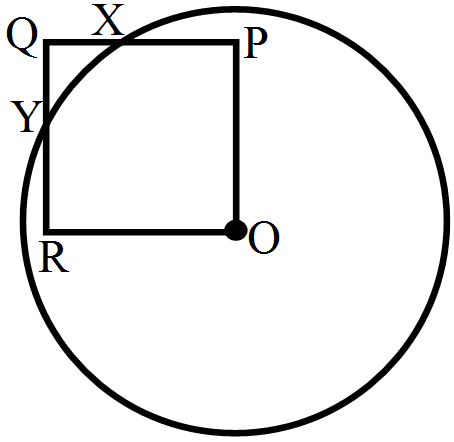
In the adjoining figure, OPQR is a square. A circle drawn with centre O cuts the square at X and Y. Prove that QX = QY.
Mr. Manohar gave 20% of his income to his elder son and 30% to his younger son. He gave 10% of the balance income as donation to a school. He still had ₹ 1,80,000 for himself. What was Mr. Manohar’s income ?
In ∆ABC, the measure of ∠A is equal to the sum of the measures of ∠B and ∠C. Also the ratio of measures of ∠B and ∠C is 4 : 5. Then find the measures of angles of the triangle.
A two digit number is 3 more than 4 times the sum of its digits. If 18 is added to this number, the sum is equal to the number obtained by interchanging the digits. Find the number.
Solve : $\frac{5 y^2+40 y-12}{5 y+10 y^2-4}=\frac{y+8}{1+2 y}$
Divide each of the following polynomials by synthetic division method and also by linear division method. Write the quotient and the remainder : $(2m^2 – 3m + 10) ÷ (m – 5)$
If an angle of a parallelogram is four-fifths of its adjacent angle, find the angles of the parallelogram.