Questions

5 Mark Question

Take a timed test

31 questions · self-marked practice — reveal the answer and mark yourself.

Question 15 Marks
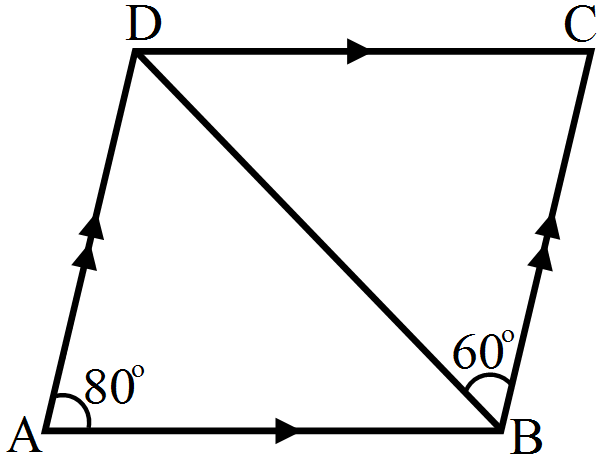
In the adjoining figure, ABCD is a parallelogram in which $\angle\text{DAB}=80^{\circ}$ and $\angle\text{DBC}=60^{\circ}.$ Calculate $\angle\text{CDB}$ and $\angle\text{ADB}.$
Answer
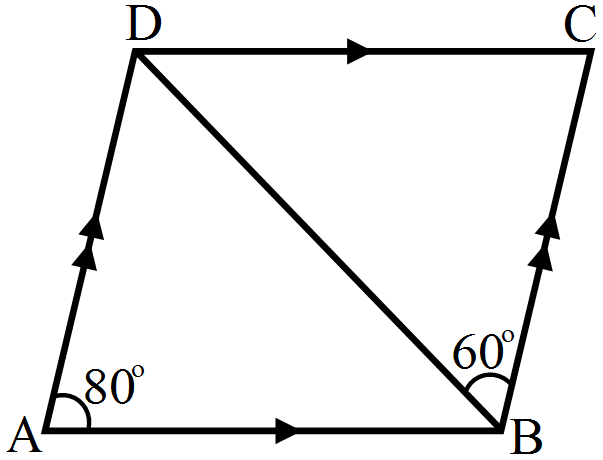
ABCD is a parallelogram, so opposite angles are equal.$\therefore\angle\text{C}=\angle\text{A}=80^{\circ}$
As AD || BC and BD is a transversal. So, $\angle\text{ADB}=\angle\text{DBC}=60^{\circ}$ [Alternate angles] In $\triangle\text{ABD}$$\angle\text{A}+\angle\text{ADB}+\angle\text{ABD}=180^{\circ}$
$\Rightarrow80^{\circ}+60^{\circ}+\angle\text{ABD}=180^{\circ}$
$\Rightarrow140^{\circ}+\angle\text{ABD}=180^{\circ}$
$\Rightarrow\angle\text{ABD}=180^{\circ}-140^{\circ}=40^{\circ}$
$\therefore\angle\text{ABC}=\angle\text{ABD}+\angle\text{DBC}$
$=40^{\circ}+60^{\circ}=100^{\circ}$
In a parallelogarm, opposite angles are equal. So, $\angle\text{ADC}=\angle\text{ABC}=\angle100^{\circ}$$\therefore\angle\text{CDB}=\angle\text{ADC}-\angle\text{ADB}$
$=100^{\circ}-60^{\circ}=40^{\circ}$
and $\angle\text{ADB}=60^{\circ}.$
View full question & answer
Question 25 Marks
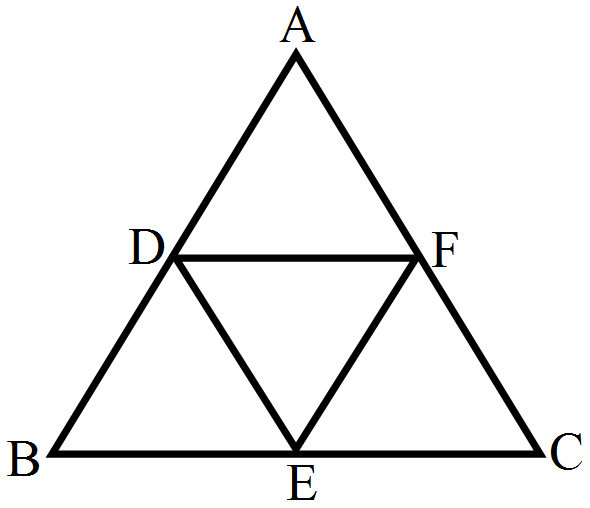
Prove that the line segments joining the middle points of the sides of a triangle divide it into four congruent triangles.
Answer
$\triangle\text{ABC}$ is shown below. D, E and F are the midpoints of sides AB, BC and CA, respectively.
As, D and Eare the mid points of sides AB, and BC of $\triangle\text{ABC}.$
$\therefore$ DE || AC (By midpoint theorem)
Similarly, DF || BC and EF || AB.
Therefore, ADEF, BDFE and DFCE are all parallelograms.
Now, DE is the diagonal of the parallelogram BDFE.
$\therefore\triangle\text{BDE}\cong\triangle\text{FED}$
Similarly, DF is the diagonal of the parallelogram ADEF.
$\therefore\triangle\text{DAF}\cong\triangle\text{FED}$
And, EF is the diagonal of the parallelogram DFCE.
$\therefore\triangle\text{EFC}\cong\triangle\text{FED}$
So, all the four triangles are congruent.
View full question & answer
Question 35 Marks
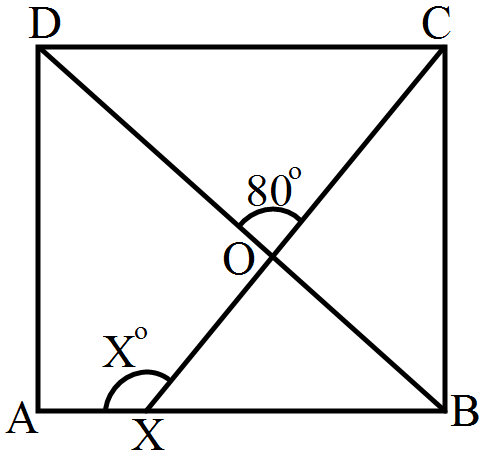
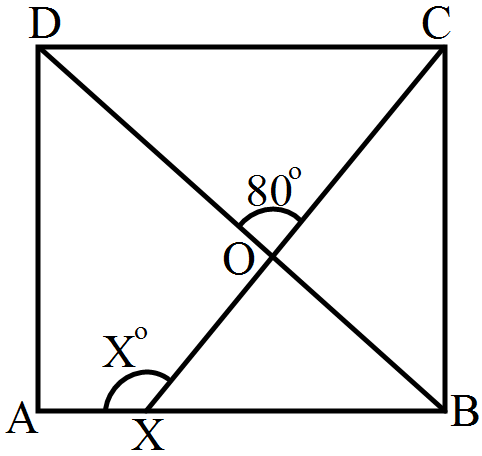
In the adjoining figure, ABCD is a square. A line segment CX cuts AB at X and the diagonal BD at O such that $\angle\text{COD}=80^{\circ}$ and $\angle\text{OXA}=\text{x}^{\circ}.$ Find the value of x.
Answer
Consider the triangle $\triangle\text{ABD}$$\text{AB = AD}$ [$\therefore$ ABCD is a square]
So, $\angle\text{ADB}=\angle\text{ABD}$ [base angles are equal]$\therefore\angle\text{ADB}+\angle\text{ABD}=90^{\circ}$ [$\because\angle\text{A}=90^{\circ}$ as ABCD is a square]
$\Rightarrow2\angle\text{ADB}=90^{\circ}$
$\Rightarrow\angle\text{ADB}=\frac{90}{2}=45^{\circ}$
Now in $\triangle\text{OXB,}$$\angle\text{XOB}=\angle\text{DOC}=80^{\circ}$ [Vertically opposite angles]
and $\angle\text{ABD}=45^{\circ}\Rightarrow\angle\text{XBD}=45^{\circ}...(1)$ So, exterior $\angle\text{AXO}=\angle\text{XOB}+\angle\text{XBD}$$\text{x}^{\circ}=80^{\circ}+45^{\circ}$ [from (1)]
$=125^{\circ}$
$\therefore\text{x}^{\circ}=125^{\circ}$
View full question & answer
Question 45 Marks
Find the measure of each angle of a parallelogram, if one of its angles is 30° less than twice the smallest angle.
Answer
Let ABCD be the given parallelogram. If $\angle\text{A}$ is smallest angle, then the greater angle$\Rightarrow\angle\text{B}=2\angle\text{A}-30^{\circ}$
In a parallelogram, the opposite angles are equal$\Rightarrow\angle\text{A}=\angle\text{C}$ and $\angle\text{B}=\angle\text{D}=2\angle\text{A}-30^{\circ}$
The sum of all the four angles of a parallelogram is 360°.$\Rightarrow\angle\text{A}+\angle\text{B}+\angle\text{C}+\angle\text{D}=360^{\circ}$
$\Rightarrow\angle\text{A}+(2\angle\text{A}-30^{\circ})+\angle\text{A}+(2\angle\text{A}-30^{\circ})=360^{\circ}$
$\Rightarrow\angle\text{A}+2\angle\text{A}-30^{\circ}+\angle\text{A}+2\angle\text{A}-30^{\circ}=360^{\circ}$
$\Rightarrow6\angle\text{A}-60^{\circ}=360^{\circ}$
$\Rightarrow6\angle\text{A}=360^{\circ}+60^{\circ}=420^{\circ}$
$\Rightarrow\angle\text{A}=\frac{420^{\circ}}{6}=70^{\circ}$
$\therefore\angle\text{A}=70^{\circ}\Rightarrow\angle\text{C}=70^{\circ}$
$\angle\text{B}=(2\angle\text{A}-30^{\circ})=(2\times70^{\circ}-30^{\circ})=110^{\circ}$
$\angle\text{D}=\angle\text{B}=110^{\circ}$
$\therefore\angle\text{A}=\angle\text{C}=70^{\circ}$ and $\angle\text{B}=\angle\text{D}=110^{\circ}.$
View full question & answer
Question 55 Marks
Prove that the line segments joining the midpoints of opposite sides of a quadrilateral bisect each other.
Answer
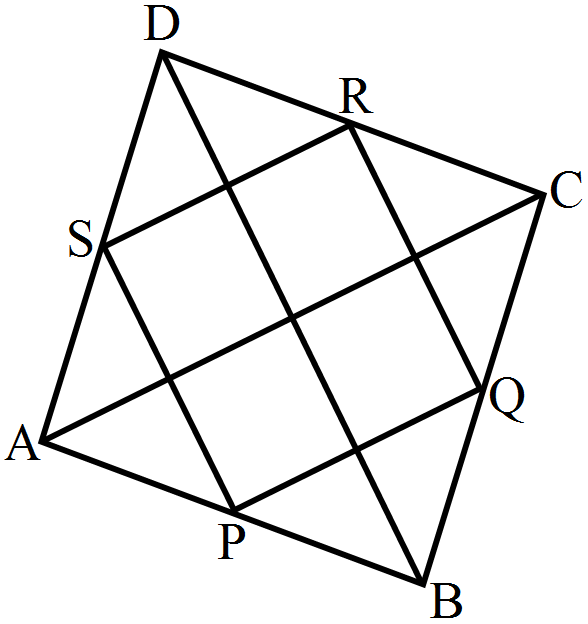
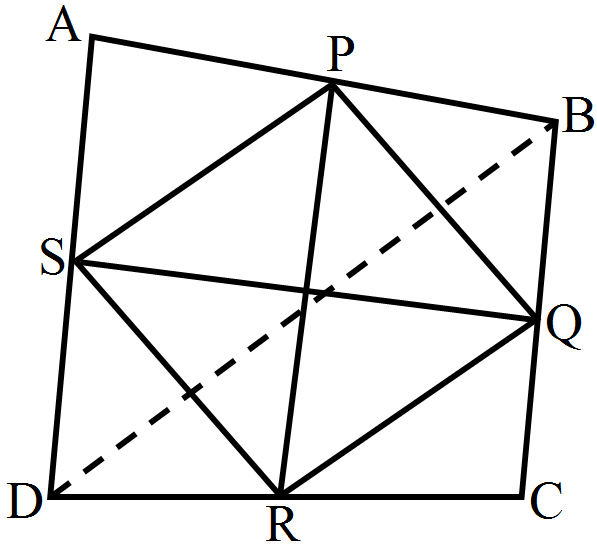
Let ABCD be the quadrilateral in which P, Q, R, and S are the midpoints of sides AB, BC, CD, and DA,respectively. Join PQ, QR, RS, SP and BD. BD is a diagonal of ABCD. In $\triangle\text{ABD},$ S and P are the midpoints of AD and AB, respectively.$\therefore\text{SP || BD}$ and $\text{SP}=\frac{1}{2}\text{BD }...(\text{i})$ (By midpoint theorem)
Similarly in $\triangle\text{BCD},$ we have:$\text{QR || BD}$ and $\text{QR} = \frac{1}{2}\text{BD }...(\text{ii})$ (By midpoint theorem)
From equations (i) and (ii), we get:$\text{SP || BD || QR}$
$\therefore\text{SP || QR}$ and $\text{SP = QR}$ $\big[$Each equal to $\frac{1}{2}\text{BD}\big]$
In quadrilateral SPQR, one pair of the opposite sides is equal and parallel to each other. $\therefore$ SPQR is a parallelogram.
We know that the diagonals of a parallelogram bisect each other.$\therefore$ PR and QS bisect each other.
View full question & answer
Question 65 Marks
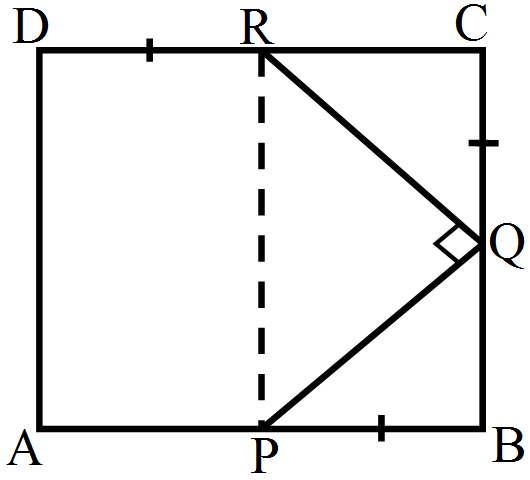
In the given figure, ABCD is a square and $\angle\text{PQR}=90^{\circ}.$ If PB = QC = DR, prove that:
  1. QB = RC,
  2. PQ = QR,
  3. $\angle\text{QPR}=45^{\circ}$
Answer
Given: ABCD is a square and $\angle\text{PQR}=90^{\circ}.$
Also, PB = QC = DR
  1. We have:
BC = CD (Sides of square)

CQ = DR (Given)

BC = BQ + CQ

⇒ CQ = BC − B

$\therefore$ DR = BC − BQ ...(i)

Also, CD = RC+ DR

$\therefore$ DR = CD − RC = BC − RC ...(ii)

From (i) and (ii), we have:

BC − BQ = ​BC − RC

$\therefore$ BQ = RC
  1. In $\triangle\text{RCQ}$ and $\triangle\text{QBP},$ we have:
$\text{PB = QC}$ (Given)

$\text{BQ = RC}$ (Proven above)

$\angle\text{RCQ}=\angle\text{QBP}$ (90° each)

i.e., $\triangle\text{RCQ}\cong\triangle\text{QBP}$ (SAS congruence rule)

$\therefore\text{QR = PQ}$ (By C.P.C.T.)
  1. $\triangle\text{RCQ}\cong\triangle\text{QBP}$ and $\text{QR = PQ}$ (Prove above)
$\therefore$ in $\triangle\text{RPQ},\angle\text{QRP}=\angle\text{QRP}=\frac{1}{2}(180^{\circ}-90^{\circ})=\frac{90^{\circ}}{2}=45^{\circ}$
View full question & answer
Question 75 Marks
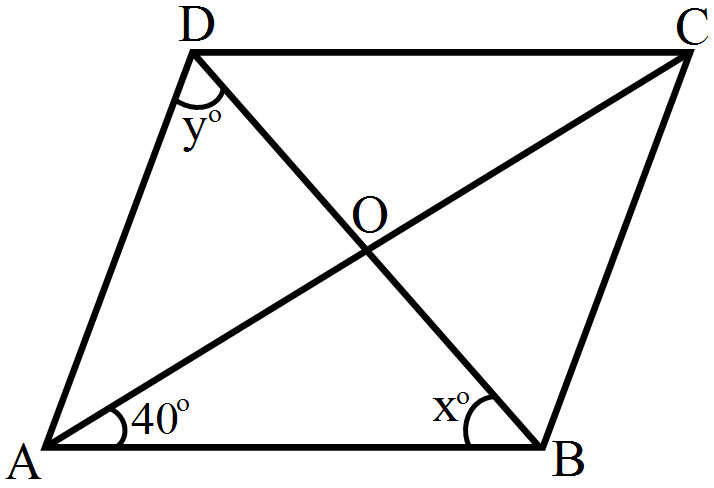
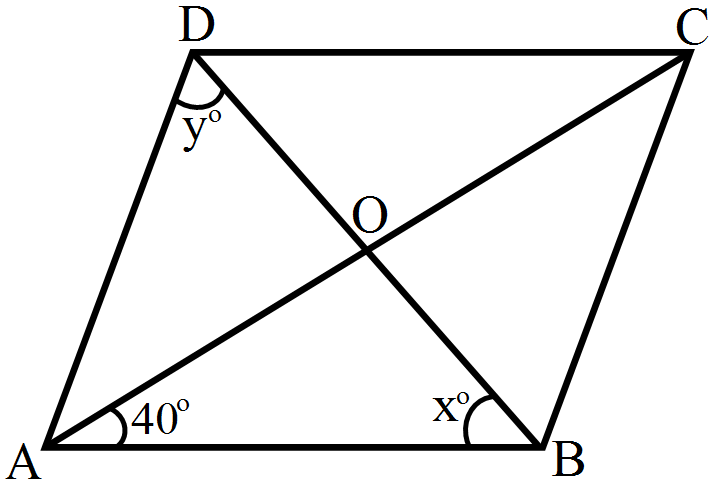
In each of the figures given below, ABCD is a rhombus. Find the value of x and y in each case.
Answer
Since in a rhombus, all sides are equal So in $\triangle\text{ABD},\text{AB = AD}$$\Rightarrow\angle\text{ABD}=\angle\text{ADB}$
$\Rightarrow\text{x = y}...(1)$
Now in $\triangle\text{ABC},\text{AB = BC}$$\Rightarrow\angle\text{CAB}=\angle\text{ACB}$
$\Rightarrow\angle\text{ACB}=40^{\circ}$
$\therefore\angle\text{B}=180^{\circ}-\angle\text{CAB}-\angle\text{ACB}$
$=180^{\circ}-40^{\circ}-40^{\circ}=100^{\circ}$
$\Rightarrow\angle\text{DBC}=\angle\text{B}-\text{x}^{\circ}=100-\text{x}^{\circ}$
But $\angle\text{DBC}=\angle\text{ADB}=\text{y}^{\circ}$ [alternate angle]$\Rightarrow100-\text{x}^{\circ}=\text{y}^{\circ}$
$\Rightarrow100^{\circ}-\text{x}^{\circ}=\text{x}^{\circ}$ [from (1)]
$\Rightarrow2\text{x}^{\circ}=100$
$\Rightarrow\text{x}^{\circ}=\frac{100}{2}=50^{\circ}$
So, $\text{x}=50^{\circ}$ and $\text{y}=50^{\circ}.$
View full question & answer
Question 85 Marks
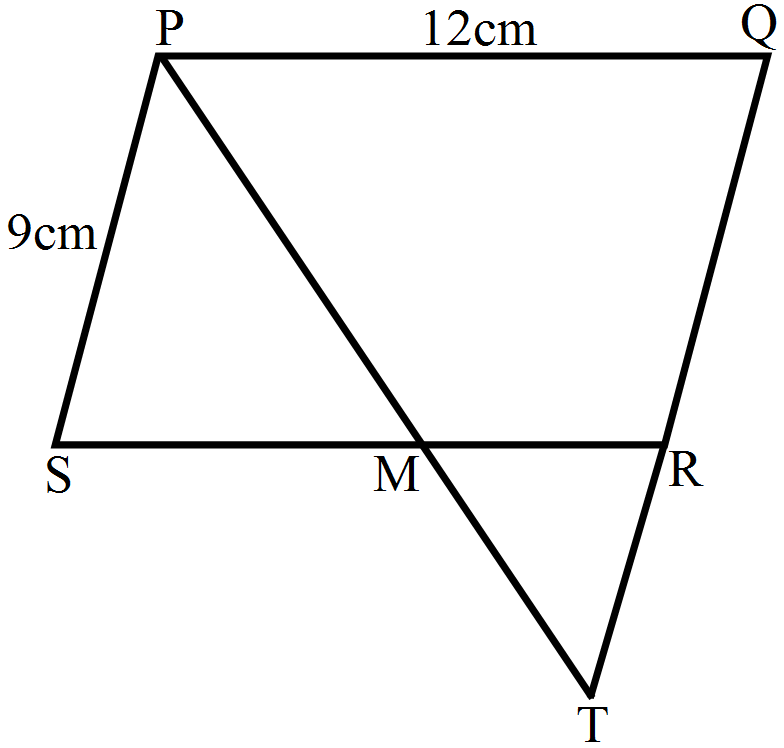
In a parallelogram PQRS, PQ = 12cm and PS = 9cm. The bisector of $\angle\text{P}$ meets SR in M. PM and QR both when produced meet at T. Find the length of RT.
Answer

PM is the bisector of $\angle\text{P}.$
$\Rightarrow\angle\text{QPM}=\angle\text{SPM}...(\text{i})$
PQRS is a parallelogram.
$\therefore\text{PQ || SR}$ and PM is the transversal.
$\Rightarrow\angle\text{QPM}=\angle\text{MS}...(\text{ii})$ (alternate angles)
From (i) and (ii),
$\angle\text{SPM}=\angle\text{PMS ...(iii)}$
$\Rightarrow\text{MS = PS}=9\text{cm}$ (sides opposite to equal angles are equal)
Now, $\angle\text{RMT}=\angle\text{PMS ...(iv)}$ (vertically opposite angles)
Also, $\text{PS || QT}$ and PT is the transversal.
$\angle\text{RTM}=\angle\text{SPM}$
$\Rightarrow\angle\text{RTM}=\angle\text{RMT}$
$\Rightarrow\text{RT = RM}$ (sides opposite to equal angles are equal)
$\text{RM = SR} - \text{MS}=12-9=3\text{cm}$
$\Rightarrow\text{RT}=3\text{cm}$
View full question & answer
Question 95 Marks
If an angle of a parallelogram is four-fifths of its adjacent angle, find the angles of the parallelogram.
Answer
Let ABCD be a parallelogram. Suppose, $\angle\text{A}=\text{x}^{\circ}$ Then, $\angle\text{B},$ which is adjacent angle of A is $\frac{4}{5}\text{x}^{\circ}.$ In a parallelogram, the opposite angles are equal$\Rightarrow\angle\text{A}=\angle\text{C}=\text{x}^{\circ}$ and $\angle\text{B}=\angle\text{D}=\frac{4}{5}\text{x}^{\circ}$
The sum of all the four angles of a parallelogram is 360°. $\Rightarrow\angle\text{A}+\angle\text{B}+\angle\text{C}+\angle\text{D}=360^{\circ}$$\Rightarrow\text{x}+\frac{4}{5}\text{x + x}+\frac{4}{5}\text{x}=360^{\circ}$
$\Rightarrow2\text{x}+\frac{8}{5}\text{x}=360^{\circ}$
$\Rightarrow\frac{18}{5}\text{x}=360^{\circ}$
$\Rightarrow\text{x}=\frac{360\times5}{18}=100^{\circ}$
$\therefore\angle\text{A}=\text{x}=100^{\circ}$
$\angle\text{B}=\frac{4}{5}\text{x}=\frac{4}{5}\times100=80^{\circ}$
$\angle\text{C}=\text{x}=100^{\circ}$
$\angle\text{D}=\frac{4}{5}\text{x}=\frac{4}{5}\times100=80^{\circ}$
$\therefore\angle\text{A}=\angle\text{C}=100^{\circ}$ and $\angle\text{B}=\angle\text{D}=80^{\circ}.$
View full question & answer
Question 105 Marks
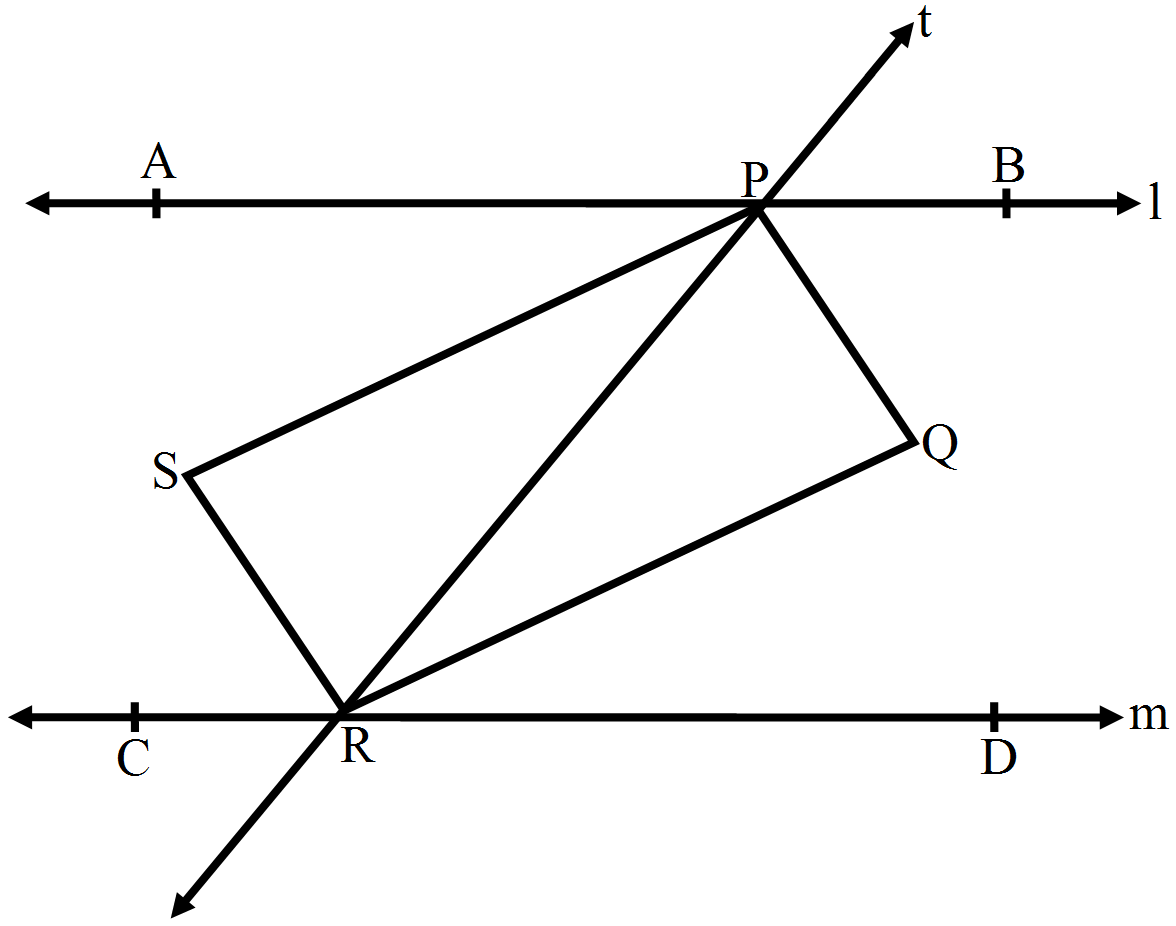
Two parallel lines l and m are intersected by a transversal t. Show that the quadrilateral formed by the bisectors of interior angles is a rectangle.
Answer
l || m and t is a transversal.$\Rightarrow\angle\text{APR}=\angle\text{PRD}$ (alternate angles)
$\Rightarrow\frac{1}{2}\angle\text{APR}=\frac{1}{2}\angle\text{PRD}$
$\Rightarrow\angle\text{SPR}=\angle\text{PRQ}$ (PS and RQ are the bisectors of $\angle\text{APR}$ and $\angle\text{PRD}$)
Thus, PR intersects PS and RQ at P and R respectively such that $\angle\text{SPR}=\angle\text{PRQ}$ i.e., alternate angles are equal.$\Rightarrow\text{PS || RQ}$
Similarly, we have $\text{SR ∥ PQ.}$ Hence, PQRS is a parallelogram. Now, $\angle\text{BPR}+\angle\text{PRD}=180^{\circ}$ (interior angles are supplementary)$\Rightarrow2\angle\text{QPR}+2\angle\text{QRP}=180^{\circ}$ (PQ and RQ are the bisectors of $\angle\text{BPR}$ and $\angle\text{PRD}$)
$\Rightarrow\angle\text{QPR}+\angle\text{QRP}=90^{\circ}$
In $\triangle\text{PQR},$ by angle sum property,$\angle\text{PQR}+\angle\text{QPR}+\angle\text{QRP}=180^{\circ}$
$\Rightarrow\angle\text{PQR}+90^{\circ}=180^{\circ}$
$\Rightarrow\angle\text{PQR}=90^{\circ}$
Since PQRS is a parallelogram,$\angle\text{PQR}=\angle\text{PSR}$
$\Rightarrow\angle\text{PSR}=90^{\circ}$
Now, $\angle\text{SPQ}+\angle\text{PQR}=180^{\circ}$ (adjacent angles in a parallelogram are supplementary)$\Rightarrow\angle\text{SPQ}+90^{\circ}=180^{\circ}$
$\Rightarrow\angle\text{SPQ}=90^{\circ}$
$\Rightarrow\angle\text{SRQ}=90^{\circ}$
Thus, all the interior angles of quadrilateral PQRS are right angles. Hence, PQRS is a rectangle.
View full question & answer
Question 115 Marks
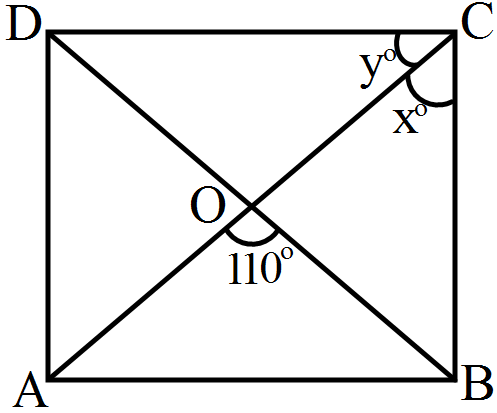
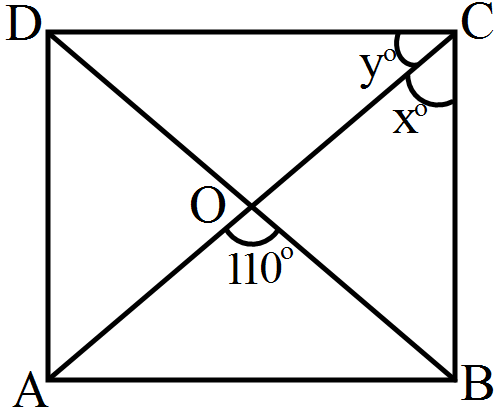
In each of the figures given below, ABD is a rectangle. Find the values of x and y in each case.
Answer
We know that diagonals of a rectangle are equal and bisect each other. So, in $\triangle\text{AOB},\text{OA = OB}$$\Rightarrow\angle\text{OAB}=\angle\text{OBA}$
Again in $\triangle\text{AOB},$$\Rightarrow\angle\text{AOB}+\angle\text{OAB}+\angle\text{OBA}=180^{\circ}$
$\Rightarrow110^{\circ}+\angle\text{OAB}+\angle\text{OBA}=180^{\circ}$
$\Rightarrow2\angle\text{OAB}=180^{\circ}-110^{\circ}=70^{\circ}$
$\Rightarrow\angle\text{OAB}+\angle\text{OBA}=\frac{70}{2}=35^{\circ}$
Since AB || CD and AC is a transversal, $\angle\text{DCA}$ and $\angle\text{CAB}$ are alternate angles, and thus they are equal. So, $\angle\text{DCA}=\text{y}^{\circ}=\angle\text{CAB}$ and $\angle\text{CAB}=35^{\circ}...(1)$$\Rightarrow\text{y}^{\circ}=35^{\circ}$
Now cosider the right triangle, $\triangle\text{ABC}$$\angle\text{ACB}=\text{x}^{\circ}=90^{\circ}-\angle\text{CAB}$
$=90^{\circ}-35^{\circ}$ [from (1)]
$=55^{\circ}$
$\therefore\text{x}=55^{\circ}$ and $\text{y}=35^{\circ}.$
View full question & answer
Question 125 Marks
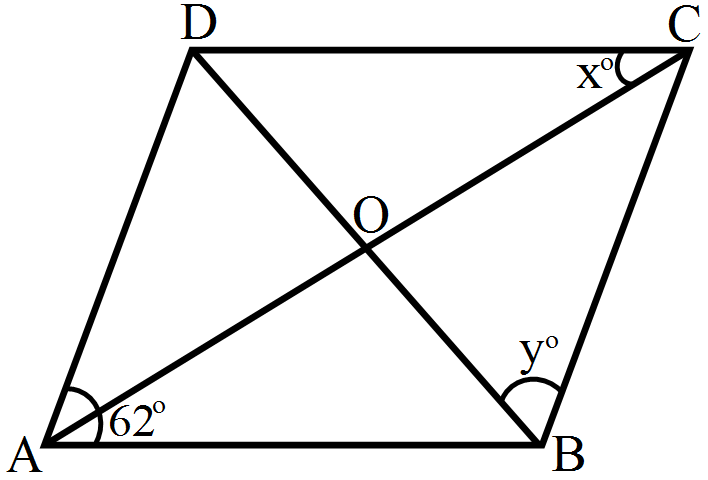
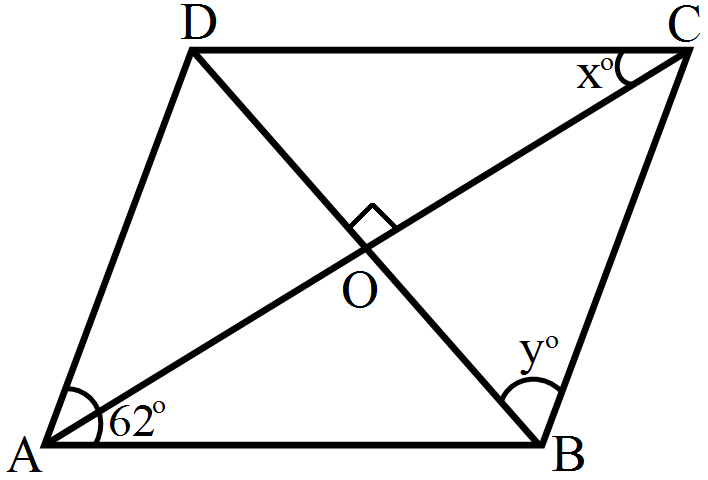
In each of the figures given below, ABCD is a rhombus. Find the value of x and y in each case.
Answer
Since ABCD is a rhombus So, $\angle\text{A}=\angle\text{C},$ i.e., $\angle\text{C}=62^{\circ}$ Now in $\triangle\text{BCD},\text{BC = DC}$$\Rightarrow\angle\text{CDB}=\angle\text{DBC}=\text{y}^{\circ}$
As, $\angle\text{BDC}+\angle\text{DBC}+\angle\text{BCD}=180^{\circ}$$\Rightarrow\text{y + y}+62^{\circ}=180^{\circ}$
$\Rightarrow2\text{y}=180^{\circ}-62^{\circ}=118^{\circ}$
$\Rightarrow\text{y}=\frac{118}{2}=59^{\circ}$
As diagonals of a rhombus are perpendicular to each other,$\triangle\text{OCD}$ is a right triangle and $\angle\text{DOC}=90^{\circ},\angle\text{ODC}=\text{y}=59^{\circ}$
$\Rightarrow\angle\text{DCO}=90^{\circ}-\angle\text{ODC}$
$=90^{\circ}-59^{\circ}=31^{\circ}$
$\therefore\angle\text{DCO}=\text{x}=31^{\circ}$
$\therefore\text{x}=31^{\circ}$ and $\text{y}=59^{\circ}$
View full question & answer
Question 135 Marks
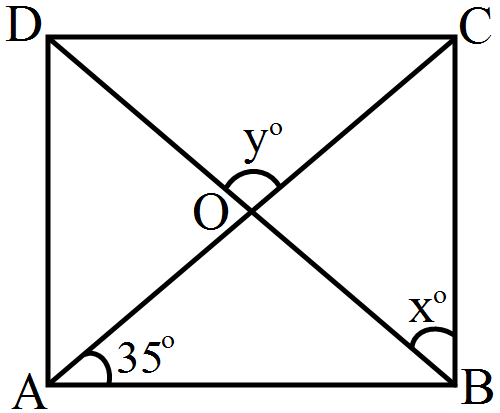
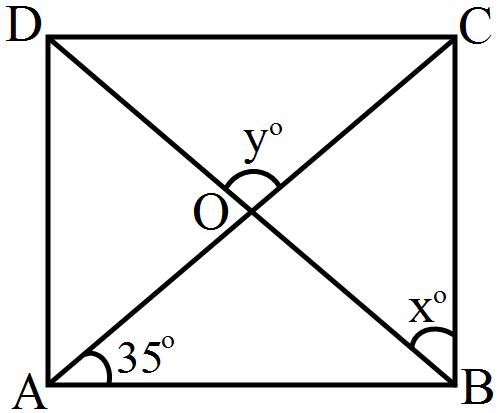
In each of the figures given below, ABD is a rectangle. Find the values of x and y in each case.
Answer

We know that diagonals of a rectangle are equal and bisect each other.
So, in $\triangle\text{AOB}$
$\text{AO = OB}$
$\Rightarrow\angle\text{OAB}=\angle\text{OBA}$ [base angles are equal]
i.e. $\angle\text{OBA}=35^{\circ}$ $[\because\angle\text{OAB}=35^{\circ},\text{given}]$
$\angle\text{AOB}=180^{\circ}-35^{\circ}-35^{\circ}=110^{\circ}$
and, $\angle\text{DOC}=\text{y}^{\circ}=\angle\text{AOB}=110^{\circ}$ [Vertically opp. angle]
Consider the right triangle, $\triangle\text{ABC},$ right angle at B.
So, $\angle\text{ABC}=90^{\circ}$ [$\because$ ABCD is a rectangle]
Now, consider the $\triangle\text{OBC}$
So, $\angle\text{OBC}=\text{x}^{\circ}=\angle\text{ABC}-\angle\text{OBA}$
$=90^{\circ}-35^{\circ}$
$=55^{\circ}$
$\therefore\text{x}=55^{\circ}$ and $\therefore\text{y}=110^{\circ}.$
View full question & answer
Question 145 Marks
ABCD is a rectangle in which diagonal AC bisects $\angle\text{A}$ as well as $\angle\text{C}.$ Show that:
  1. ABCD is a square
  2. diagonal BD bisects $\angle\text{B}$ as well as $\angle\text{D}.$​​​​​​​
Answer

  1. ABCD is a rectangle in which diagonal AC bisects $\angle\text{A}$ as well as $\angle\text{C}.$
$\Rightarrow\angle\text{BAC}=\angle\text{DAC}...(1)$

And $\angle\text{BCA}=\angle\text{DCA}...(2)$

Since every rectangle is a parallelogram, therefore

AB || DC and AC is the transversal.

$\Rightarrow\angle\text{BAC}=\angle\text{DCA}$ (alternate angles)

$\Rightarrow\angle\text{DAC}=\angle\text{DCA}$ [from]

Thus in $\triangle\text{ADC},$

$\text{AD = CD}$ (opposite sides of equal angles are equal)

But, $\text{AD = BC}$ and $\text{CD = AB}$ (ABCD is a rectangle)

$\Rightarrow\text{AB = BC = CD = AD}$

Hence, ABCD is a square.
  1. In $\triangle\text{BAD}$ and $\triangle\text{BCD},$
$\text{AB = CD}$

$\text{AD = BC}$

$\text{BD = BD}$

$\therefore\triangle\text{BAD}\cong\triangle\text{BCD}$ (by SSS congruence criterion)

$\Rightarrow\angle\text{ABD}=\angle\text{CBD}$ and $\angle\text{ADB}=\angle\text{CDB}$ [CP.C.T.]

Hence, diagonal BD bisects $\angle\text{B}$ as well as $\angle\text{D}.$
View full question & answer
Question 155 Marks
Show that the quadrilateral formed by joining the midpoints of the pairs of adjacent sides of a rectangle is a rhombus.
Answer
Let ABCD be the rectangle and P, Q, R and S be the midpoints of AB, BC, CD and DA, respectively.

Join AC, a diagonal of the rectangle.

In $\triangle\text{ABC},$ we have:

$\therefore$ PQ || AC and $\text{PQ}=\frac{1}{2}\text{AC}$ [By midpoint theorem]

Again, in $\triangle\text{DAC,}$ the points S and R are the mid points of AD and DC, respectively.

$\therefore$ SR || AC and $\text{SR}=\frac{1}{2}\text{AC}$ [By midpoint theorem]

Now, PQ || AC and SR || AC

⇒ PQ || SR

Also, PQ = SR [Each equal to $\frac{1}{2}$ AC] ...(i)

So, PQRS is a parallelogram.

Now, in $\triangle\text{SAP}$ and $\triangle\text{QBP},$ we have:

AS = BQ

$\angle\text{A}=\angle\text{B}=90^{\circ}$

AP = BP

i.e., $\triangle\text{SAP}\cong\triangle\text{QBP}$

$\therefore$ PS = PQ ...(ii)

Similarly, $\triangle\text{SDR}\cong\triangle\text{QCR}$

$\therefore$ SR = RQ ...(iii)

From (i), (ii) and (iii), we have:

PQ = PQ = SR = RQ

Hence, PQRS is a rhombus.
View full question & answer
Question 165 Marks
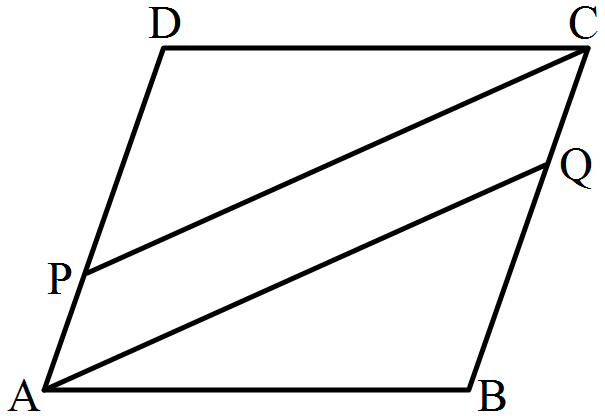
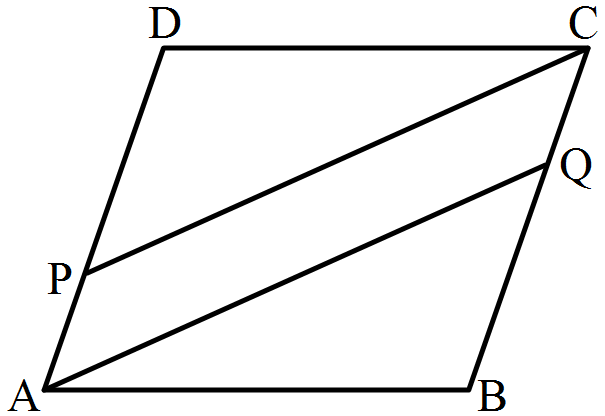
In the adjoining figure, ABCD is a parallelogram. If P and Q are points on AD and BCrespectively such that $\text{AP}=\frac{1}{2}\text{AD}$ and $\text{CQ}=\frac{1}{2}\text{BC},$ prove that AQCP is a parallelogram.
Answer
Given: A parallelogram ABCD in which $\text{AP}=\frac{1}{3}\text{AD}$ and $\text{CQ}=\frac{1}{3}\text{BC}$
To Prove: PAQC is a parallelogram. Proof: In $\triangle\text{ABQ}$ and $\triangle\text{CDP}$$\text{AB = CD}$ [$\because$ Opposite angles of parallelogram]
$\angle\text{B}=\angle\text{D}$
and $\text{DP = AD}-\text{PA}=\frac{2}{3}\text{AD}$ and, $\text{BQ = BC}-\text{CQ}=\text{BC}-\frac{1}{3}\text{BC}$$=\frac{2}{3}\text{BC}=\frac{2}{3}\text{AD}$ [$\because$ AD = BC]
$\therefore\text{BQ = DP}$
Thus, by Side-Angle-Side criterion of congruence, we have, So, $\triangle\text{ABQ}\cong\triangle\text{CDP}$ [By SAS] The corresponding parts of the congruent triangles are equal.$\text{AQ = CP}$ [By C.P.C.T.]
and $\text{PA}=\frac{1}{3}\text{AD}$ and $\text{CQ}=\frac{1}{3}\text{BC}=\frac{1}{3}\text{AD}$$\text{PA = CQ}$ $[\because\text{AD = BC}]$
Also, by C.P.C.T., $\angle\text{QAB}=\angle\text{PCD}...(1)$ Therefore,$\angle\text{QAP}=\angle\text{A}-\angle\text{QAB}$
$=\angle\text{C}-\angle\text{PCD}$ [Since $\angle\text{A}=\angle\text{C}$ and from (1)]
$=\angle\text{PCQ}$ [alternate interior angles are equal]
Therefore, AQ and CP are two parallel lines. So, PAQC is a parallelogram.
View full question & answer
Question 175 Marks
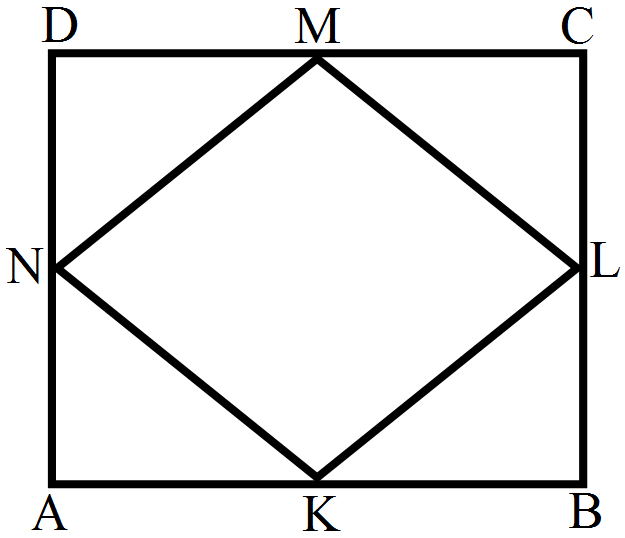
K, L, M and N are points on the sides AB, BC, CD and DA respectively of a square ABCD such that AK = BL = CM = DN. Prove that KLMN is a square.
Answer

$\text{AK = BL = CM = DN}$ (given)
$\Rightarrow\text{BK = CL = DM = AN}...(1)$ (since ABCD is a square)
In $\triangle\text{AKN}$ and $\triangle\text{BLK},$
$\text{AK = BL}$ (given)
$\angle\text{A}=\angle\text{B}$ (Each 90°)
$\text{AN = BK}$ [From (i)]
$\therefore\triangle\text{AKN}\cong\triangle\text{BLK}$ (by SAS congruence criterion)
$\Rightarrow\angle\text{AKN = }\angle\text{BLK}$ and $\angle\text{ANK}=\angle\text{BKL}$ (C.P.C.T.)
But, $\angle\text{AKN}+\angle\text{ANK}=90^{\circ}$ and $\angle\text{BLK}+\angle\text{BKL}=90^{\circ}$
$\Rightarrow\angle\text{AKN}+\angle\text{ANK}+\angle\text{BLK}+\angle\text{BKL}=90^{\circ}+90^{\circ}$
$\Rightarrow2\angle\text{AKN}+2\angle\text{BKL}=180^{\circ}$
$\Rightarrow\angle\text{AKN}+\angle\text{BKL}=90^{\circ}$
$\Rightarrow\angle\text{NKL}=90^{\circ}$
Similarly, we have
$\angle\text{KLM}=\angle\text{LMN}=\angle\text{MNK}=90^{\circ}$
Hence, KLMN is a square.
View full question & answer
Question 185 Marks
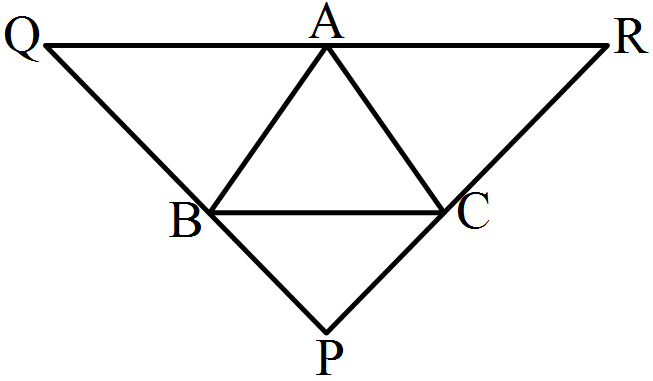
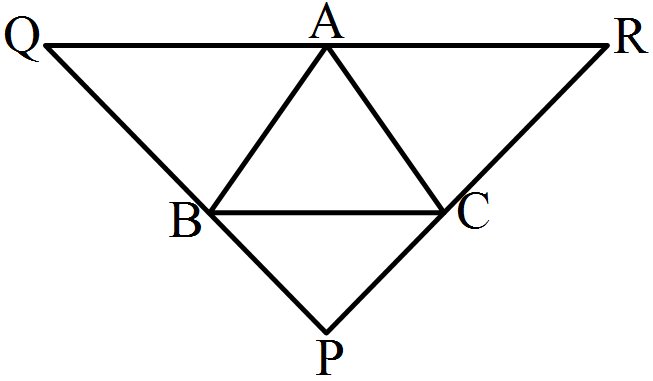
In the adjoining figure, $\triangle\text{ABC}$ is a triangle and through A, B, C, lines are drawn, parallel respectively to BC, CA and AB, intersecting at P, Q and R. Prove that the perimeter of $\triangle\text{PQR}$ is double the perimeter of $\triangle\text{ABC}.$
Answer
Given: A $\triangle\text{ABC},$ in which through points A, B and C, lines QR, QP and RP have been draw parrallel to BC, AC and AB of$\triangle\text{ABC}$ respectively.

To Prove: Perimeter of $\triangle\text{PQR}=2(\text{Perimeter of} \triangle\text{ABC})$ Proof: Since AR || BC and AB || RC [Given] So, ABCR is a parallelogram. Therefore AR = BC ...(i) Also, AQ || BC and QB || AC So, AQBC is a parallelogram, Therefore QA = BC...(ii) Adding both side of (i) and (ii), we get AR + QA = BC + BC ⇒ QR = 2BC$\Rightarrow\text{BC}=\frac{\text{QR}}{2}$
$\therefore\text{BC}=\frac{1}{2}\text{QR}$
Similarly we can prove $\text{AB}=\frac{1}{2}\text{RP}$ and $\text{AC}=\frac{1}{2}\text{PQ}$ So, Perimeter of $\triangle\text{PQR}$ = PQ + QR + RP = 2AC + 2BC + 2AB = 2(AC + BC + AB) =2(Perimeter of $\triangle\text{ABC}$)
View full question & answer
Question 195 Marks
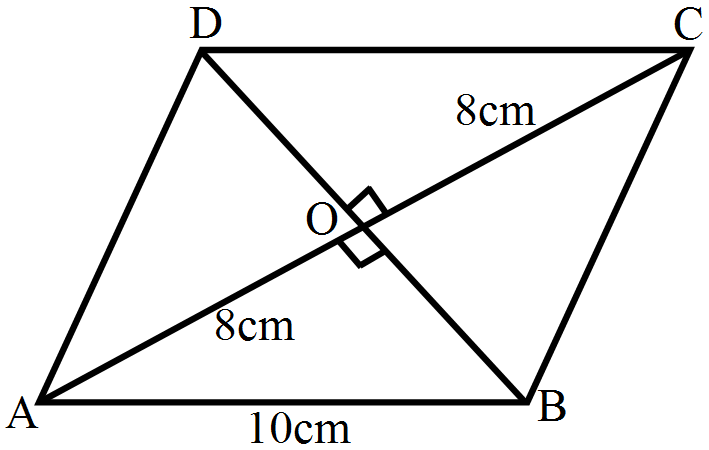
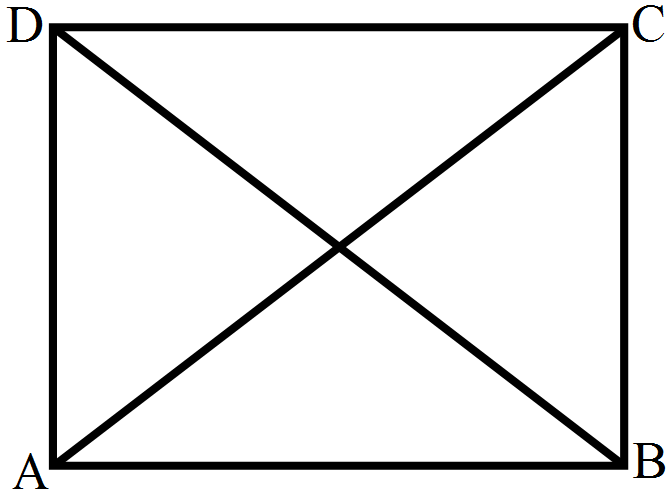
Each side of a rhombus is 10cm long and one of its diagonals measures 16cm. Find the length of the other diagonal and hence find the area of the rhombus.
Answer
Since diagonals of a rhombus bisect each other at right angles. So, $\text{AO = OC}=\frac{1}{2}\text{AC}=\frac{1}{2}\times16=8\text{cm}.$$\therefore$ In right $\triangle\text{AOB},$
$\text{AB}^{2}=\text{AO}^2+\text{OB}^2$
$\Rightarrow10^2=8^2+\text{OB}^2$
$\Rightarrow\text{OB}^2=100-64=36$
$\Rightarrow\text{OB}=\sqrt{36}=6\text{cm}.$
$\therefore$ Length of the other diagonal $\text{BD}=2\times\text{OB}$
$=2\times6=12\text{cm}.$
Area of $\triangle\text{ABC}=\frac{1}{2}\times\text{AC}\times\text{OB}$$=\frac{1}{2}\times16\times6=48\text{cm}^2.$
Area of $\angle\text{ACD}=\frac{1}{2}\times\text{AC}\times\text{OD}$$=\frac{1}{2}\times16\times6=48\text{cm}^2.$
$\therefore$ Area of rhombus ABCD = $(\text{Area of }\triangle\text{ABC}+\text{Area of }\triangle\text{ACD})$
$=(48+48)\text{cm}^2=96\text{cm}^2.$
View full question & answer
Question 205 Marks
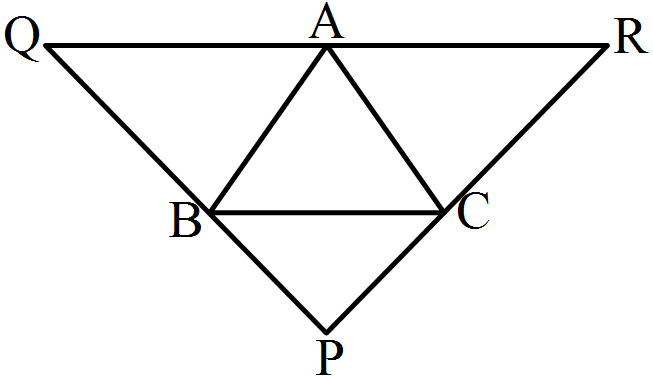
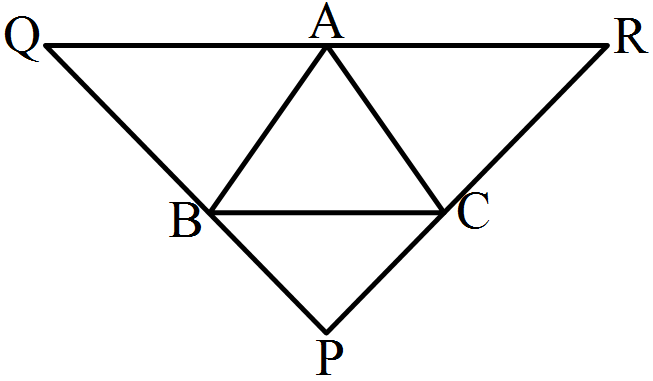
A $\triangle\text{ABC}$ is given. If lines are drawn through A, B, C, parallel respectively to the sides BC, CA and AB, forming $\triangle\text{PQR},$ as shown in the adjoining figure, show that $\text{BC}=\frac{1}{2}\text{QR}.$
Answer
Given: A $\triangle\text{ABC}$ in which through points A, B and C, line QR, QP and RP are drawn parallel to BC, CA and AB.To prove: $\text{BC}=\frac{1}{2}\text{QR}$
Proof: Since AR || BC and AB || RC [Given] So, ABCR is a parallelogram. Therefore AR = BC ...(i) Also, AQ || BC and QB || AC So, AQBC is a parallelogram.Therefore QA = BC ...(ii) Adding both side of (i) and (ii), we get AR + QA = BC + BC ⇒ QR = 2BC$\Rightarrow\text{BC}=\frac{\text{QR}}{2}$
$\therefore\text{BC}=\frac{1}{2}\text{QR}$
View full question & answer
Question 215 Marks
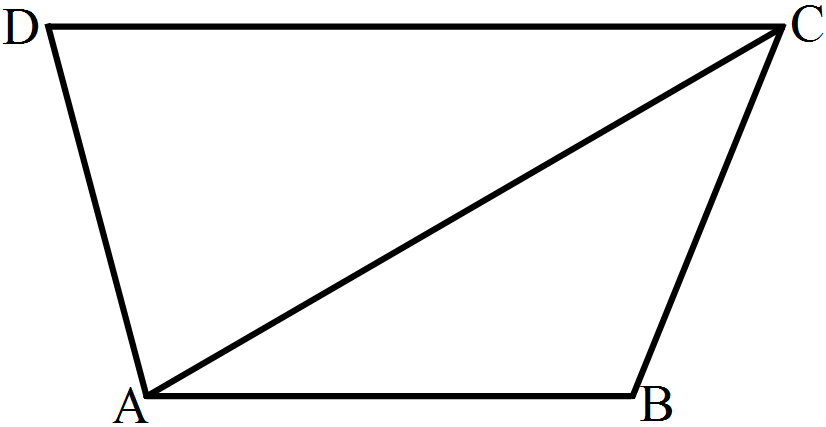
In the adjoining figure, ABCD is a quadrilateral and AC is one of its diagonals. Prove that:
(i) AB + BC + CD + DA > 2AC
(ii) AB + BC + CD > DA
(iii) AB + BC + CD + DA > AC + BD
Answer
Given: ABCD is a quadrilateral and AC is one of its diagonal.
  1. We know that the sum of any two sides of a triangle is greater than the third side.
In $\triangle\text{ABC},$ AB + BC > AC ...(1)

In $\triangle\text{ACD,}$ CD + DA > AC ...(2)

​Adding inequalities (1) and (2), we get:

AB + BC + CD + DA > 2AC
  1. In $\triangle\text{ABC},$ we have:
AB + BC > AC ...(1)

We also know that the length of each side of a triangle is greater than the positive difference of the length of the other two sides.

In $\triangle\text{ACD},$ we have:​

AC > |DA − CD| ...(2)

From (1) and (2), we have:

AB + BC > |DA − CD|​

⇒ AB + BC + CD > DA
  1. In $\triangle\text{ABC, AB + BC > AC}$
In $\triangle\text{ACD, CD + DA > AC}$

In $\triangle\text{BCD, BC + CD > BD}$

In $\triangle\text{ABD, DA + AB > BD}$

​Adding these inequalities, we get:

2(AB + BC + CD + DA) > 2(AC + BD)

⇒ (AB + BC + CD + DA) > (AC + BD)
View full question & answer
Question 225 Marks
In a || gm ABCD, if $\angle\text{A}=(2\text{x}+25)^{\circ}$ and $\angle\text{B}=(3\text{x}-5)^{\circ},$ find the value of x and the measure of each angle of the parallelogram.
Answer
In a parallelogarm, the opposite angle are equal. So, in the parallelogram ABCD,$\angle\text{A}=\angle\text{C}$
and $\angle\text{B}=\angle\text{D}$ Since $\angle\text{A}=(2\text{x}+25)^{\circ}$$\therefore\angle\text{C}=(2\text{x}+25)^{\circ}$
and $\angle\text{B}=(3\text{x}-5)^{\circ}$$\therefore\angle\text{D}=(3\text{x}-5)^{\circ}$
In a parallelogram, the sum of all the four angles is 360°$\therefore\angle\text{A}+\angle\text{B}+\angle\text{C}+\angle\text{D}=360^{\circ}$
$\Rightarrow(2\text{x}+25)+(3\text{x}+5)+(2\text{x}+25)+(3\text{x}-5)=360^{\circ}$
$\Rightarrow10\text{x}+40=360^{\circ}$
$\Rightarrow10\text{x}=360^{\circ}-40^{\circ}=320^{\circ}$
$\Rightarrow\text{x}=\frac{320}{10}=32^{\circ}$
$\therefore\angle\text{A}=(2\text{x}+25)=(2\times32+25)=89^{\circ}$
$\angle\text{B}=(3\text{x}-5)=(3\times32-5)=91^{\circ}$
$\angle\text{C}=(2\text{x}+25)=(2\times32+25)=89^{\circ}$
$\angle\text{D}=(3\text{x}-5)=(3\times32-5)=91^{\circ}$
$\therefore\angle\text{A}=\angle\text{C}=89^{\circ}$ and $\angle\text{B}=\angle\text{D}=91^{\circ}$
View full question & answer
Question 235 Marks
Show that the quadrilateral formed by joining the midpoints of the pairs of adjacent sides of a rhombus is a rectangle.
Answer


Let ABCD be a rhombus and P, Q, R and S be the midpoints of AB, BC, CD and DA, respectively.

Join the diagonals, AC and BD.

In $\triangle\text{ABC},$ we have:

$\text{PQ ∣∣ AC}$ and $\text{PQ}=\frac{1}{2}\text{AC}$ [By midpoint theorem]

Again, in $\triangle\text{DAC,}$ the points S and R are the midpoints of AD and DC, respectively.

$\therefore\text{SR }|| \text{ AC}$ and $\text{SR}=\frac{1}{2}\text{AC}$ [By midpoint theorem]

Now, $\text{PQ || AC}$ and $\text{SR || AC}\Rightarrow\text{PQ || SR}$

Also, $\text{PQ = SR}$ $\big[$Each equal to $\frac{1}{2}\text{AC}\big]$ ...(i)

So, PQRS is a parallelogram.

We know that the diagonals of a rhombus bisect each other at right angles.

$\therefore\angle\text{EOF}=90^{\circ}$

Now, $\text{RQ || DB}$

$\Rightarrow\text{RE || FO}$

Also, $\text{SR || AC}$

$\Rightarrow\text{FR || OE}$

$\therefore$ OERF is a parallelogram.

So, $\angle\text{FRE}=\angle\text{EOF}=90^{\circ}$ (Opposite angles are equal)

Thus, PQRS is a parallelogram with $\angle\text{R}=90^{\circ}.$

$\therefore$ PQRS is a rectangle.
View full question & answer
Question 245 Marks
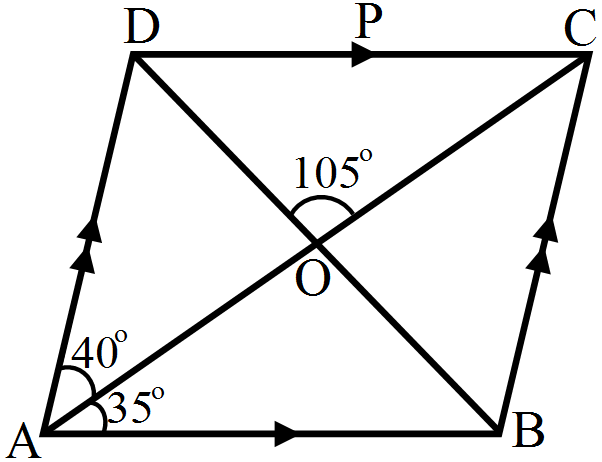
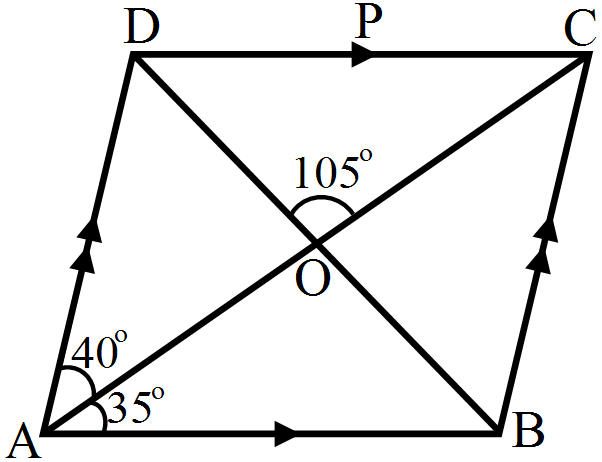
In the adjoining figure, ABCD is a parallelogram in which $\angle\text{BAO}=35^{\circ},\angle\text{DAO}=40^{\circ}$ and $\angle\text{COD}=150^{\circ}.$ Calculate
  1. $\angle\text{ABO},$
  2. $\angle\text{ODC},$
  3. $\angle\text{ACB},$
  4. $\angle\text{CBD}.$
Answer
ABCD is a parallelogram
  1. $\angle\text{AOB}=\angle\text{COB}=105^{\circ}$ [Vertical opposite angels]
Now in $\triangle\text{AOB},$ we have
$\angle\text{OAB}+\angle\text{AOB}+\angle\text{ABO}=180^{\circ}$
$\Rightarrow35^{\circ}+105^{\circ}+\angle\text{ABO}=180^{\circ}$
$\Rightarrow140^{\circ}+\angle\text{ABO}=180^{\circ}$
$\Rightarrow\angle\text{ABO}=180^{\circ}-140^{\circ}=40^{\circ}.$
  1. Since AB || DC and BD is a transversal
So, $\angle\text{ABD}=\angle\text{CDB}$ [alternate angles]
$\Rightarrow\angle\text{CDO}=\angle\text{CDB}=\angle\text{ABD}=\angle\text{ABO}=40^{\circ}$
$\therefore\angle\text{ODC}=40^{\circ}$
  1. As AB || CD and AC is a transversal
So, $\angle\text{ACB}=\angle\text{DAC}=40^{\circ}$ [alternate opposite angles]
  1. $\angle\text{CBD}=\angle\text{B}-\angle\text{ABO}$
But, $\angle\text{A}+\angle\text{B}+\angle\text{C}+\angle\text{D}=360^{\circ}$ [$\because$ ABCD is a parrellogram]
$\Rightarrow2\angle\text{A}+2\angle\text{B}=360^{\circ}$
$\Rightarrow2\times(40^{\circ}+35^{\circ})+2\angle\text{B}=360^{\circ}$
$\Rightarrow150^{\circ}+2\angle\text{B}=360^{\circ}$
$\Rightarrow2\angle\text{B}=360^{\circ}-150^{\circ}=210^{\circ}$
$\Rightarrow\angle\text{B}=\frac{210^{\circ}}{2}=105^{\circ}$
and $\angle\text{CBD}=\angle\text{B}-\angle\text{ABO}$
$=105^{\circ}-40^{\circ}=65^{\circ}$
$\angle\text{CBD}=65^{\circ}$
View full question & answer
Question 255 Marks
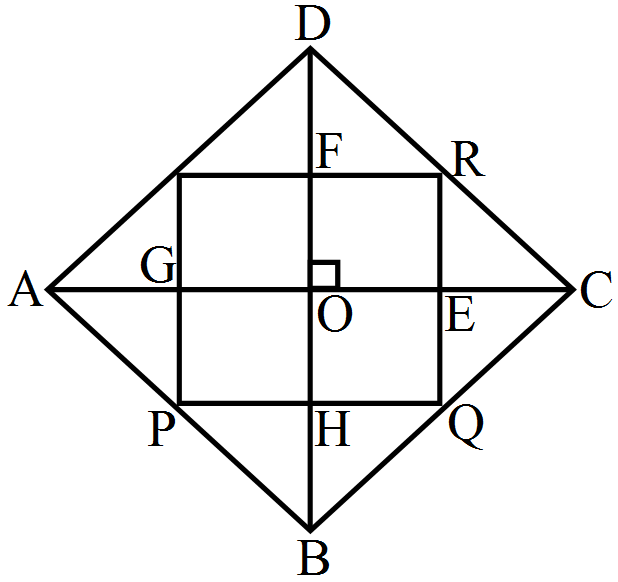
The midpoints of the sides AB, BC, CD and DA of a quadrilateral ABCD are joined to form a quadrilateral. If AC = BD and $\text{AC}\perp\text{BD}$ then prove that the quadrilateral formed is a square.
Answer

Given: In quadrilateral ABCD, AC = BD and $\text{AC}\perp\text{BD}.$ P, Q, R and S are the mid-points of AB, BC, CD and AD, respectively.
To prove: PQRS is a square.
Construction: Join AC and BD.
Proof:
In $\triangle\text{ABC},$
$\because$ P and Q are mid-points of AB and BC, respectively.
$\therefore\text{PQ || AC}$ and $\text{PQ}=\frac{1}{2}\text{AC}$ (Mid-point theorem) ...(1)
Similarly, in $\triangle\text{ACD},$
$\because$ R and S are mid-points of sides CD and AD, respectively.
$\therefore\text{SR || AC}$ and $\text{SR}=\frac{1}{2}\text{AC}$ (Mid-point theorem) ...(2)

From (1) and (2), we get

$\text{PQ || SR}$ and $\text{PQ = SR}$
But this a pair of opposite sides of the quadrilateral PQRS.
So, PQRS is parallelogram.
Now, in $\triangle\text{BCD,}$
$\because$ Q and R are mid-points of sides BC and CD, respectively.
$\therefore\text{QR || BD}$ and $\text{QR}=\frac{1}{2}\text{BD}$ (Mid-point theorem) ...(3)
From (2) and (3), we get
$\text{RS || AC}$ and $\text{QR || BD}$
But, $\text{AC}\perp\text{BD}$ (Given)
$\therefore\text{RS}\perp\text{QR}$
But this a pair of adjacent sides of the parallelogram PQRS.
So, PQRS is a rectangle.
Again, AC = BD (Given)
$\Rightarrow\text{RS = QR}$ [From (2) and (3)]
But this a pair of adjacent sides of the rectangle PQRS.
Hence, PQRS is a square.
View full question & answer
Question 265 Marks
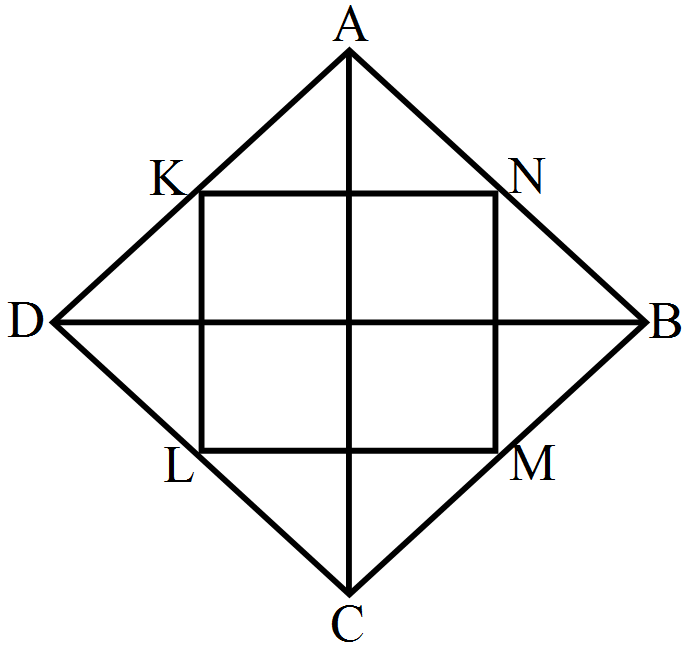
The diagonals of a quadrilateral ABCD are equal. Prove that the quadrilateral formed by joining the midpoints of its sides is a rhombus.
Answer
Given: In quadrilateral ABCD, BD = AC and K, L, M and N are the mid-points of AD, CD, BC and AB, respectively. To prove: KLMN is a rhombus. Proof: In $\triangle\text{ADC},$ Since, K and L are the mid-points of sides AD and CD, respectively. So, $\text{KL || AC}$ and $\text{KL}=\frac{1}{2}\text{AC}...(1)$ Similarly, in $\triangle\text{ABC,}$ Since, M and N are the mid-points of sides BC and AB, respectively. So, $\text{NM || AC}$ and $\text{NM}=\frac{1}{2}\text{AC}...(2)$ From (1) and (2), we get$\text{KL = NM}$ and $\text{KL || NM}$
But this a pair of opposite sides of the quadrilateral KLMN. So, KLMN is a parallelogram. Now, in $\triangle\text{ABD},$ Since, K and N are the mid-points of sides AD and AB, respectively. So, $\text{KN || BD}$ and $\text{KN}=\frac{1}{2}\text{BD}...(3)$ But $\text{BD = AC}$ (Given)$\Rightarrow\frac{1}{2}\text{BD}=\frac{1}{2}\text{AC}$
$\Rightarrow\text{KN = NM}$ [From (2) and (3)]

But these are a pair of adjacent sides of the parallelogram KLMN.

Hence, KLMN is a rhombus.
View full question & answer
Question 275 Marks
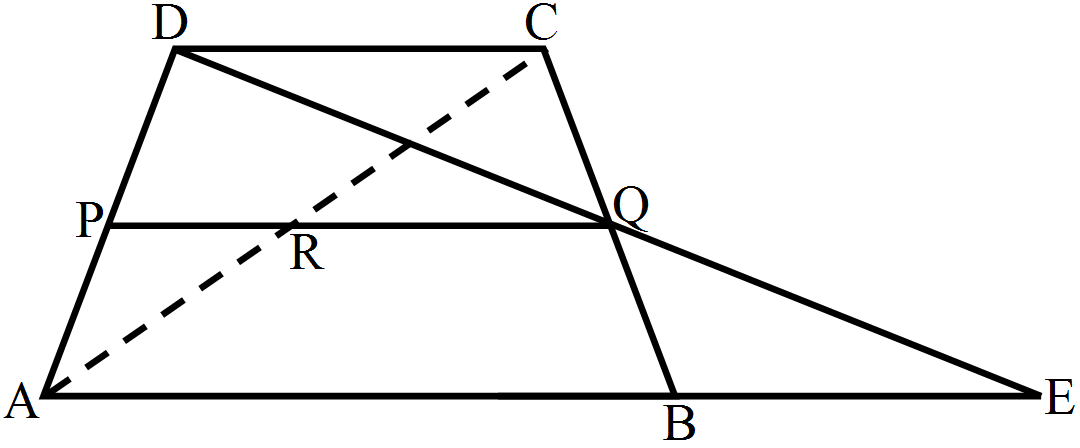
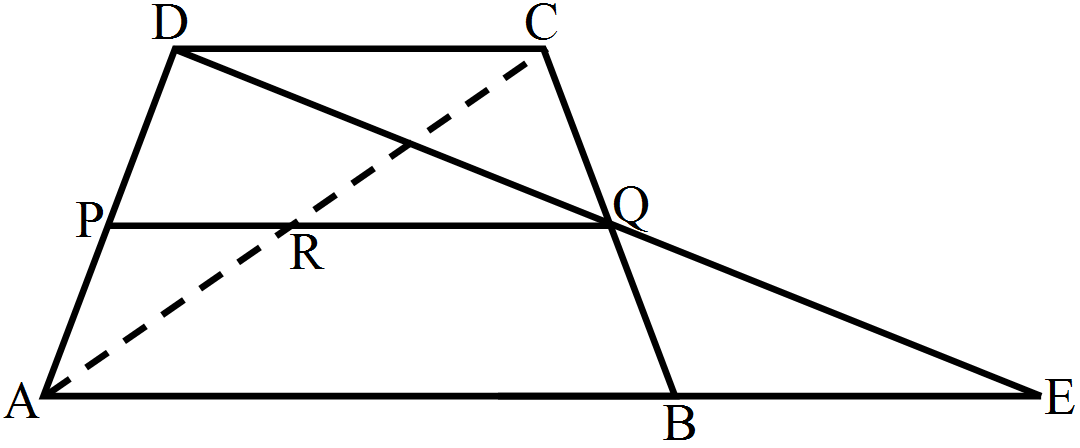
In the adjoining figure, ABCD is a trapezium in which AB || DC and P, Q are the midpoints of AD and BC respectively. DQ and AB when produced meet at E. Also, AC and PQintersect at R. Prove that:
  1. DQ = QE,
  2. PR || AB,
  3. AR = RC.
​​​​​​​
Answer
Given: ABCD is trapezium in which AB || DC
P and Q are the mid-points of AD and BC. DQ is joined and produced and Ab is also produced and so that they meet at E.
Ac cuts PQ at R.

To prove:
DQ = QE
PR || AB
AR = RC
Proof:
  1. Consider the triangles $\triangle\text{QCD}$ and $\triangle\text{QBE}$
$\angle\text{DQC}=\angle\text{BQE}$ [verically opposite angles]

$\text{CQ = BQ}$ [$\because$ Q is the midpoint of BC]

$\angle\text{QDC}=\angle\text{QEB}$ [AE || DC, is a transversal, and thus alternate angles are equal]

Thus, by Angles-Side-Angle criterion of congruence, we have

$\triangle\text{QCD}\cong\triangle\text{QEB}$ [by ASA]

The corresponding parts of the congruent triangles are equal.

Thus, DQ = QE [by C.P.C.T.]
  1. Midpoint Theorem: The line segment joining the midpoints of any two sides of a triangle is parallel to the third side and equal to half of it.
Thus by the midpoint Theorem, PQ || AE.

AB is a part of AE and hence, we have PQ || AB

Since the intercepts made by the lines AB, PQ and DC

on AD

Since PQ || AB || DC

SO, PR which is part of PQ is also parallel to AB

PR || AB || DC
  1. Intercept Theorem: If there are three parallel lines and the intercepts made by them on one transversal are equal then the intercept on any other transversal are also equal. The three lines PR, AB and DC are cut by AC and AD. So, by intercept Theorem, AR = RC
View full question & answer
Question 285 Marks
The diagonals of a quadrilateral ABCD are perpendicular to each other. Prove that the quadrilateral formed by joining the midpoints of its sides is a rectangle.
Answer

Given: In quadrilateral ABCD, $\text{AC}\perp\text{BD},$ P, Q, R and S are the mid-points of AB, BC, CD and AD, respectively.
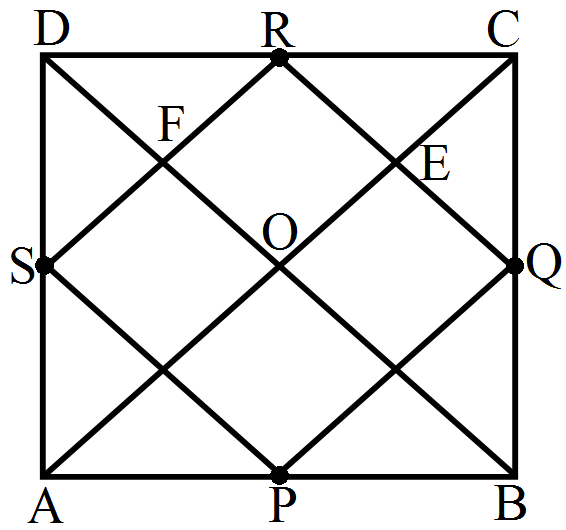
To prove: PQRS is a rectangle.
Proof:
In $\triangle\text{ABC},$ P and Q are mid-points of AB and BC, respectively.
$\therefore\text{PQ || AC}$ and $\text{PQ}=\frac{1}{2}\text{AC}$ (Mid-point theorem) ...(1)
Similarly, in $\triangle\text{ACD},$
So, R and S are mid-points of sides CD and AD, respectively.
$\therefore\text{SR || AC}$ and $\text{SR}=\frac{1}{2}\text{AC}$ (Mid-point theorem) ...(2)
From (1) and (2), we get
$\text{PQ || SR}$ and $\text{PQ || SR}$
But this is a pair of opposite sides of the quadrilateral PQRS,
So, PQRS is parallelogram.
Now, in $\triangle\text{BCD},$ Q and R are mid-points of BC and CD, respectively.
$\therefore\text{QR || BD}$ and $\text{QR}=\frac{1}{2}\text{BD}$ (Mid-point theorem)...(3)
From (2) and (3), we get
$\text{SR || AC}$ and $\text{QR || BD}$
But, $\text{AC}\perp\text{BD}$ (Given)
$\therefore\text{RS}\perp\text{QR}$
Hence, PQRS is a rectangle.
View full question & answer
Question 295 Marks
Show that the quadrilateral formed by joining the midpoints of the pairs of adjacent sides of a square is a square.
Answer

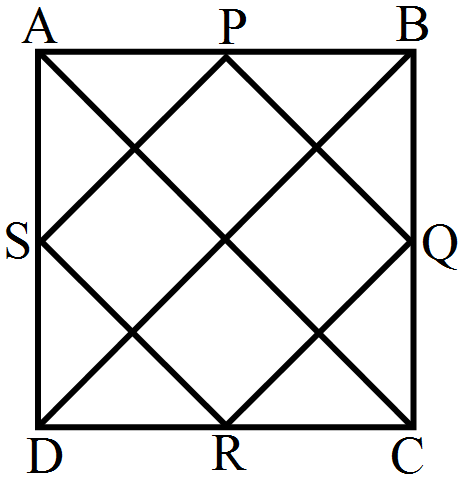
Let ABCD be a square and P, Q, R and S be the midpoints of AB, BC, CD and DA,respectively.
Join the diagonals AC and BD. Let BD cut SR at F and AC cut RQ at E. Let O be the intersection point of AC and BD.
In $\triangle\text{ABC},$ we have:
$\therefore\text{PQ || AC}$ and $\text{PQ}=\frac{1}{2}\text{AC}$ [By midpoint theorem]
Again, in $\triangle\text{DAC,}$, the points S and R are the midpoints of AD and DC, respectively.
$\therefore\text{SR || AC}$ and $\text{SR}=\frac{1}{2}\text{AC}$ [By midpoint theorem]
Now, $\text{PQ || AC}$ and $\text{SR || AC}\Rightarrow\text{PQ || SR}$
Also, $\text{PQ = SR}$ $\big[$Each equal to $\frac{1}{2}\text{AC}\big]$ ...(i)
So, PQRS is a parallelogram.
Now, in $\triangle\text{SAP}$ and $\triangle\text{QBP},$ we have:
$\text{AS = BQ}$
$\angle\text{A}=\angle\text{B}=90^{\circ}$
$\text{AP = BP}$
i.e., $\triangle\text{SAP}\cong\triangle\text{QBP}$
$\therefore\text{PS = PQ }...(\text{ii})$
Similarly, $\triangle\text{SDR}\cong\triangle\text{RCQ}$
$\therefore\text{SR = RQ }...(\text{iii})$
From (i), (ii) and (iii), we have:
$\text{PQ = PS = SR = RQ ...(iv)}$
We know that the diagonals of a square bisect each other at right angles.
$\therefore\angle\text{EOF}=90^{\circ}$
Now, $\text{RQ || DB}$
$\Rightarrow\text{RE || FO}$
Also, $\text{SR || AC}$
$\Rightarrow\text{FR || OE}$
$\therefore$ OERF is a parallelogram.
So, $\angle\text{FRE}=\angle\text{EOF}=90^{\circ}$ (Opposite angles are equal)
Thus, PQRS is a parallelogram with $\angle\text{R}=90^{\circ}$ and $\text{PQ = PS = SR = RQ.}$
$\therefore$ PQRS is a square.
View full question & answer
Question 305 Marks
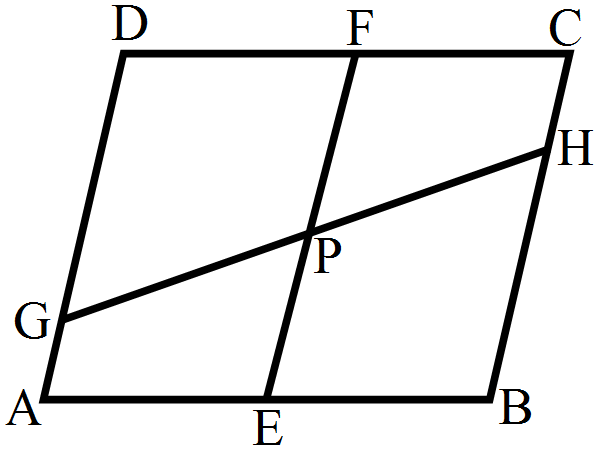
In the adjoining figure, ABCD is a || gm in which E and F are the midpoints of AB and CDrespectively. If GH is a line segment that cuts AD, EF and BC at G, P and H respectively, prove that GP = PH.
Answer
Given: A parallelogram ABCD in which E and F are the mid points of AB and CD. A line segment GH cuts EF at P.
To prove: GP = PH Proof: AD, EF and BC are three line segments and DC and Ab are two transversal.The intercepts made by the line on transversal AB and CD are equal because,
AE = EB
and DF = FC
We need to prove that FE is parallel to AD.
Let us prove by the method of contradiction.
Let us assume that FE is not parallel to AD.
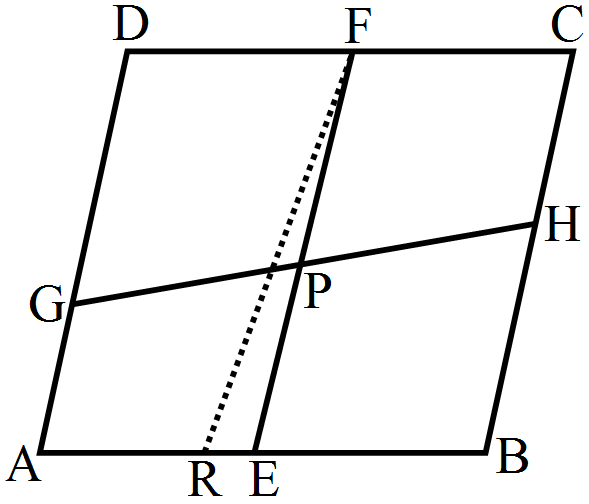
Now, draw FR parallel to AD.
Intercept Theorem: If there are three parallel lines and the intercepts made by them on one transversal are equal then the intercept on any other transversal are also equal.
Thus, by Intercept Theorem, AR = RB because
DF = FC
But AE = EB [Given]
There can not be two mid points R and E of AB. Hence our assumption is wrong.
SO, AD || EF || BC
Now, again by Intercept Theorem, we have
GP = PH
because GH is transversal and intecept made by AD, EF and BC on are as DF = FC.
View full question & answer
Question 315 Marks
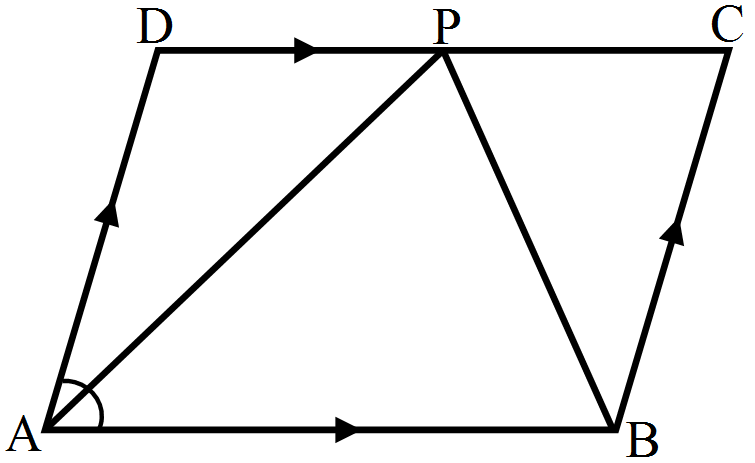
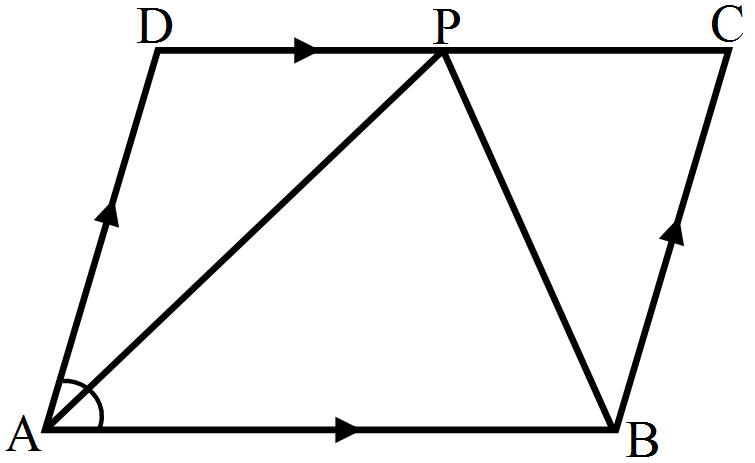
In the adjoining figure, ABCD is a parallelogram in which $\angle\text{A}=60^{\circ}.$ If the bisectors of $\angle\text{A}$ and $\angle\text{B}$ meet DC at P, prove that
  1. $\angle\text{APB}=90^{\circ},$
  2. AD = DP and PB = PC = BC,
  3. DC = 2AD.
​​​​​​​
Answer

ABCD is a parallelogram in which DA = 60° and bisectore of A and B meets DC at P.
  1. In a parallelogram, opposite angles are equal.
So, $\angle\text{C}=\angle\text{A}=60^{\circ}$

In a parallelogram the sum of all the four angles is 360°

$\Rightarrow\angle\text{A}+\angle\text{B}+\angle\text{C}+\angle\text{D}=360^{\circ}$

Now, $\angle\text{B}+\angle\text{D}=360^{\circ}-(\angle\text{A}+\angle\text{C})$

$=360^{\circ}-(60^{\circ}+60^{\circ})=240^{\circ}$

$\therefore2\angle\text{B}=240^{\circ}$ $[\because\angle\text{B}=\angle\text{D}]$

So, $\angle\text{B}=\angle\text{D}=\frac{240^{\circ}}{2}=120^{\circ}$

Since AB || DP and AP is a transversal

SO, $\angle\text{APD}=\angle\text{PAB}=\frac{60^{\circ}}{2}=30^{\circ}...(1)$ [$\therefore$ alternate angles]

Also, AB || PC and BP is a transversal.

So, $\angle\text{ABP}=\angle\text{CPB}$

But, $\angle\text{ABP}=\frac{\angle\text{B}}{2}=\frac{120^{\circ}}{2}=60^{\circ}$

$\therefore\angle\text{CPB}=60^{\circ}...(2)$

Now, $\angle\text{APD}+\angle\text{APB}+\angle\text{CPB}=180^{\circ}$ [As DPC is a straight line]

$30^{\circ}+\angle\text{APB}+60^{\circ}=180^{\circ}$

$\Rightarrow\angle\text{APB}=180^{\circ}-30^{\circ}-60^{\circ}=90^{\circ}$
  1. Since $\angle\text{APD}=30^{\circ}$ [from (1)]
and $\angle\text{DAP}=\frac{60^{\circ}}{2}=30^{\circ}$

So, $\angle\text{APD}=\angle\text{DAP}$

Now in $\triangle\text{APD},$

$\angle\text{APD}=\angle\text{DAP}...(3)$

$\therefore\text{DP = AD}$ [isosceles triangle, sides are equal]

As $\angle\text{CPB}=60^{\circ}$ [from (2)]

and $\angle\text{C}=60^{\circ}$

So, $\angle\text{PBC}=180^{\circ}-60^{\circ}-60^{\circ}=60^{\circ}$

Since all angles in the $\triangle\text{PCB}$ are equal,

it is an equilateral triangle.

$\therefore\text{PB = PC = BC}...(4)$
  1. $\angle\text{DPA}=\angle\text{PAD},$ [from (3)]
$\therefore\text{DP = AD}$ [isoscele striangle, sides are equal]

$=\text{BC}$ [opposite sides are equal]

$=\text{PC}$ [from(4)]

$=\frac{1}{2}\text{DC}$ [$\because\text{DP = PC}\Rightarrow\text{P}$ is the midpoint of DC]

$\therefore\text{DC = 2AD.}$
View full question & answer