MCQ
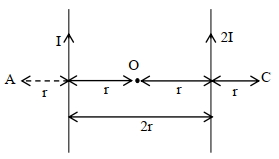
Two parallel long current carrying wire separated by a distance $2 \mathrm{r}$ are shown in the figure. The ratio of magnetic field at $\mathrm{A}$ to the magnetic field produced at $C$ is $\frac{x}{7}$. The value of $x$ is $\qquad$
  • $5$
  • B
    $4$
  • C
    $3$
  • D
    $2$

Answer

Correct option: A.
$5$
a
$\mathrm{B}_{\mathrm{A}}=\frac{\mu_0 \mathrm{i}}{2 \pi \mathrm{r}}+\frac{\mu_0(2 \mathrm{i})}{2 \pi(3 \mathrm{r})}=\frac{5 \mu_0 \mathrm{i}}{6 \pi \mathrm{r}}$

$\mathrm{B}_C=\frac{\mu_0(2 \mathrm{i})}{2 \pi \mathrm{r}}+\frac{\mu_0 \mathrm{i}}{2 \pi(3 \mathrm{r})}=\frac{7 \mu_0 \mathrm{i}}{6 \pi \mathrm{r}}$

$\therefore \frac{\mathrm{B}_A}{\mathrm{~B}_C}=\frac{5}{7}$

$\therefore \mathrm{x}=5$

Need a full question paper?

Generate a complete, print-ready paper with questions like this in minutes — across 16+ boards, with answer keys.

Start Generating Free

Similar questions

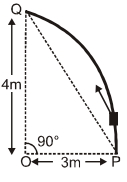
Consider an elliptically shaped rail $P Q$ in the vertical plane with $O P=3 \ m$ and $OQ =4 \ m$. A block of mass $1 \ kg$ is pulled along the rail from $P$ to $Q$ with a force of $18 \ N$, Which is always parallel to line $PQ$ (see the figure given). Assuming no frictional losses, the kinetic energy of the block when it reaches $Q$ is $(n \times 10)$ joules. The value of $n$ is (take acceleration due to gravity $=10 \ ms ^{-2}$ )
In a hydrogen atom the electron makes a transition from $( n +1)^{\text {th }}$ level to the $n ^{\text {th }}$ level. If $n>>1,$ the frequency of radiation emitted is proportional to
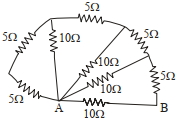
The equivalent resistance between points $A$ and $B$ in the given network is ............ $\Omega$
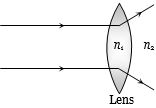
The relation between $n_1$ and $n_2$, if behaviour of light rays is as shown in figure is
In projectile motion, the modulus of rate of change of velocity
A person carrying a whistle emitting continuously a note of $272 Hz$ is running towards a reflecting surface with a speed of $18\, km/hour. $ The speed of sound in air is $345m{s^{ - 1}}$. The number of beats heard by him is
A beam of electromagnetic radiation of intensity $6.4 \times 10^{-5}\; \mathrm{W} / \mathrm{cm}^{2}$ is comprised of wavelength, $\lambda=310 \;\mathrm{nm} .$ It falls normally on a metal (work function $\varphi=2 \;\mathrm{eV}$ ) of surface area of $1\; \mathrm{cm}^{2} .$ If one in $10^{3}$ photons ejects an electron, total number of electrons ejected in $1 \;s$ is $10^{\mathrm{x}}$.then $\mathrm{x}$ is

$\left(\mathrm{hc}=1240\; \mathrm{eV} \mathrm{nm}, 1\; \mathrm{eV}=1.6 \times 10^{-19} \;\mathrm{J}\right)$

For a crystal system, $a = b = c,\alpha = \beta = \gamma, \neq 90^{0}$, the system is
The numerical aperture of a microscope is $0.12$, and the wavelength of light used is $600\,nm$. Then its limit of resolution will be nearly $.............-\,\mu\,m$
The dimensions of impulse are equal to that of