Question
Two parallel metal plates P and Q are inserted at equal distances into a plane capacitor as shown in fig. Plates A and B of the capacitor are connected to a battery of e.m.f. V.
a. What are the potentials of the four plates?
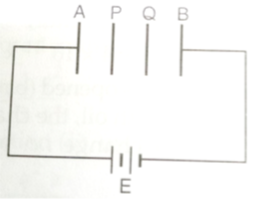
Image
a. What are the potentials of the four plates?
b. How will the potentials of plates P and Q and the intensities of the fields in each of the three spaces change after plates P and Q have been connected by a wire?
c..What will happen to the charges on plates A and B, when plates P and Q are connected with a wire?
d. Will there be charges on the plates P and Q after connecting them with a wire?
Answer

a. The plates P and Q divide the space between the plates A and B in three equal parts. Since V = Ed, the potentials of the plates A, P, Q, and B will be respectively V, 2V/3, V/3 and 0.
b. When the plates P and Q are connected with a wire, the space between the plates A and B gets divided into two equal parts. Hence, the potentials of plates A, P, Q, and B will be respectively V, V/2, V/2 and 0.
Since the potential difference between the plates A and P; and between the plates, Q and B have increased from V/3 to V/2, the electric field between these plates will increase. As the potential difference the plates P and Q is zero, the electric field will also be zero.
c. Since the potential difference between the plates A and P and between the plates Q and B have increased, the charge on the plates A and B will increase.
d. Yes, the plate P will have a positive charge and the plate Q will have a negative charge.

Need a full question paper?

Generate a complete, print-ready paper with questions like this in minutes — across 16+ boards, with answer keys.

Start Generating Free

Similar questions

A converging lens of focal length $15\ cm$ and a converging mirror of focal length $10\ cm$ are placed $50\ cm$ apart. If a pin of length $2.0\ cm$ is placed $30\ cm$ from the lens farther away from the mirror, where will the final image form and what will be the size of the final image?
A small block of superdense material has a mass of $3 \times 10^{24}kg.$ It is situated at a height $h ($much smaller than the earth's radius$)$ from where it falls on the earth's surface. Find its speed when its height from the earth's surface has reduced to $\frac{\text{h}}{2}.$ The mass of the earth is $6 \times 10^{24}\ kg.$
A wire of length l is bent in the form of an equilateral triangle and carries an electric currrent i.
  1. Find the magnetic field B at the centre.
  2. If the wire is bent in the form of a square, what would be the value of B at the centre?
A bullet of mass 20g moving horizontally at a speed of 300m/s is fired into a wooden block of mass 500g suspended by a long string. The bullet crosses the block and emerges on the other side. If the centre of mass of the block rises through a height of 20.0cm, find the speed of the bullet as it emerges from the block.
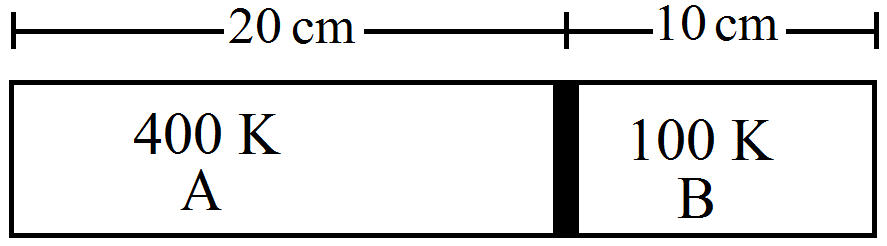
Figure. shows a cylindrical tube of length 30cm which is partitioned by a tight-fitting separator. The separator is very weakly conducting and can freely slide along the tube. Ideal gases are filled in the two parts of the vessel. In the beginning, the temperatures in the parts A and B are 400K and 100K respectively. The separator slides to a momentary equilibrium position shown in the figure. Find the final equilibrium position of the separator, reached after a long time.
Two charges $5 \times 10^{–8} C$ and $–3 \times 10^{–8} C$ are located $16 \ cm$ apart. At what point $(s)$ on the line joining the two charges is the electric potential zero? Take the potential at infinity to be zero.
Two masses $m_1$ and $m_2$ are connected by a spring of spring constant $k$ and are placed on a frictionless horizontal surface. Initially the spring is stretched through a distance $x_0$ when the system is released from rest. Find the distance moved by the two masses before they again come to rest.
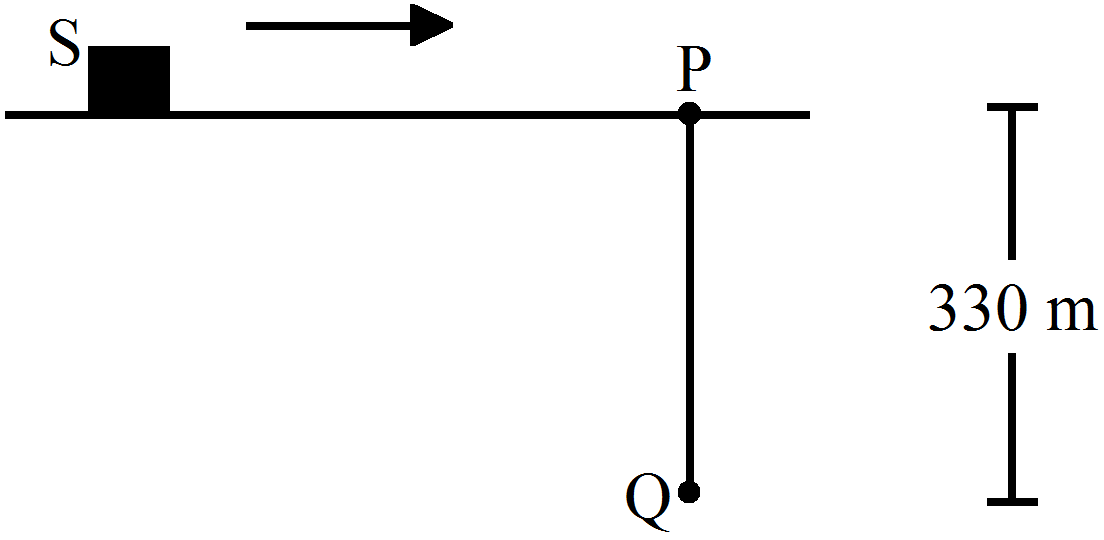
Figure, shows a source of sound moving along the X-axis at a speed of 22m/s continuously emitting a sound of frequency 2.0kHz which travels s in air at a speed of 330m/s. A listener Q stands on the Y-axis at a distance of 330 m from the origin. At t = 0, the source crosses the origin P.
  1. When does the sound emitted from the source at P reach the listener Q?
  2. What will be the frequency heard by the listener at this instant?
  3. Where will the source be at this instant?
 
Two friends $A$ and $B \ ($each weighing $40\ kg)$ are sitting on a frictionless platform some distance $d$ apart. A rolls a ball of mass $4\ kg$ on the platform towards $B$ which $B$ catches. Then $B$ rolls the ball towards $A$ and $A$ catches it. The ball keeps on moving back and forth between $A$ and $B$. The ball has a fixed speed of $5m/s$ on the platform.
  1. Find the speed of $A$ after he rolls the ball for the first time.
  2. Find the speed of $A$ after he catches the ball for the first time.
  3. Find the speeds of $A$ and $B$ after the ball has made $5$ round trips and is held by $A$.
  4. How many times can $A$ roll the ball?
  5. Where is the centre of mass of the system $''A + B \ +$ ball'' at the end of the $n^{th}$ trip?
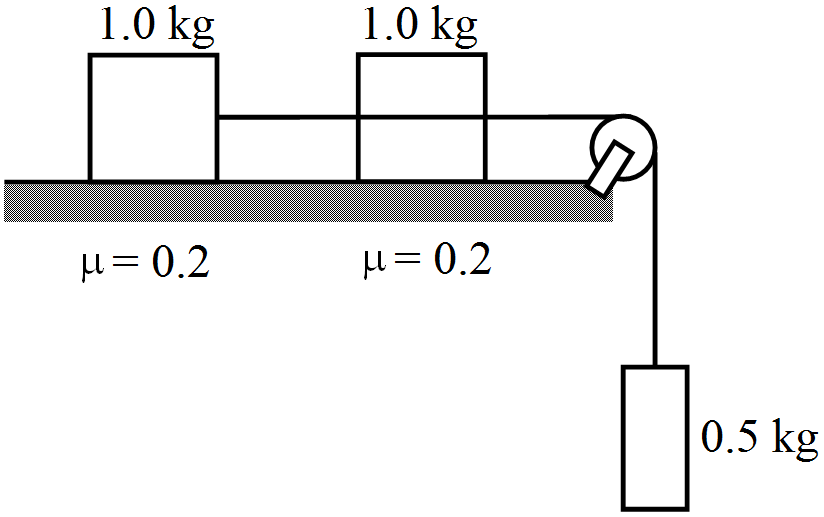
Consider the situation shown in figure. Calculate:
  1. The acceleration of the $1.0\ kg$ blocks.
  2. The tension in the string connecting the $1.0\ kg$ blocks.
  3. The tension in the string attached to $0.50\ kg.$