MCQ
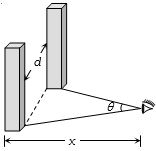
Two parallel pillars are $11\, km$ away from an observer. The minimum distance between the pillars so that they can be seen separately will be.....$m$
  • $3.2 $
  • B
    $20.8$
  • C
    $91.5$
  • D
    $183$

Answer

Correct option: A.
$3.2 $
a
(a) As limit of resolution of eye is ${\left( {\frac{1}{{60}}} \right)^o}$, the pillars will be seen distinctly if $\theta > {\left( {\frac{1}{{60}}} \right)^o}$
i.e., $\frac{d}{x} > \left( {\frac{1}{{60}}} \right) \times \frac{\pi }{{180}}$
$ \Rightarrow d > \frac{{\pi \times x}}{{60 \times 180}}$
$ \Rightarrow d > \frac{{3.14 \times 11 \times {{10}^3}}}{{60 \times 180}}$$ \Rightarrow d > 3.2\;m$

Need a full question paper?

Generate a complete, print-ready paper with questions like this in minutes — across 16+ boards, with answer keys.

Start Generating Free

Similar questions

The Bohr model for the spectra of a H-atom:
A parallel plate capacitor of plate separation $2$ mm is connected in an electric circuit having source voltage 400 V . if the plate area is $60 cm^2$, then the value of displacement current for $10^{-6} sec$ will be
64 small drops of mercury, each of radius r and charge q coalesce to form a big drop. The ratio of the surface density of charge of each small drop with that of the big drop is
According to the Heisenberg uncertainty principle:
A conducting body $1$ has some initial charge $Q$, and its capacitance is $C$. There are two other conducting bodies, $2$ and $3$, having capacitances : $C_2 = 2C$ and $C_3 \rightarrow \infty$ . Bodies $2 $ and $3 $ are initially uncharged. "Body $2$ is touched with body $1$. Then, body $2$ is removed from body $1 $ and touched with body $3$, and then removed." This process is repeated $N$ times. Then, the charge on body $1$ at the end must be
Two light beams of intensities in the ratio of $9: 4$ are allowed to interfere. The ratio of the intensity of maxima and minima will be
A red colour in air has wavelength $760 \,nm$ when light passes through water of refractive index $\left(n=\frac{4}{3}\right)$, wavelength becomes $570 \,nm$. (wavelength of yellow colour in air is $570 \,nm$ ). Then colour of red light in water is
Which of the following formula is correct for a spherical lens?
A uniform wire of length $l$ and radius $r$ has a resistance of $100\, \Omega $. It is recast into a wire of radius $\frac{r}{2}$. The resistance of new wire will be ............... $\Omega$
Which of the following is most suitable for the core of electromagnets