Two parallel plate condensers of capacity of $20 \mu F$ and $30 \mu F$ are charged to the potentials of $30V$ and $20V$ respectively. If likely charged plates are connected together then the common potential difference will be :-......$V$
Medium
Download our app for free and get started
Common potential
$\mathrm{V}=\frac{\mathrm{C}_{1} \mathrm{V}_{1}+\mathrm{C}_{2} \mathrm{V}_{2}}{\mathrm{C}_{1}+\mathrm{C}_{2}}=\frac{600+600}{20+30}=24 \mathrm{\,V}$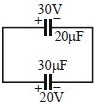

Download our appand get started for free
Experience the future of education. Simply download our apps or reach out to us for more information. Let's shape the future of learning together!No signup needed.*
Similar Questions
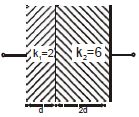
- 1View SolutionA parallel plate capacitor has two layers of dielectrics as shown in fig. This capacitor is connected across a battery, then the ratio of potential difference across the dielectric layers is
- 2$64$ small drops of mercury, each of radius $ r$ and charge $q$ coalesce to form a big drop. The ratio of the surface density of charge of each small drop with that of the big drop isView Solution
- 3The distance between the two plates of a parallel plate capacitor is doubled and the area of each plate is halved. If $C$ is its initial capacitance, its final capacitance is equal toView Solution
- 4A thin metal plate $P$ is inserted half way between the plates of a parallel plate capacitor of capacitance $C$ in such a way that it is parallel to the two plates. The capacitance now becomesView Solution
- 5A proton is accelerated through $50,000\, V$. Its energy will increase byView Solution
- 6A metallic spherical shell has an inner radius $R_1$ and outer radius $R_2$. A charge $Q$ is placed at the centre of the spherical cavity. What will be surface charge density on the inner surfaceView Solution
- 7The dielectric strength of air at $NTP$ is $3 \times {10^6}\,V/m$ then the maximum charge that can be given to a spherical conductor of radius $3\, m$ isView Solution
- 8A pellet carrying charge of $0.5\, coulombs$ is accelerated through a potential of $2,000\, volts$. It attains a kinetic energy equal toView Solution
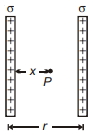
- 9For two infinitely long charged parallel sheets, the electric field at $P$ will beView Solution
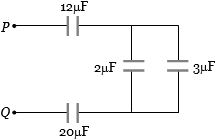
- 10In the circuit diagram shown in the adjoining figure, the resultant capacitance between $P$ and $Q$ is........$\mu F$View Solution